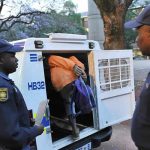
The cash-strapped Matjhabeng Local Municipality has again found itself at the centre of a financial and governance storm after the sheriff of the court attached six municipal traffic vehicles over a relatively modest unpaid debt of R350,000 to a service provider.
The attachment, carried out on Tuesday, saw marked traffic police vehicles physically removed from officers who had already started their shifts, further exposing the depth of the administrative collapse in a municipality already saddled with debts running into the billions.
Matjhabeng, which serves Welkom, Odendaalsrus, Virginia, Hennenman, Allanridge and Ventersburg, has been under provincial administration since June last year. That step followed a Bloemfontein High Court ruling that placed the municipality under the control of a provincial exco representative (PER) after what the court described as a total breakdown in service delivery and a R16‑billion debt crisis.
The latest incident – assets being seized over a debt that, in comparison to Matjhabeng’s wider financial woes, is small – has become a vivid symbol of how far the municipality has fallen.
Traffic cops ordered out of vehicles
According to insiders, the sheriff arrived at the municipal premises armed with a court order to attach the six traffic vehicles, which are used for daily by-law enforcement operations.
The seizure of the vehicles caused confusion as some traffic police officers had already reported for work, where they use the cars for by-law enforcement operations. Some were even ejected from the vehicles, which they were already occupying.
In one of the video clips seen by Sunday World, municipal workers can be heard reacting with a mixture of disbelief and grim satisfaction as the sheriff’s team drives off in the branded vehicles. Some employees are heard welcoming the move, saying the municipality has become notorious for not paying its service providers.
“The situation was very hostile and shocking when the sheriff arrived armed with the court order to attach the municipal traffic vehicles. The police driving those vehicles were stunned when they were told to get out of the vehicles.
“They were told to find other cars to use for patrols in Welkom, Virginia, and Hennenman, as the ones they usually use are no longer Matjhabeng’s,” said an insider within the municipality.
Another senior official, speaking on condition of anonymity, described a system in freefall.
“Matjhabeng is run like a spaza shop. Nothing works within this municipality. The property of the municipality is being attached. It’s a mess here…,” said a municipal official who asked not to be named.
Since 2017, multiple contractors have turned to the courts, accusing Matjhabeng of owing them millions in unpaid invoices. The fact that a R350,000 debt escalated to the point where an essential fleet was attached is being held up by insiders as evidence of chronic mismanagement and an inability to resolve disputes before they spill into legal enforcement.
Municipality says cars returned – but doubts linger
Following the attachment, municipal spokesperson Tshediso Tlali moved to reassure residents that traffic enforcement would continue.
According to Matjhabeng spokesperson Tshediso Tlali, all the seized vehicles have since been brought back to the municipality after the matter was settled.
However, Sunday World’s attempts to independently verify this version of events met a wall of silence from the contractor involved.
Meanwhile, Sunday World approached the service provider to verify Tlali’s claims, but they declined to comment.
The reluctance of the service provider to speak publicly reflects an environment in which many companies fear jeopardising already fraught relationships with the municipality – or losing any chance of ultimately being paid.
R16bn debt, hostile leadership and failing basics
The attachment of traffic vehicles is only the latest symptom of a much larger crisis in Matjhabeng.
In March, Sunday World reported that the municipality’s leadership – including mayor Thanduxolo Khalipha, municipal manager Thabo Panyani and other senior officials – were allegedly resisting the implementation of a financial recovery strategy drawn up by the PER appointed after the High Court intervention.
In March, Sunday World reported that the leadership of the troubled Matjhabeng, including mayor Thanduxolo Khalipha, municipal manager Thabo Panyani and other officials, were allegedly pushing back on implementing the financial recovery strategy put together by the provincial exco representative (PER). Khalipha and his supporters had allegedly been hostile towards the PER led by Makalo Mohale, who was appointed to help implement the turnaround strategy plan devised as a remedy to Matjhabeng’s governance and administrative woes.
Financially, the picture is dire. It emerged that the municipality owes Eskom R7‑billion and Vaal Central Water R9‑billion, part of a towering R16‑billion liability that has made it one of the most indebted municipalities in the country.
It also emerged that Matjhabeng owed Eskom R7-billion and Vaal Central Water R9-billion. It has received a qualified opinion in the past three years because the budget steering committee failed to meet to discuss crucial budget matters and votes.
The Auditor-General has repeatedly flagged governance failures, issuing qualified opinions for three consecutive years. Among the problems cited are a budget steering committee that simply does not meet, chronic weaknesses in expenditure and revenue management, and broken contract and asset management systems.
Furthermore, Matjhabeng has faced issues around expenditure, revenue, and contract management, including asset management. For several years its municipal revenue collection stood at 51%.
With only about half of billed revenue being collected, the municipality has been unable to keep up with bulk services payments or maintain essential infrastructure, accelerating a downward spiral.
Service delivery in collapse
For residents in Welkom, Odendaalsrus, Virginia and surrounding towns, the effect of this mismanagement is visible in leaking pipes, overflowing sewers and erratic water and electricity supply.
On the issue of service delivery, which directly affects residents, water distribution losses cost Matjhabeng R418-million, electricity supply losses are sitting at R204-million, and the infrastructure has completely collapsed with sewer and water leakages across areas run by the municipality. Money spent on maintenance was found to be 1.2% of the budget, much lower than the norm of 8%, as master plans are non-existent and outdated.
Water leaks and illegal connections are costing the municipality an estimated R418‑million in water distribution losses, while electricity losses amount to R204‑million. Infrastructure is described as “completely collapsed” in several areas, with residents routinely posting images of raw sewage running in streets and water gushing from broken pipes.
Despite these pressures, only 1.2% of the municipal budget has been going to maintenance – far below the generally accepted norm of around 8%. Master plans for infrastructure are either outdated or non-existent.
The attachment of traffic vehicles – even if they have since been returned – has underscored just how vulnerable Matjhabeng’s basic operations have become. With creditors increasingly willing to use the courts, and leadership allegedly fighting off recovery plans, insiders warn that more attachments, more disruptions and more service delivery failures may follow.
For now, traffic officers in Welkom and nearby towns are back in their branded vehicles. But behind the scenes, the financial time bomb that led to their brief eviction from those cars remains very much live.