

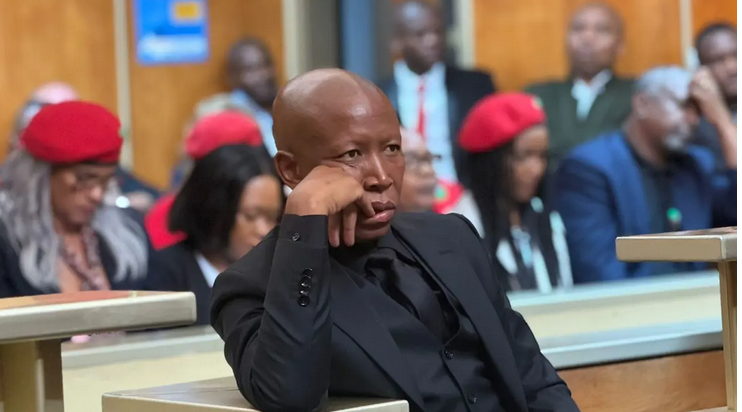
Johannesburg, Gauteng – The political landscape of South Africa has been set ablaze once again as Economic Freedom Fighters (EFF) leader Julius Malema launched a blistering R1 million defamation lawsuit against controversial former Ukhozi FM broadcaster Ngizwe Mchunu. The legal offensive follows a series of explosive allegations made by Mchunu, who claimed that the "Commander-in-Chief" had received a staggering R60 million from Nigerian drug syndicates.
The lawsuit, filed in the High Court, represents a dramatic escalation in a long-standing feud between the two
influential figures. Malema’s legal team has characterized the remarks as "malicious, untrue, and a calculated attempt to assassinate his character" just as the country moves into a critical political season.
The Spark: A March in Pretoria
The current legal firestorm was ignited during a recent march in Pretoria on April 28, 2026. Mchunu, addressing a crowd of supporters, allegedly made the startling claim that Malema’s political activities were being funded by international drug dealers. The former broadcaster, known for his fiery rhetoric and "tribalist" controversies, suggested that the EFF leader was "in the pocket" of Nigerian cartels who had paid him R60 million to influence policy and social sentiment.
The remarks were captured on video and quickly went viral across TikTok and WhatsApp, sparking a frenzy of speculation. For Malema, who has built his political identity on being a champion of the poor and a critic of "white monopoly capital," the allegation of being a "drug-funded criminal" was a bridge too far.
'Vexatious and Spurious': The Legal Demand
Through his attorneys, England Slabbert Inc., Malema issued a 24-hour ultimatum to Mchunu, demanding a full public apology and the payment of R1 million in damages. The letter of demand, which has been seen by investigative reporters, pulls no punches.
"Your defamatory statements are vexatious, untrue, spurious, and misplaced," the letter states. "They paint our client as a criminal and a person who lacks integrity, which is a direct assault on his professional and personal reputation."
The EFF has also weighed in, labeling Mchunu a "distraction" and a "tribalist provocateur." The party suggests that Mchunu’s remarks are part of a broader campaign to discredit the EFF ahead of the upcoming elections. "We will not allow a man who thrives on division and sensationalism to drag the name of our President through the mud without consequences," an EFF spokesperson said.
A History of Friction
The feud between Malema and Mchunu is not new. The two have been at loggerheads for months, particularly regarding the EFF’s presence in KwaZulu-Natal. Earlier this year, Mchunu made headlines for declaring KZN a "no-go area" for Malema, citing what he described as the EFF leader’s "disrespect" for Zulu culture and the AmaZulu King.
Mchunu, who has rebranded himself as a "cultural activist" since his departure from the SABC, has often positioned himself as a gatekeeper of KZN’s political and cultural landscape. His attacks on Malema have frequently touched on themes of ethnicity and regionalism, leading the EFF to accuse him of being a "useful idiot" for rival political factions.
"Ngizwe is playing a dangerous game," says a Durban-based political analyst. "By framing Malema as a foreign-funded criminal, he is tapping into existing xenophobic and regionalist sentiments. This isn't just about defamation; it’s about political territorialism."
The R1 Million Gamble
While defamation lawsuits are common in South African politics, the R1 million price tag attached to Malema’s claim sends a clear message. It is a high-stakes gamble designed to financially cripple a vocal critic and set a precedent for future detractors.
Legal experts suggest that for Malema to succeed, he will need to prove that the remarks were not only false but were made with the specific intent to cause harm. Mchunu, on the other hand, is expected to lean into a defense of "fair comment" or "public interest," though the specific allegation of a R60 million bribe from drug dealers is a factual claim that will be difficult to defend without evidence.
"In South African law, if you make a factual allegation of criminality, you have to be able to back it up," says a High Court advocate. "If Mr Mchunu cannot provide a shred of evidence for this R60 million payment, he is in very deep legal trouble. You can't just call someone a drug-funded criminal because you don't like their politics."
The Public's Verdict
As the legal papers fly, the public reaction has been split. On social media, supporters of the EFF have rallied behind Malema, using hashtags like #HandsOffMalema and calling for Mchunu to be "dealt with" by the courts. Conversely, Mchunu’s followers have praised him for "speaking truth to power," even if that truth remains unverified.
The lawsuit also comes at a time when the EFF is under intense scrutiny regarding its own funding and internal dynamics. By taking Mchunu to court, Malema is effectively challenging his critics to "put up or shut up."
For now, Ngizwe Mchunu remains defiant. In a brief response posted to his social media pages, the former broadcaster seemed unfazed by the R1 million threat. "I am a child of the soil, and I will not be silenced by those who think they are gods," he wrote in IsiZulu.
As the 24-hour deadline passes, the stage is set for a protracted and potentially explosive High Court battle. In the court of public opinion, however, the verdict is already out: the "Battle of the Titans" is just beginning, and the fallout will be felt across the political spectrum for months to come.