

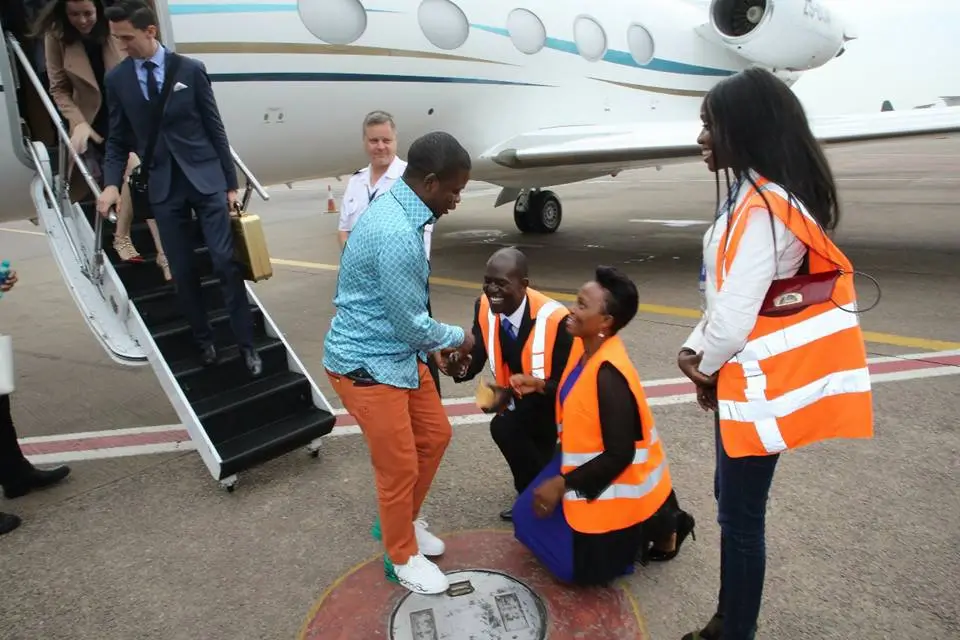
When fugitive pastor Shepherd Bushiri arrived at the Lanseria offices of an aircraft dealer in November 2015, he did not produce a bank transfer or cheque. Instead he turned up with a suitcase of US dollars — so many notes that the salesman had to fetch a currency‑counting machine the next day.
That scene, recalled in court papers now before the Pretoria high court, sits at the centre of a bitter legal fight over whether Bushiri, the controversial leader of the Enlightened Christian Gathering Church, bought his Gulfstream executive jet with the proceeds of crime. The National Prosecuting Authority (NPA) has already obtained an asset forfeiture order to seize the aircraft; Bushiri is asking a judge to stop an auction he says is unlawful and to find the NPA has failed to show the jet was bought with illicit funds.
The purchase was dramatic. According to affidavits filed in the matter, Bushiri arrived at National Airways Corporation (NAC)’s Lanseria outlet and attempted to pay in hard cash. The initial payment counted to $1,147,200 — short of the $1.25m purchase price — and, the papers say, the balance was paid later in rand. NAC staff told investigators they had to delay the handover for a day because no currency‑counting machine was available that evening. When the plane was finally handed over, Bushiri reportedly staged “a lavish handing‑over ceremony to celebrate and publicise that this aircraft was delivered to him”.
That public display is one reason the transaction has been so controversial. It later emerged that the seller claims it cannot issue an invoice or bill of sale because Bushiri allegedly did not provide invoicing details. More troubling for the state is the question of where the seven‑figure cash came from — an issue complicated by the absence of a traceable loan or bank transaction.
Bushiri maintains that the aircraft purchase was lawful. In papers filed on 6 March he contends the jet was bought under a legitimate sale agreement with NAC and financed by a US‑dollar loan from Joint Aviation Resources (JAR). He signed an NAC document stating the “cash was not obtained through ill‑gotten gains” and insists there is “no evidence of fraud in the purchase and financing of the aircraft”.
But the critical problem for Bushiri is that there is no record of such a JAR loan. Sabine Kruger, a director at JAR, swore an affidavit denying any knowledge of a loan agreement, saying she and the company had never met or done business with Bushiri and that the receipts shown to her were “false, to my knowledge”.
Reserve Bank and police investigators found other irregularities. Ebenhaezer Minnie, an investigator for the South African Reserve Bank (SARB), concluded in 2018 that the transaction breached exchange control regulations. South African law requires anyone carrying more than $10,000 in foreign currency to declare it to customs — amounts far smaller than the million‑plus dollars seen in the Lanseria transaction. Minnie said he could find no trace of bank transfers linked to JAR and no evidence of a loan agreement.
Police investigator Charles Maritz described the paperwork as suggestive of money‑laundering. He said it appeared Bushiri had “intentionally and falsely represented to the SARB that the money he used to purchase the aircraft originated from JAR”, calling the purported loan a fabrication intended to disguise the source of the funds. “With all the facts at my disposal, it is difficult to determine the source from which the money was obtained,” Maritz added in an affidavit quoted in court papers.
Bushiri’s camp has rejected that account. Milton Owuor, chief operating officer of Shepherd Bushiri Investments who accompanied the pastor to NAC, filed an affidavit describing the handover process. He said Bushiri met NAC executive director Jacobus Fourie, who raised no objection to receiving payment in US dollars for an aviation transaction. Owuor said he left Bushiri with two colleagues to handle the payment. Because it was late, Fourie told them the office had no counting machine that evening; they would return in the morning when a currency‑counting machine was available. The cash was subsequently counted and tallied as $1,147,200. Owuor said he did not ask Bushiri where the cash came from because “it was obvious to me that he regularly gets blessed by congregants from abroad in foreign currency, notably US dollars”.
That explanation sits uneasily with the record‑keeping and regulatory obligations that apply to large foreign‑currency transactions. SARB’s exchange control rules are designed to ensure foreign currency entering the country is declared and to prevent illicit flows. Prosecutors argue the absence of a formal loan and the use of hard cash — coupled with allegedly fabricated documents — together point to an effort to launder money through a conspicuous purchase.
Bushiri and his wife Mary fled South Africa in 2020 after being granted bail on a suite of charges including fraud, money‑laundering and rape. South Africa successfully applied for their extradition, but the Malawian high court later overturned the order in October, leaving the couple beyond the reach of South African courts for the present.
In the Pretoria litigation, Bushiri contends the NPA has not proved its money‑laundering case and also argues the prosecuting authority lacks jurisdiction to investigate exchange control violations. The NPA, for its part, relies on the SARB and police findings, and on the gaps and inconsistencies in paperwork around the jet sale.
At stake is more than ownership of an aircraft. The case raises broader questions about how large‑value purchases should be tracked and regulated, the ease with which cash can be used to obscure origins of wealth, and the limits of enforcement against high‑profile individuals with international reach. A judge’s ruling on Bushiri’s interdict application will test whether the state can convert a complex administrative and criminal investigation into a successful legal claim to seize the jet.
Whatever the outcome, the image of a pastor accepting a pile of US dollars to take possession of a luxury jet will remain politically and legally combustible — especially in a country where questions about money, power and accountability have long animated public debate.