

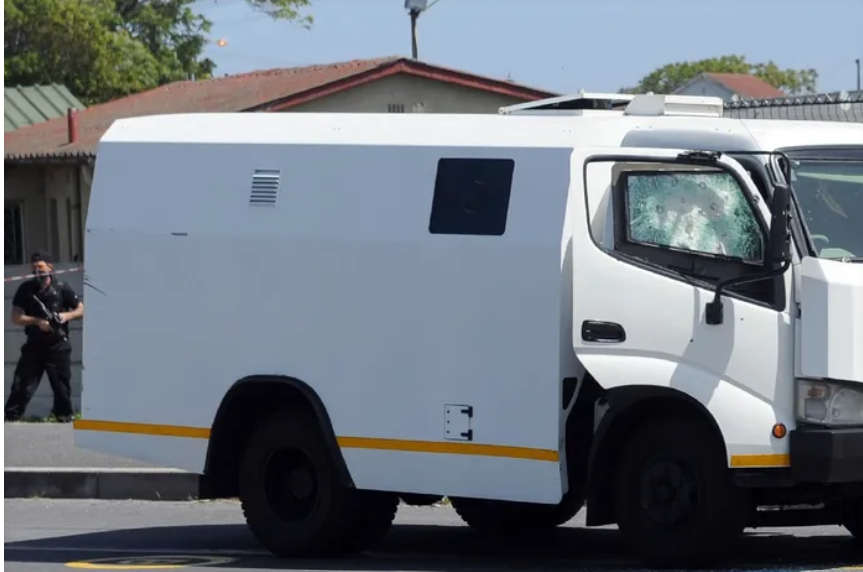
A Fidelity cash-in-transit crewman has been arrested over a violent robbery near Cape Town International Airport after investigators concluded that the attack may have been an inside job involving two members of the security crew.
The 40-year-old man was arrested at his home in Gugulethu on Thursday, 5 November 2026, by the Hawks’ Bellville National Priority Violent Crime team.
He appeared in the Bishop Lavis Magistrates’ Court on Friday, 6 November. The case was postponed to 18 November for a bail application.
A second Fidelity crew member is still being sought after the Director of Public Prosecutions ruled that both men should be arrested and charged. The Hawks said the investigation had led detectives to believe that the cash-in-transit robbery was staged.
The robbery took place in September 2025 on Borchards Quarry Road in Airport Industria. The Fidelity crew had been travelling along Airport Approach Road towards its base in Parow Industria when the armoured vehicle was allegedly ambushed by several armed men.
According to Hawks spokesperson Captain Zinzi Hani, a white Nissan bakkie stopped in front of the cash-in-transit truck. The armoured vehicle collided with the bakkie, but the danger did not end there.
When the driver tried to reverse, a white Toyota Fortuner blocked the truck from behind. A Volkswagen Polo then pulled up, leaving the cash-in-transit vehicle surrounded by the three vehicles.
Gunmen allegedly climbed out and opened fire on the armoured truck. The security guards were forced to flee towards nearby bushes as the attackers moved in on the vehicle.
Hani said the driver was caught by one of the suspects while trying to escape.
“The driver was tackled by a suspect and searched,” she said.
The suspect allegedly took the driver’s cellphone and R200 in cash. At the same time, other attackers approached the armoured truck and attached explosives to it.
The robbery was interrupted when a Flying Squad vehicle travelling to another shooting in Elsies River came across the scene. The arrival of the police vehicle appears to have forced the suspects to abandon their attack and flee.
The suspects allegedly escaped in the Toyota Fortuner and the Nissan bakkie. The Volkswagen Polo was left behind at the scene.
“The VW Polo hatchback was set alight and completely burnt out,” Hani said.
An undisclosed amount of money was taken during the robbery and has never been recovered, according to the Hawks.
The attack initially appeared to be a planned ambush by a heavily armed group targeting a cash-in-transit vehicle. However, the investigation later raised questions about whether the robbers had received help or information from inside the security crew.
Hani said investigators eventually concluded that the robbery appeared to have been staged.
“The Cash in Transit Robbery appeared to have been staged,” Hani said.
The Hawks said two Fidelity guards were believed to have been involved. The identities of the two crew members and the specific allegations against each man have not been fully disclosed in the available information.
“Two of the Fidelity guards were believed to have been involved,” the Hawks said.
The arrest warrant was obtained on 30 October after the DPP considered the completed investigation. The decision meant the driver and the other crew member could be arrested and charged. So far, only the 40-year-old crewman has been arrested.
“Tracing continues for the second person,” Hani said.
The allegations against the arrested man have not been tested in court. He remains innocent until proven guilty, and the State will have to present evidence showing what role he allegedly played in the robbery.
The fact that he was part of the Fidelity crew does not, by itself, prove that he helped organise the attack. Investigators will need to establish whether he shared information, assisted the suspects during the robbery, arranged the route or played another role in the alleged plan.
The same questions will apply to the second guard who is still being traced. Detectives may examine cellphone records, vehicle movements, communication between the crew and the attackers, and information about the money that was taken.
The use of three vehicles suggests that the attackers had prepared for the robbery. The Nissan bakkie was positioned in front of the armoured truck, the Fortuner blocked it from behind and the Polo arrived during the attack. Investigators will now need to determine whether the vehicles were stolen, rented or linked to people known to the crew.
The alleged use of explosives also adds to the seriousness of the case. The attackers were not merely accused of threatening the guards; they allegedly tried to breach the armoured vehicle while explosives were attached to it. The arrival of the Flying Squad interrupted that part of the operation.
The burnt-out Polo may provide forensic evidence despite the fire. Investigators can examine the vehicle’s registration, ownership history, remains and possible links to the other vehicles. They may also look at surveillance footage from Airport Approach Road, Borchards Quarry Road and surrounding industrial areas.
The fact that the Flying Squad was travelling to another shooting when it encountered the robbery may also become important. Officers could provide evidence about what they saw when they arrived, how the suspects reacted and which vehicles were left at the scene.
Cash-in-transit robberies remain a serious national security concern. The Cash-In-Transit Association of South Africa recorded almost 120 incidents across the country between January and mid-August 2026, according to the figures cited by the Hawks.
An inside job creates an additional risk because security crews have access to information about routes, schedules, vehicles and procedures. If guards are involved, criminals may be able to plan attacks with greater accuracy and reduce the chance of being caught by surprise.
The Cape Town case follows other investigations into alleged inside involvement in cash-in-transit robberies. In a separate matter, three Fidelity guards were arrested over an alleged inside job in Bloemfontein.
The arrest near Cape Town International Airport is therefore likely to be watched closely by investigators and the security industry. A successful prosecution could provide more information about how the alleged plan was arranged and whether others helped the attackers.
The Bishop Lavis court postponed the case to 18 November for a bail application. During that application, the State is expected to outline the allegations against the accused and explain why it believes he should remain in custody or face strict conditions if released.
The bail hearing will not determine whether he is guilty. It will deal with whether he may be released while the criminal case continues and whether there are concerns about his possible flight, interference with witnesses or access to evidence.
Police and prosecutors may also continue investigating the second crew member and any other people connected to the robbery. Further arrests or charges could follow if the evidence supports them.
For now, the case contains two very different pictures of the same attack. On the surface, it was a dramatic ambush involving gunmen, explosives and a burning getaway vehicle. The Hawks now allege that the operation may have been helped from inside the very crew responsible for transporting the cash.
The accused man’s court appearance has started the formal legal process, but many questions remain unanswered. Investigators still need to find the second crew member, trace the missing money and establish how the attackers knew where and when to strike.
Until those questions are answered in court, the alleged inside job remains an accusation rather than a proven fact. The next major step will be the bail application on 18 November, while the Hawks continue to build their case.