

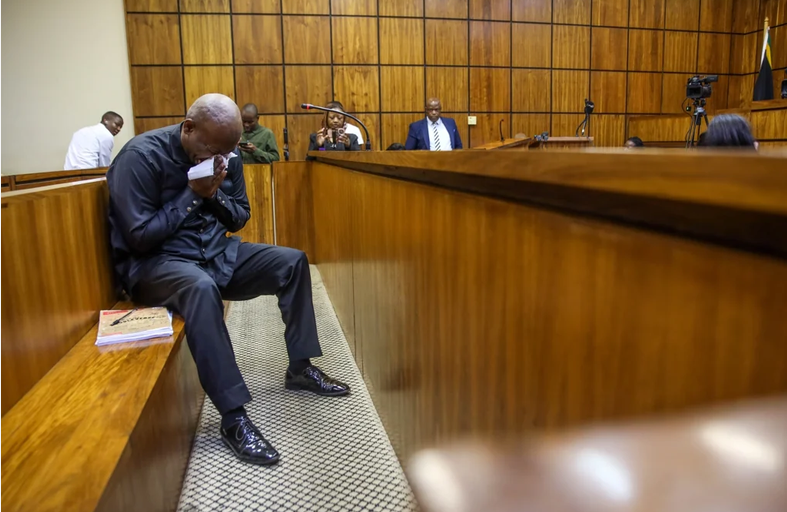
Former deputy national police commissioner Shadrack Sibiya’s lawyers have accused the State of trying to place him in the high-security C-Max section of Kgosi Mampuru II Correctional Centre to “break him down” after his arrest on sexual-offence charges.
The allegations are contained in a 17-page bail appeal filed in the Gauteng High Court in Johannesburg.
Sibiya, 59, is challenging Randburg Magistrate Hleziphi Mkhasibe’s decision to refuse him bail. The National Prosecuting Authority is opposing the appeal.
His lawyers argue that the magistrate made several errors when she dismissed his lengthy bail application and that the State relied on charges and procedures that were not legally justified.
Sibiya is accused of raping an 18-year-old woman, sexually grooming a 16-year-old girl and human trafficking. He also faces a charge relating to the negligent handling of a firearm, according to the earlier bail proceedings.
He denies the allegations. His legal team has argued that his sexual interaction with the 18-year-old was consensual and that his request for sexual material from the 16-year-old did not constitute sexual grooming because the material was allegedly provided consensually.
The allegations have not been tested in a criminal trial. Sibiya remains innocent until proven guilty.
Lawyers allege plan to ‘break him down’
Sibiya’s lawyers claim the State plotted to place him in the C-Max section of Kgosi Mampuru II after his arrest on what they describe as “trumped-up” rape charges.
They argue that the alleged plan was intended to “break him down” and should be considered when the High Court assesses whether he should be released on bail.
The lawyers also accuse the State of repeatedly serving Sibiya with disciplinary-hearing notices while he was in custody.
According to the appeal, the notices were served “whilst in custody to destabilise him” during his unsuccessful attempt to secure bail.
The defence maintains that the criminal case and the disciplinary process were improperly used together to place pressure on Sibiya.
His lawyers further argue that the State acted “ultra vires”, meaning outside its legal powers, by pursuing the matter through a referral task team linked to the Madlanga Commission of Inquiry.
They say the charges should have been investigated by the Independent Police Investigative Directorate rather than by the commission’s referral task team.
The State has not accepted those allegations and is opposing the bail appeal.
Arrest followed police corruption inquiry
Sibiya was arrested at The Grand strip club in Sandton in September.
The arrest came while his conduct and alleged relationships with suspected criminal figures were under scrutiny at the Madlanga Commission of Inquiry into police corruption and collusion with criminals.
The commission heard allegations involving Sibiya’s relationship with attempted-murder accused tenderpreneur Vusimusi “Cat” Matlala and underworld figures.
Sibiya has denied allegations aired during the inquiry, including a claim that he received 20 impalas from a suspected criminal kingpin in exchange for a police contract.
The criminal charges now before the court relate to alleged sexual offences involving two young complainants.
The State alleges that Sibiya plied the 18-year-old with alcohol until she passed out before raping her. Sibiya’s defence is that their sexual interaction was consensual.
The State also alleges that he sexually groomed the 16-year-old and requested explicit videos and photographs from her.
Sibiya’s lawyers contend that the teenager provided the material consensually and that his conduct did not amount to sexual grooming.
The 16-year-old is in witness protection, according to evidence placed before the bail court.
Lawyers challenge magistrate’s findings
A central part of the appeal concerns the magistrate’s findings about alleged threats made to the father of the 16-year-old complainant.
The father, identified in court as Mr M, confronted Sibiya about his daughter’s allegations.
The State said Sibiya threatened Mr M during a phone call, telling him that he would “wipe out” the family.
The State also relied on another call in which Sibiya allegedly told Mr M: “The easiest person to deal with is you. I can deal with you very quick and easy.”
Mkhasibe found that the alleged comments established a dangerous pattern of behaviour.
“When a person makes such utterances, there can never be any interpretation other than the threat of harm,” the magistrate said in her bail ruling.
She also found that Sibiya knew his arrest was imminent when he called Mr M while the father was at a police station reporting the matter.
“He could have opted not to call Mr M, but he allowed his anger and ego to cloud his judgement,” Mkhasibe said.
“He never thought that Mr M would record a conversation; hence he threatened him. In threatening Mr M, he threatened a witness, knowing very well that he was a witness.”
Sibiya’s lawyers dispute that interpretation.
They argue that the magistrate relied on facts that were not before the court when she found that Sibiya knew Mr M was a State witness.
The defence also argues that Mr M was not a victim of threats but the person who initiated threats against Sibiya’s wife.
According to the appeal, Mr M sent messages saying that he would expose Sibiya’s potentially criminal conduct.
Sibiya’s lawyers describe Mr M as “not a victim of threats, but rather the initiator of threats”.
The competing versions have not been tested at trial.
Cellphone evidence at centre of bail dispute
The appeal also challenges the magistrate’s findings about Sibiya’s cellphones.
During the bail proceedings, the State alleged that Sibiya wiped his phones before his arrest and told officers searching his home that he had “got rid of” the devices because he knew they had been intercepted.
Mkhasibe found that his conduct created a risk that he would tamper with evidence if released.
The magistrate said Sibiya’s conduct suggested that he would go to extraordinary lengths to remove evidence that implicated him.
“To my mind, the accused will go to any length and/or there is no end to what he will do to tamper with evidence that implicates him,” she said.
She also stressed that Sibiya had been a high-ranking police officer and would have understood the significance of evidence and the consequences of destroying it.
“He was also aware that he is tampering with evidence that has the potential to implicate him,” Mkhasibe said.
Sibiya’s lawyers argue that the finding was based on factual inaccuracies and was made without proof or sufficient evidence.
They do not set out in detail which parts of the magistrate’s finding they say were inaccurate.
The defence maintains that the phone-wiping allegation should not have been treated as proof that Sibiya would interfere with the investigation if released.
The State argues that the conduct is relevant to the bail inquiry because it indicates a risk of evidence tampering.
Defence says magistrate treated allegations as proven
Sibiya’s lawyers accuse Mkhasibe of treating the State’s evidence as if it had already been proven at trial.
They argue that the magistrate made credibility findings against Sibiya by describing his version of events as “bizarre”.
The defence says the magistrate simultaneously acknowledged that a bail hearing was not a trial but then accepted the State’s allegations as established facts.
According to the appeal, the magistrate should have assessed whether the State had presented a case strong enough to justify continued detention without determining Sibiya’s guilt.
The defence also argues that Sibiya’s decision to disclose his version of events during the bail proceedings should have counted as an exceptional circumstance in favour of his release.
He told the bail court that his interactions with the two complainants were consensual.
His lawyers say the disclosure showed that he was not attempting to evade the allegations and that his account should have been considered when the court assessed his application.
The State disputes the defence’s characterisation of the evidence and continues to oppose bail.
Human-trafficking charge challenged
The appeal challenges the human-trafficking charge linked to the treatment of the 18-year-old complainant and her friends before the alleged rape.
Sibiya’s lawyers describe the charge as “tenuous” and argue that it was used deliberately to make it more difficult for him to secure bail.
Because human trafficking is treated as a Schedule 6 offence, Sibiya was required to show exceptional circumstances that justified his release in the interests of justice.
The defence says the charge was legally unjustified and that the State should not have relied on it to impose the higher bail threshold.
The State maintains its position on the charges and is opposing Sibiya’s release.
The criminal case will ultimately determine whether the allegations are proven. The bail appeal deals only with whether Sibiya should remain in custody while the case continues.
Defence challenges arrest warrant
Sibiya’s lawyers also argue that the warrant used to arrest him was “defective and incomplete”.
They say his arrest at The Grand in Sandton, rather than at his home, was calculated to embarrass him publicly.
The defence argues that the circumstances amounted to “objective proof of abuse of power” and undermined Sibiya’s right to a fair bail hearing.
The State has not accepted that description of the arrest.
The arrest location formed part of the defence’s broader argument that the investigation and prosecution had been conducted improperly.
His lawyers maintain that the charges should have been investigated by IPID and not by a task team linked to the Madlanga Commission.
They say the State acted outside its legal powers and that this should weigh in favour of bail.
Magistrate found risk to witnesses
Mkhasibe refused bail after considering the alleged threats to Mr M, the two young complainants’ concerns and the evidence-tampering allegations.
The court heard that the 16-year-old feared for herself and her family if Sibiya was released.
The 18-year-old also described the emotional impact of the case and her fear of what might happen if he returned to the community.
The magistrate found that Sibiya’s status as a former senior police officer increased the risk of interference with witnesses.
She also found that his alleged threats were not an isolated lapse in judgement but part of a dangerous pattern.
The court concluded that Sibiya had not shown exceptional circumstances that justified his release.
The defence now asks the High Court to overturn that decision.
NPA opposes appeal
The National Prosecuting Authority is opposing Sibiya’s bail appeal.
The prosecution maintains that the alleged threats, the cellphone evidence and the concerns raised by the complainants justify continued detention.
The NPA also disputes the defence’s claim that the charges were improperly investigated or that the human-trafficking charge was included solely to make bail more difficult.
The High Court will have to consider whether the magistrate misdirected herself, whether the evidence justified the refusal of bail and whether Sibiya has shown grounds for release.
The appeal does not determine whether Sibiya is guilty of the charges.
If the appeal is unsuccessful, he will remain in custody while the criminal case proceeds. The trial was expected to begin later in November, subject to the outcome of the appeal and other court processes.
Sibiya has pleaded not guilty and remains legally presumed innocent.
The case is being watched closely because it involves a former senior police officer who has also been questioned at a public inquiry into alleged corruption within the police service.
For now, the central dispute is whether he should remain behind bars while prosecutors prepare the case and whether the magistrate correctly assessed the risks of witness interference and evidence tampering.