

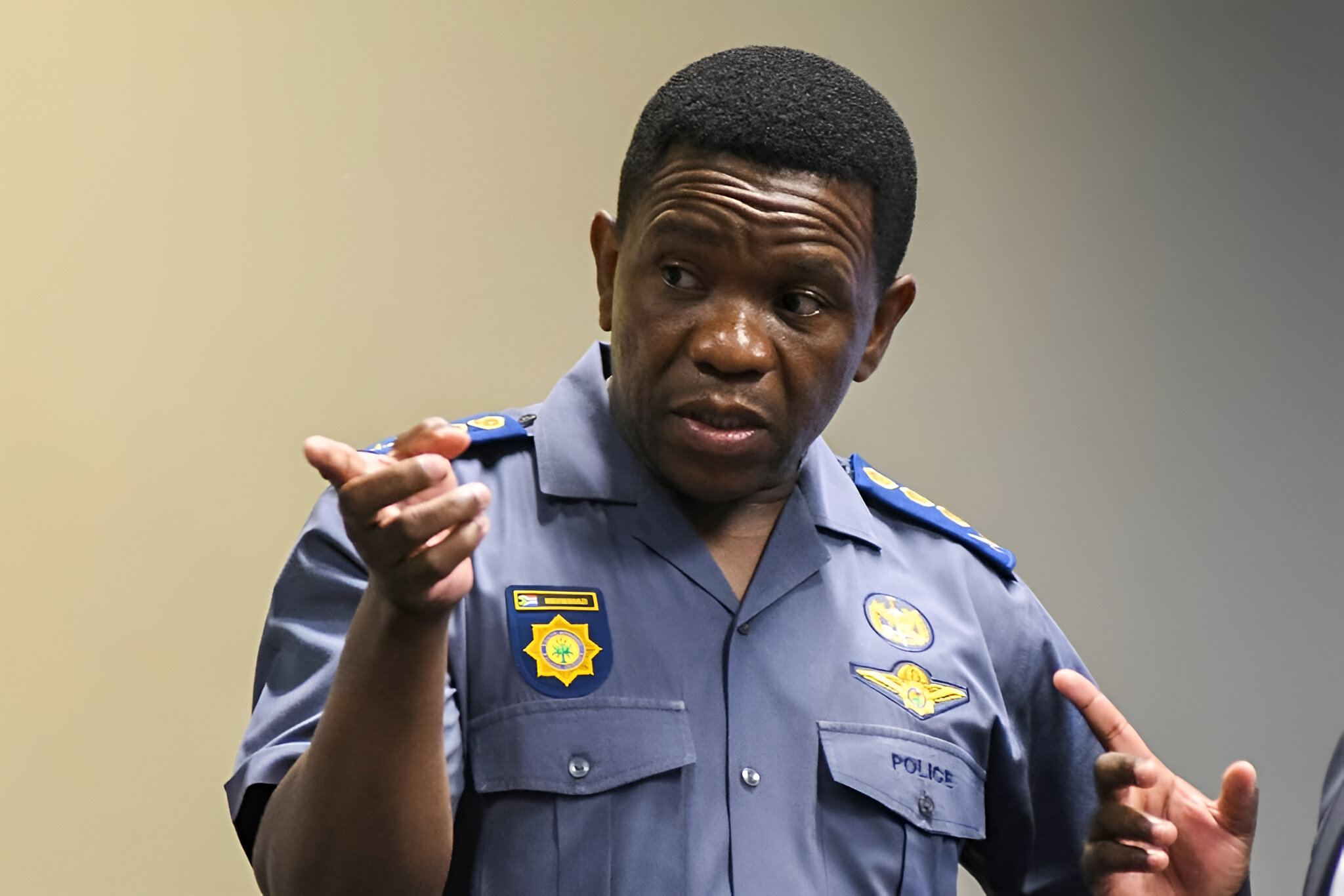
A recording in which KwaZulu-Natal police commissioner Lieutenant-General Nhlanhla Mkhwanazi discusses possible criminal charges against a musician who insulted him and his wife has raised questions about the use of police authority against critics.
The recording, obtained by Sunday World, captures a discussion between Mkhwanazi and Captain Phaladi Makola, who is described as an investigating officer in a separate case involving musician and vocalist Lehlogonolo “Shebeshxt” Chauke.
Mkhwanazi is heard referring to Paul “Tsaka” Madubanya, who is facing criminal proceedings after a Thobela FM radio presenter opened a case of crimen injuria against him.
Crimen injuria is a criminal offence involving the unlawful, intentional and serious impairment of another person’s dignity or privacy.
According to the recording, Mkhwanazi asked Makola whether Madubanya was mentally sound after hearing about profanities directed at him and his wife.
The recording has not resulted in a finding that the police commissioner abused his authority. Mkhwanazi, through police spokesperson Brigadier Athlenda Mathe, has denied using his position to victimise social media personalities or interfere with an investigation.
‘He needs to be taught a lesson’
In the audio, Mkhwanazi is heard asking whether a separate case could be opened against Madubanya or added to the matter already before the court.
“I wanted to have a case on him running. Can we add that up or did you take my things into that court case that he already has?” Mkhwanazi is heard saying.
Makola reportedly told him that the insults directed at Mkhwanazi, President Cyril Ramaphosa and Madlanga Commission chairperson Justice Mbuyiseli Madlanga were not part of the case.
The investigating officer allegedly said those insults had nevertheless been raised to strengthen the State’s opposition to Madubanya’s bail application.
Mkhwanazi then referred to information about other alleged crimes involving Madubanya, including possession of an unlicensed firearm.
“There is something wrong with him,” Mkhwanazi is heard saying.
He continued: “I think the more cases that are brought to him [Madubanya], the more others are going to [learn] a lesson from it [and we must] make an example of it [Madubanya case].”
Mkhwanazi also said: “I was less interested in him but then I realised I am not the only one because he is dissing everyone. I then realised he needs to be taught a lesson.”
Makola reportedly responded, “yes, General”, and advised Mkhwanazi to open his case against Madubanya in Pretoria, where the musician is facing other criminal allegations.
The remarks have prompted concerns that the authority of the police may have been used in response to personal insults.
Madubanya’s camp has echoed those concerns, arguing that the recording suggests an intolerance of criticism by a senior public official.
Police say Mkhwanazi is the victim
Mathe said the recording had to be understood in the context of the alleged remarks made against Mkhwanazi and his wife.
“It is not unusual for police officers, including senior management, to communicate with one another about policing matters and ongoing investigations. Such communication forms part of the normal operational environment within the South African Police Service,” Mathe said.
He said Mkhwanazi was the victim in the matter and had a right to report alleged criminal conduct despite holding a senior position in the police service.
“It is important to clarify that Lieutenant-General Mkhwanazi is a victim in this matter,” Mathe said.
“The insults and derogatory remarks were directed at him and his wife, including threats by the suspect that he would sleep with the general’s wife, accompanied by remarks intended to intimidate and provoke him.”
Mathe said Mkhwanazi’s question about Madubanya’s mental state was a genuine concern because of the alleged content and severity of the remarks.
“Given the nature, severity and disturbing content of [Madubanya’s] utterances, [Mkhwanazi] sought to establish whether the suspect might have mental health challenges. This was a genuine concern,” he said.
The police spokesperson rejected the suggestion that Mkhwanazi ordered officers to bring unlawful charges against Madubanya.
“There was no instruction to unlawfully arrest, intimidate, victimise or interfere with the suspect or the investigation,” Mathe said.
“Lieutenant-General Mkhwanazi remains committed to upholding the law and ensuring that all investigations are conducted without fear, favour or prejudice. Being a senior police officer does not deprive him of his rights as a victim of alleged criminal conduct.”
Recording surfaces after influencer’s arrest
The recording emerged after the arrest of popular TikToker and MK Party activist Nkululeko “Max” Makhanya in Durban.
Makhanya was arrested on 1 November after allegedly insulting Mkhwanazi and the KwaZulu-Natal police on social media.
He was detained at Greenwood Park police station after his arrest at Princess Magogo Stadium in KwaMashu, where he had attended an MK Party election rally.
Makhanya faced charges of crimen injuria and inciting violence.
The Durban Magistrate’s Court released him on R7 000 bail on 2 November. The court imposed conditions prohibiting him from inciting violence or encouraging anyone to abuse or assault police officers, their families or government employees.
The magistrate warned Makhanya that he should take the case seriously after he laughed in the dock.
The State had initially asked for bail of R10 000, while Makhanya’s lawyer argued that his client was unemployed and could afford only R1 000.
After his release, Makhanya apologised to Mkhwanazi and the people of South Africa.
“I made attempts for the video to not go viral. I even fought with the people that posted the video. I would like to apologise to Mkhwanazi and the whole of South Africa,” Makhanya said, according to IOL.
His case is expected to return to court on 20 January 2027.
The arrest and bail proceedings brought fresh attention to the way police respond to online criticism and alleged incitement involving public officials.
Makola disputes discussion with Mkhwanazi
The recording has also created difficulties for Captain Makola.
The Limpopo office of the SAPS is investigating his conduct in connection with the recording.
Sunday World reported that Makola rejected the account that he had discussed the Madubanya case with Mkhwanazi.
“I have never spoken with General Mkhwanazi regarding the case of Tsaka [Madubanya],” Makola told the publication.
His denial is at odds with the recording described by Sunday World as verified.
The investigation into Makola’s conduct is separate from the criminal proceedings against Madubanya and does not establish whether the musician is guilty of any offence.
It is also separate from the question of whether Mkhwanazi acted within his authority when discussing the possibility of further charges.
Mkhwanazi’s public profile under scrutiny
The controversy comes as Mkhwanazi remains one of the most prominent police figures in South Africa.
He has received public attention for raising allegations about organised crime, political interference and corruption within the police service.
His testimony and public claims have been examined through the Madlanga Commission of Inquiry and parliamentary processes.
The commission has heard evidence about alleged links between senior officials, political figures and criminal networks. Mkhwanazi has presented himself as a senior officer willing to confront interference in policing.
That public role has increased the scrutiny surrounding the recording because the latest allegations concern his conduct as a complainant and police commissioner rather than his broader claims about corruption.
The issue is not whether a police commissioner may report alleged threats or insults. Senior officials, like other members of the public, may seek police protection and open criminal cases where the law allows it.
The concern raised by Madubanya’s camp is whether a senior officer’s personal involvement in a case could influence the number of charges considered or the way investigators handle a suspect.
Mathe has denied that Mkhwanazi instructed officers to act unlawfully or interfere with the investigation.
Questions over criticism and police power
The recording has reignited debate about the boundary between legitimate police action and the use of official power in a personal dispute.
Mkhwanazi is heard discussing a possible case after learning that Madubanya had insulted him and his wife. He also refers to making an example of the musician so that others would learn a lesson.
The police explanation is that the comments were made in the context of alleged threats and disturbing remarks directed at Mkhwanazi’s family.
The competing accounts have not been tested in court.
Madubanya has not been convicted of the alleged offences referred to in the recording. The same principle applies to Makhanya, who has been released on bail and remains entitled to the presumption of innocence.
The criminal cases and the SAPS investigation into Makola’s conduct will determine what further action is taken.
For now, the recording has placed the conduct of a senior police commissioner under renewed scrutiny and raised questions about how officials respond when criticism becomes personal or offensive.
Mkhwanazi maintains that he is the victim of alleged criminal conduct and that he has not abused his authority.
The SAPS maintains that investigations under his leadership must be conducted without fear, favour or prejudice.