

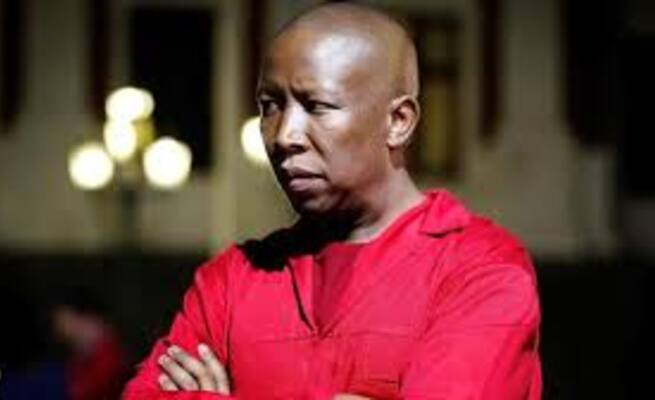
Economic Freedom Fighters leader Julius Malema has called for a united front between the EFF, African National Congress, uMkhonto weSizwe Party and South African Communist Party after his party suffered a major decline in support during the 2026 local government elections.
Addressing the media at the Electoral Commission of South Africa’s Results Operations Centre in Midrand, Malema acknowledged that the EFF had lost 612 326 votes compared with the 2021 local elections.
The party received approximately 1.8 million votes in 2026, down from about 2.4 million in 2021. Its national support fell from 10.31% to 6.26%, moving the EFF from third to fourth place nationally.
Malema said the result was a setback but insisted that it was not the end of the party’s political campaign.
“A setback is not a defeat; it is an opportunity which gives us a moment to reflect on how to better present ourselves and our message of service delivery to the people,” he said.
The EFF leader said the party would use the result to prepare for the 2029 national and provincial elections.
“We will not hide from the national picture and we will not make excuses. We have lost 612 326 votes nationally and moved from third to fourth place,” Malema said.
Malema blames ANC’s DA partnership
Malema placed much of the blame for the EFF’s decline on the ANC’s decision to enter into a government of national unity with the Democratic Alliance after the 2024 national election.
He accused the ANC of legitimising what he described as “white supremacist” and “right-wing” forces by sharing power with the DA.
Malema argued that the ANC’s decision to work with the DA at national level had made it easier for voters to support the DA in municipalities.
“The DA did not steal votes. Our people decided to go to bed with the DA because the ANC said to them in 2024, ‘It is nice to sleep with the DA’,” he said.
He pointed to the DA’s control of key government departments, including Home Affairs, Basic Education and Agriculture, as evidence that the ANC had given the party political legitimacy.
Malema said the election result created an opportunity for parties that shared similar political positions to reconsider their divisions.
He called on the ANC, EFF, MK Party and SACP to abandon the DA and form what he described as a progressive alliance.
“If MK puts a demand that Ramaphosa must go, the ANC must agree that Ramaphosa must go because we are in this mess because of him,” Malema declared.
“It is either we unite or perish.”
The call places President Cyril Ramaphosa at the centre of Malema’s proposed realignment. The EFF leader said the ANC should prioritise cooperation with organisations that support economic transformation rather than protect individual leaders.
EFF vote fell most in metropolitan areas
The EFF’s losses were concentrated in metropolitan areas where the DA strengthened its position.
Malema said the result reflected a broader problem of voter turnout in township communities. He contrasted participation in poorer areas with turnout in communities he described as “white” areas.
“Where white people vote, they vote in their numbers. 80%, 90% of those who are registered go out to vote, and we don’t vote,” he said.
The EFF has also faced the challenge of convincing disillusioned voters that elections can improve their daily lives.
Mail & Guardian reported that Malema acknowledged the need for the party to show communities that participation in elections could produce practical benefits. The EFF has linked its future work to water shortages, poor roads and other service-delivery problems.
The party’s treasurer-general, Omphile Maotse, had earlier said the EFF would accept the decision made by voters.
“Ours is to accept the voices of our people. This is democracy, and the people must choose who they wish to lead the municipalities. If he did not choose the EFF, we will accept it. If they had chosen the EFF, we would also accept it,” Maotse said.
The party is expected to hold a meeting to assess its campaign, internal structures and use of resources after the official results are finalised.
Party points to ward-level gains
Although the EFF lost national support, Malema highlighted the party’s gains at ward level.
The EFF increased its ward representation from 19 to 27 seats, according to the election figures discussed at the Results Operations Centre. The IEC had allocated 465 of 7 450 council seats to the party, with final proportional representation allocations still pending.
The party made its strongest ward-level gains in the North West, Mpumalanga and the Free State.
In the North West, its ward representation increased from three to 10. In Mpumalanga, the party went from no wards to seven. Its representation in the Free State rose from two wards to four.
The EFF also pointed to its performance in areas associated with the 2012 Marikana massacre.
In Marikana, the party retained 13 of 26 wards and won one ward from the ANC, giving it 14 seats in the area.
In Rustenburg, the EFF’s vote share increased from 23.67% to 32.95%, allowing it to secure four of seven wards.
These results gave Malema a basis for arguing that the party retained support in selected communities even as its national vote declined.
The party’s final representation could still change as proportional representation seats are allocated and any electoral objections are considered.
Malema announces 100-day service plan
Malema announced a 100-day plan aimed at using EFF resources in the wards where the party had won representation.
The plan includes drilling boreholes, fixing roads and addressing refuse removal.
He said EFF councillors should take responsibility for their communities even if the party did not control a municipality or hold the mayoral or speaker position.
“You don’t have to be formally in government as a mayor or speaker for you to accept the responsibility that you are deployed for that particular ward,” he said.
Malema suggested that boreholes could be drilled in EFF councillors’ yards to provide water to nearby residents while communities waited for municipal supply.
He also referred to paving provincial roads to connect them with municipal roads.
The approach is intended to make the party more visible between elections and to show voters that EFF representatives can respond to service-delivery problems outside formal control of a municipality.
Malema accused DA-run metros of prioritising residents who could afford municipal services.
He said DA control would lead to service delivery being available mainly to those who could pay.
The DA has not accepted Malema’s characterisation of its approach to municipal governance.
EFF rejects claims it has lost national relevance
Malema dismissed suggestions that ActionSA had become a major national political force.
He pointed out that ActionSA was not among the top 10 parties nationally and insisted that the EFF remained a national political player.
He said the EFF would use the period before the 2029 elections to reorganise and strengthen its structures.
The party leader also criticised what he described as divisions among organisations that share positions on land redistribution, affirmative action and economic transformation.
“We have fragmented political parties competing over liberation narratives and ideological divisions without strategic consolidation,” he said.
“The oppressed are increasingly divided amongst themselves, while the structure of historical power remains remarkably resilient.”
Malema’s argument is that political competition among parties with broadly similar constituencies has weakened the influence of poor and working-class voters, while established political and economic power remains intact.
He said an alliance could prevent those divisions from continuing into the 2029 elections.
Whether the ANC, MK Party or SACP will support the proposal remains uncertain. The parties have different positions on leadership, coalitions and the future direction of government.
The ANC has also suffered an electoral setback and faces coalition negotiations in several municipalities. The MK Party has grown strongly in KwaZulu-Natal and has pursued its own political agenda, while the SACP has contested the ANC’s direction in recent years.
Voting remains central to EFF message
Malema urged EFF supporters not to withdraw from electoral politics after the party’s losses.
He described voting as a revolutionary duty and warned supporters that staying away from the polls would reduce their ability to influence government.
“Not voting is counter-revolutionary,” he said.
The message comes as political parties confront uneven turnout and growing frustration among voters who say elections have not improved their living conditions.
For the EFF, the challenge now is to turn its ward-level representation into visible community work before the next national election cycle.
Malema said the party would continue its political programme whether it was in government or opposition.
He urged the ANC to reconnect with former supporters and choose unity with progressive forces over its partnership with the DA.
“Come back and look for the children, brothers, and cousins that they lost because of their arrogance,” he said.
The EFF leader ended by insisting that the party’s election performance should be treated as a warning and an opportunity rather than a final defeat.
“We have come too far to let a setback define the end of our day,” Malema said.
The EFF’s immediate test will be whether it can deliver on its 100-day service plan in the wards it controls, rebuild support in metropolitan communities and persuade voters that the party can translate its political message into practical improvements.