The ANC Women’s League is consulting legal experts on whether South Africans could be asked to decide the future of the death penalty through a referendum, following the discovery of nine women’s bodies in Ekurhuleni.
The organisation has not announced a formal campaign to immediately restore capital punishment. Instead, it says it wants the country to reopen the debate, follow the correct legal process and allow citizens of voting age to have their say.
The call comes as women and communities across the country demand stronger action against gender-based violence and violent crime. The discovery of the bodies in Ekurhuleni has brought renewed attention to the fear faced by women and to questions about whether existing measures are protecting victims.
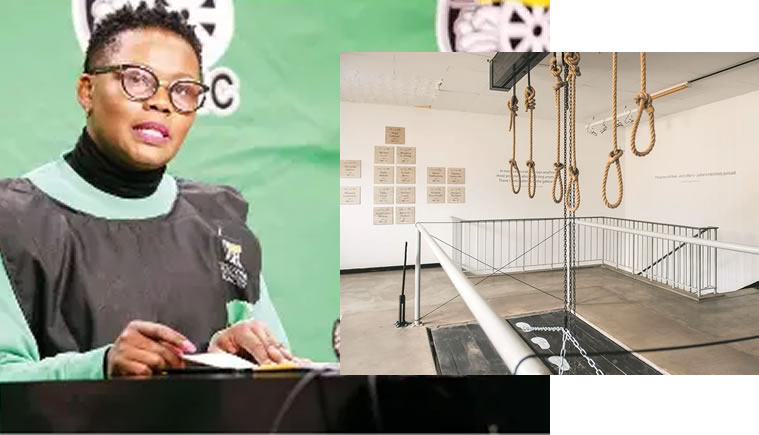
ANC Women’s League secretary-general Nokuthula Nqaba said marches and night vigils had not produced the results many people hoped for. She said the league believed the death-penalty debate could no longer be avoided while violent crimes continued.
The issue was discussed at the Women’s League’s special national executive committee meeting on Thursday. According to Nqaba, members unanimously agreed that the debate should be reopened responsibly.
“Our special NEC this week acknowledged that there is an outcry in society for the return of the death penalty and that the debate should be allowed to take place so that through public discussions and participation, the relevant ministers can guide us as to what should happen moving forward,” Nqaba said.
South Africa abolished the death penalty in 1995. The ANC Women’s League accepts that the Constitution protects the right to life, but argues that the country must examine how that right is understood when convicted violent offenders continue to live while victims and survivors carry the consequences of their crimes.
Nqaba said the league was not simply demanding that capital punishment be brought back without considering the law. Instead, it wants legal experts, government ministers and the public to take part in a structured debate.
“We are alive to the provisions of our constitution and the right to life, particularly, hence we cannot just say ‘bring back the death penalty’ but rather are saying, ‘open up the debate and let the people discuss and decide’.”
She said the discussion should also ask difficult questions about people accused of repeatedly killing innocent victims.
“The debate should be shaped in such a way that it asks the question about criminals who are serial killers killing innocent people who continue to enjoy their right to life. So the right to life applies to perpetrators and not survivors?”
The comments follow the discovery of women’s bodies in and around Kempton Park and other parts of Ekurhuleni. Police have not confirmed that one serial killer is responsible for the deaths, and no suspect had been arrested at the time of the report.
The Women’s League’s proposal is therefore linked to the wider national debate about gender-based violence rather than to a confirmed finding that all the Ekurhuleni cases were committed by one person. Investigations into the deaths remain ongoing, and the identity of the person or people responsible has not been established.
Nqaba said the lack of an arrest in the killings showed that the country needed to consider a different approach. She said the Women’s League had begun consulting lawyers to determine how its position could be developed within the law.
“We are advocating for this matter to be settled through a referendum by the look of things. At the moment we are consulting lawyers on how we go about shaping our stance in a responsible manner that is within the confines of the law.”
She added:
“But the Constitution must be put to the test; we cannot continue in this way. Let us follow due process and see how that goes, but we will be patient.”
A referendum would require careful legal and political consideration. The Women’s League has not set out a date, question or process for such a vote. It has also not explained what constitutional steps would need to be taken before citizens could vote on the issue.
For now, its position is that the public should be invited to participate in the discussion. The league says the matter should not be decided only by politicians or organisations, but should involve South Africans of voting age.
The death penalty remains one of the most divisive issues in the country. Supporters argue that the harshest punishment could deter people from committing the most serious crimes and could provide a sense of justice to families of victims. Opponents have raised concerns about wrongful convictions, unequal enforcement and the irreversible nature of an execution.
The Women’s League says it is aware of those legal and constitutional concerns. That is why it has chosen to begin with consultations instead of announcing an immediate demand for executions.
Nqaba said the death penalty was abolished three decades ago under circumstances that were different from those facing South Africa today. She argued that the country’s current levels of gender-based violence and violent crime required authorities and society to consider every possible solution.
“We have tried everything and anything possible to fight GBV and violent crimes broadly, and it just never ends. We are saying we will support any groundbreaking and viable solution to deal with this catastrophe.”
She said measures introduced so far had not produced enough change and referred to last year’s declaration of gender-based violence as a national disaster.
“Everything that has been placed on the table so far has been proven beyond doubt that it does not work. A case in point, last year GBV was declared a disaster, but we are now talking about bodies of murdered women in Kempton Park. Clearly that too did not work.”
The proposal will almost certainly lead to strong reactions from legal experts, political parties, civil-society groups and families affected by violent crime. Some may see a referendum as a way for citizens to express their anger and demand tougher punishment. Others may argue that the death penalty would not address failures in policing, prosecutions, witness protection or support for survivors.
The Women’s League has not said that capital punishment alone would end gender-based violence. Its argument is that the country should test all possible options while following the Constitution and due process.
As the legal consultations continue, police investigations into the Ekurhuleni deaths remain separate from the political debate. Families still need answers about how their loved ones died, while investigators must identify and arrest those responsible.
The question of the death penalty may now move from public anger into a formal national conversation. Whether it leads to a referendum, a constitutional challenge or no change at all will depend on the legal advice received and the response from the government and the broader public.