

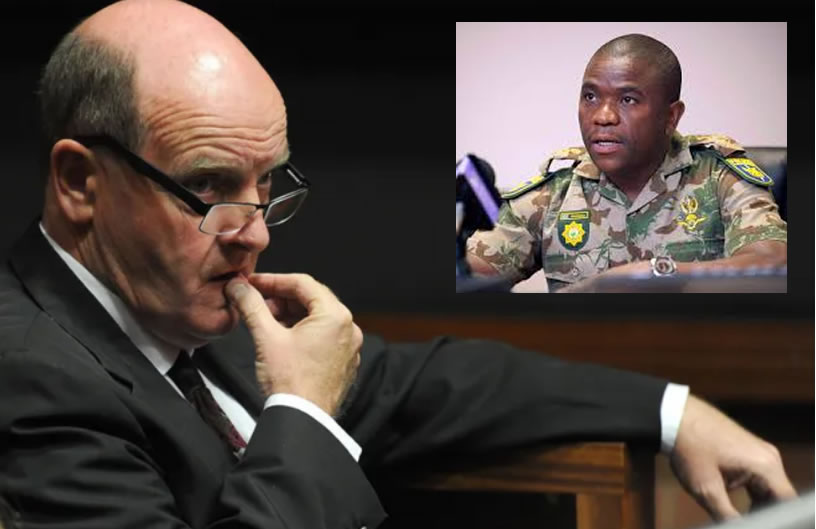
Lieutenant-General Nhlanhla Mkhwanazi’s appointment as the new head of the Directorate for Priority Crime Investigation, commonly known as the Hawks, is facing a threatened legal challenge from forensic investigator Paul O’Sullivan.
The challenge has brought a long-running public feud between the two men back into the spotlight, with accusations of foreign-intelligence links, corruption, political interference and personal vendettas still unresolved.
Acting Police Minister Firoz Cachalia initiated the formal process to appoint Mkhwanazi as the new Hawks chief on Thursday.
O’Sullivan, acting through his organisation Forensics for Justice, has reportedly warned that it will challenge the appointment unless the government suspends the process or opens it to public scrutiny.
He argues that Mkhwanazi does not meet the requirement in Section 17CA(1)(B) of the South African Police Service Act, which requires the national head of the Hawks to be a “fit and proper person”.
O’Sullivan’s objection is based on serious allegations he previously submitted to Parliament’s ad hoc committee and the Madlanga Commission of Inquiry.
Those allegations have not been proved in court.
O’Sullivan threatens legal action
O’Sullivan is challenging the appointment before Mkhwanazi formally takes over the Hawks.
His organisation is reportedly seeking either the suspension of the appointment process or a more transparent process that allows the public to scrutinise the candidates and objections.
The argument centres on the legal requirement that the head of the Hawks must be a fit and proper person to hold the position.
O’Sullivan has relied on allegations involving Mkhwanazi’s conduct and claims made during parliamentary and commission proceedings.
It is not yet clear whether Forensics for Justice has filed court papers or whether the threat remains at the stage of a formal warning.
KwaZulu-Natal police spokesperson Colonel Robert Netshiunda said Mkhwanazi would not comment on the threatened legal action.
O’Sullivan did not respond to questions sent to him on Friday afternoon.
The lack of responses means that the competing claims remain largely presented through previous public statements, parliamentary evidence and the opinions of analysts.
Allegations of foreign-intelligence links
The dispute intensified after Mkhwanazi accused O’Sullivan of being a foreign spy and working with foreign intelligence agencies during a high-profile media briefing in July 2025.
Mkhwanazi, dressed in Special Task Force combat fatigues and flanked by armed tactical officers, used the briefing to raise allegations about criminal infiltration and political interference within South Africa’s security structures.
As part of those disclosures, he accused O’Sullivan of operating as a foreign-intelligence operative under the guise of an anti-corruption activist.
O’Sullivan has denied the accusation.
During testimony before Parliament’s ad hoc committee on 10 February, he said:
“Since living in this country, I have not been involved in any way, shape or form with any intelligence activity whatsoever.”
He did, however, acknowledge that he had historically worked for British Army counterterrorism and counterintelligence.
That admission has become part of the public dispute, although it does not by itself establish that O’Sullivan worked as a foreign intelligence agent in South Africa.
The allegations and denials remain contested.
Defamation lawsuits follow
The personal conflict later developed into legal action in the South Gauteng High Court.
Mkhwanazi initially filed a R5 million defamation claim against O’Sullivan over separate remarks in which O’Sullivan allegedly accused him of corruption and links to organised crime.
In October 2025, O’Sullivan countersued for R10 million, arguing that Mkhwanazi’s allegations about foreign-intelligence links, made during parliamentary testimony and at the Madlanga Commission, were defamatory.
The combined claims amount to R15 million, although the court proceedings and any defences remain separate from the appointment process.
Neither defamation claim establishes that the underlying allegations are true. Those matters must be determined through the relevant court processes or withdrawn if the parties reach a settlement.
Analysts question O’Sullivan’s motives
Political analyst Zakhele Ndlovu said O’Sullivan’s opposition to the appointment and threat of legal action appeared to be driven by a personal vendetta and concern about losing investigative access, rather than genuine public interest.
Ndlovu also linked the opposition to resentment over Mkhwanazi’s public allegations about O’Sullivan’s purported foreign-intelligence ties, which he said had damaged O’Sullivan’s professional standing.
The claims about O’Sullivan’s motives are opinions and have not been established as facts.
Chad Thomas, the chief executive of IRS Forensic Investigations, said O’Sullivan was using Forensics for Justice as an alter ego to advance his own narrative and interfere in state-related matters.
“It’s a mockery for O’Sullivan to compare his organisation with the likes of genuine NGOS and NPCS,” Thomas said.
“Everything with O’Sullivan is personal. He hitched his wagon to Sibiya a long time ago and when Mkhwanazi laid out the facts at his July 2025 presser, O’Sullivan came out blazing against Mkhwanazi and Fannie Masemola (National Police Commissioner). So far, Mkhwanazi has been right about everything and O’Sullivan has gone very quiet about his support for Sibiya,” he added.
Thomas also described O’Sullivan as an alleged agent provocateur based on his conduct over the years.
“For someone who claimed so vehemently to be anti-corruption, one would have expected him to embrace Mkhwanazi’s exposé on what was happening in the police, instead O’Sullivan chose to deride and vilify him.”
Thomas’s comments represent his assessment of the dispute and are not court findings.
Support for Mkhwanazi appointment
Political analyst Professor André Duvenhage said he was uncertain about the basis of O’Sullivan’s opposition but suggested it could be driven by jealousy.
“We have seen that Mkhwanazi came out and took a firm stance on a number of issues. And I believe that he is probably the best person I know about at the moment to be in leadership of the Hawks,” he said.
The appointment process is taking place amid intense scrutiny of South Africa’s law-enforcement agencies and allegations of criminal infiltration, corruption and political interference.
Mkhwanazi has become a prominent figure in those debates after making public allegations about criminal networks and alleged interference in police operations.
His supporters argue that his experience and willingness to confront powerful interests make him suitable to lead the Hawks.
O’Sullivan’s organisation argues that the appointment must be examined against the legal requirement that the national head be fit and proper.
The court may ultimately have to decide whether the objections are legally sufficient to stop or delay the process.
Louis Vuitton bag allegations
O’Sullivan has previously alleged that Mkhwanazi and National Police Commissioner Fannie Masemola received luxury Louis Vuitton bags, reportedly worth about R100,000 each, from businessman Inbanathan Kistiah of I-View Integrated Systems.
He claimed the bags were rewards or kickbacks linked to irregular or inflated SAPS bulletproof-vest contracts.
The allegation has not been proved.
During testimony at the Madlanga Commission in June, O’Sullivan conceded that he did not have proof of the claims.
That concession is likely to form part of any debate about whether the allegations can properly be relied on to challenge Mkhwanazi’s suitability for the Hawks position.
A serious allegation without supporting evidence may not be sufficient to establish that a candidate is not fit and proper, but the legal test will depend on the evidence and arguments presented to the court.
What happens next?
The formal appointment process began on Thursday, but the threatened challenge could delay the process if Forensics for Justice proceeds with an urgent application.
The organisation may ask a court to suspend the appointment, compel greater transparency or review the minister’s decision-making process.
The government may oppose the application and argue that the appointment process complies with the SAPS Act.
Mkhwanazi’s legal team could also defend his suitability and challenge the basis of O’Sullivan’s objections.
Until a court makes a ruling, the appointment remains part of an unfolding legal and political dispute.
At the latest update, O’Sullivan had threatened legal action, Mkhwanazi had declined to comment through the KwaZulu-Natal police spokesperson and the government’s formal appointment process had begun.
The allegations exchanged between the two men remain contested, while the question of who will lead the Hawks moves closer to the courts.