Four of the five women whose bodies were found in and around Kempton Park since July were sexually assaulted, police have confirmed, as investigators continue to examine whether the deaths are connected.
The condition of the fifth body was too advanced for investigators to confirm whether sexual assault had taken place. Police have not ruled out the possibility of a serial killer, but say they have not found enough evidence to reach that conclusion.
The confirmation came as the family of missing runner Elizabeth “Tsontso” Moselakgomo, 38, identified her body at the Germiston state mortuary. Moselakgomo disappeared after leaving for her routine evening run on 9 September.
Her identification ended days of uncertainty for her family, but also confirmed that she was among the women whose deaths are being investigated in the Kempton Park area. She leaves behind a minor child.
Deputy national commissioner for policing Lieutenant General Tebello Mosikili said investigators had established that four of the five victims had been sexually assaulted.
“The issue of molestation cannot be ruled out at this moment,” Mosikili said.
She added: “As for the mutilation, not yet, but we know that they were all sexually molested or at least the majority of them. They were found to be sexually molested except for one that was found in a state of decomposition, but the other four, the team can confirm that they were sexually molested.”
The police confirmation has intensified concern in Kempton Park, where five bodies have now been found and several women have been reported missing. Since January, 17 women have been reported missing in the area, with 14 later found and reunited with their families.
The figures do not mean that all 17 missing-person cases are connected to the five deaths. Each case must be investigated separately, and the fact that a person was reported missing does not by itself establish that a crime took place.
However, the number of missing women and the discovery of the bodies have placed the area under intense scrutiny. Residents are demanding more information, while police are trying to establish whether the deaths share a common link or involve different perpetrators.
Serial Killer Possibility Not Ruled Out
Mosikili cautioned against declaring that a serial killer was operating in the area before investigators had completed their analysis.
She said: “I do not want to get into the space that I said earlier, we are not discounting the possibility, but also when the investigation is still under way, we have not yet got to that conclusion that there is a serial killer on the loose.
“We have not yet arrived there.”
The statement reflects the difficult position facing investigators. The victims were women, several bodies were found in the same broad area and four were sexually assaulted. But those similarities do not automatically prove that the same person was responsible for every death.
Police are expected to compare the crime scenes, forensic findings, timelines and the victims’ last known movements. They will also have to establish whether the bodies were found where the women were killed or whether some may have been moved.
The investigation will need to determine whether there are common links between the victims, including their routines, relationships, workplaces, transport routes or people who may have had access to them.
Fifth Body Found In Olifantsfontein
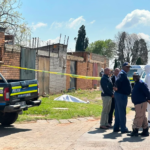
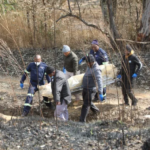
The latest body was discovered on Monday morning on Porcelain Avenue in Olifantsfontein, next to an overgrown field along a road used by vehicles and pedestrians.
A passerby found the body and alerted authorities. National police spokesperson Athlenda Mathe said the unidentified woman was found partially clothed and had bruises over her body.
There was no blood at the scene, raising the possibility that she may have been killed elsewhere and dumped beside the road.
“She could’ve been murdered elsewhere and dumped on this side of the road,” Mathe said.
Police closed the road to traffic until about 11.30am while the K9 Unit searched the area. The search was aimed at locating evidence that could help investigators establish what happened and whether the area had been used to dispose of the body.
Mathe said police were still trying to establish whether the Olifantsfontein death was connected to the other four cases. The latest body was found about 25km north of the previous discovery, which was outside a hotel in Rhodesfield.
“It is quite a concern to have several women who are found killed with the same similarities,” Mathe said.
She asked members of the public to share anything they had seen, even if they believed the information was insignificant.
“It may be a piece of information that our investigators can utilise to crack this particular case.”
Mathe also issued a warning to anyone who may be responsible.
“We are sending a stern warning to those who may be behind these crimes: we will find you, track you down, and put you behind bars.”
She said police were confident that the teams working on the investigation were making progress.
“We are quite confident that the teams that are working on this are on the right track and in no time, they will be able to solve these cases,” she said.
Police have urged women to remain extra vigilant and to report suspicious activity. Residents are also encouraged to provide information about vehicles, people or unusual movements near locations connected to the cases.
Moselakgomo Identified
Moselakgomo’s family had been unable to identify the badly beaten body found in Rhodesfield because of the injuries to the woman’s face. The uncertainty ended when the family went to the Germiston state mortuary and confirmed that the body was hers.
The family said the identification had brought an end to days of painful uncertainty. They now want investigators to establish what happened to Moselakgomo after she left home for her evening run and to hold those responsible accountable.
Her death has also renewed questions about the safety of runners and women who exercise alone. Police have urged women to be cautious, particularly when using isolated routes or exercising at times when few people are present.
The safety advice is not a substitute for the investigation, and residents have called for visible policing and better communication. They want to know which precautions are recommended and whether any areas should be avoided while detectives work.
Forensic Evidence Under Spotlight
Action Society national spokesperson Juanita du Preez said the discovery of the bodies highlighted the danger of delays in South Africa’s forensic DNA system.
Du Preez said Action Society had reported on 12 December 2023 that DNA analysis had identified 486 serial rapists among 10 493 prioritised cases processed between July 2021 and May 2022.
“At least 4.6% of the sexual offenders identified were repeat offenders.”
She called for forensic evidence from all four Kempton Park scenes to be processed immediately.
“Women cannot be told to stay indoors and hope they’re not next.
“If DNA evidence is allowed to disappear into the backlog, another woman may pay for that failure with her life,” she said.
The demand places the forensic process at the centre of the investigation. DNA evidence from the scenes, the victims’ clothing and other items may help detectives establish whether the cases are linked.
But forensic evidence must be collected, preserved and tested correctly. A DNA result must also be connected to a particular suspect and supported by other evidence before it can form the basis of a prosecution.
Calls For Specialist Investigation
Portfolio committee on police chair Ian Cameron said the events were deeply concerning and called on investigators to determine whether a wider trend or pattern was emerging.
“Investigators have to establish whether we are seeing a broader trend or pattern. This is why specialist investigative capability matters.”
The police have deployed specialised resources to examine the deaths. The team will need to review earlier cases, compare medical and forensic findings and follow up on information from residents and witnesses.
The number of missing women is likely to be examined as part of the wider review, but detectives must avoid assuming that every missing-person report is linked to the deaths. Each case will require its own evidence and timeline.
Residents have been urged not to spread unverified information or name suspects online. Rumours can put innocent people at risk and make it harder for police to obtain reliable statements.
The investigation is also likely to require sensitive handling of the families. Moselakgomo’s relatives have already endured days of uncertainty, and the families of the other women are waiting for answers about how their loved ones died.
For now, police have confirmed sexual assault in four of the five cases, while the fifth body was too decomposed for investigators to make a determination. They have not ruled out a serial killer, but they have not reached that conclusion.
The central questions remain unanswered: are the deaths connected, were different perpetrators involved and is another woman at risk? Police say they are working to establish the truth and have warned anyone behind the crimes that they will be pursued.
As forensic examinations continue and investigators compare evidence, women in Kempton Park are being urged to remain vigilant and report suspicious activity. The families want justice, while the wider community wants clear answers and reassurance that the people responsible will be identified and prosecuted.