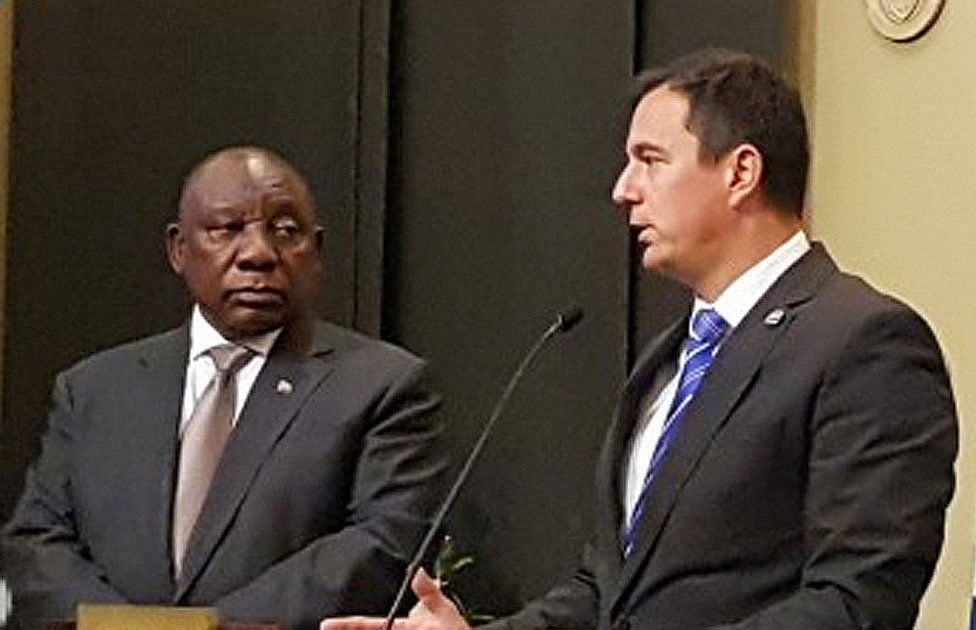
Pretoria, South Africa – A significant political reshuffle appears to be on the horizon as Democratic Alliance (DA) leader Geordin Hill-Lewis has formally requested President Cyril Ramaphosa to remove John Steenhuisen from his Cabinet position. The move comes amidst a backdrop of ongoing controversy surrounding Steenhuisen's tenure as agriculture minister, particularly his protracted disputes with key agricultural organisations and a recent high-profile court defeat.
Sources close to the presidency indicate that Steenhuisen, currently serving as the Minister of Agriculture, is slated for a demotion to the less prominent role of Deputy Minister of Trade and Industry. This proposed change marks a considerable shift in the political landscape, potentially signaling a loss of confidence in Steenhuisen's leadership within the critical agricultural sector.
Filling the void left by Steenhuisen, Willie Aucamp, the incumbent Minister of Forestry, Fisheries and the Environment, is expected to step into the agriculture portfolio. Aucamp's background as a farmer is seen by some as a strategic appointment, aiming to bring practical experience and a more conciliatory approach to a sector that has recently been fraught with tension.
Further complicating the proposed Cabinet adjustments, Rapport, a prominent Afrikaans newspaper, has reported that Hill-Lewis has also urged President Ramaphosa to consider appointing David Maynier, the Western Cape MEC for Education, to the Cabinet. Maynier would reportedly take over Aucamp’s former portfolio, suggesting a broader realignment of responsibilities within the executive.
Steenhuisen's time at the helm of the agriculture ministry has been characterised by a persistent and often acrimonious battle with the farming organisation SAAI (South African Agricultural Initiative), which is closely aligned with the influential civil rights group AfriForum. This ongoing conflict has frequently spilled into the public domain, raising questions about the minister's ability to foster collaborative relationships essential for the stability and growth of the agricultural industry.
The culmination of these tensions manifested dramatically last month when the Gauteng High Court in Pretoria delivered a ruling against Steenhuisen. The case revolved around the contentious issue of the private rollout of foot-and-mouth disease vaccines by farmers and veterinarians. The court's decision was a significant blow to Steenhuisen's policy stance and further eroded his standing within the agricultural community. The implications of this ruling are far-reaching, potentially impacting disease control strategies and the autonomy of private sector actors in managing animal health.
Foot-and-mouth disease (FMD) poses a severe threat to South Africa's livestock industry, with outbreaks leading to significant economic losses due to trade restrictions and culling of affected animals. The debate over vaccine distribution and administration has been a critical point of contention, with farmers advocating for greater flexibility and quicker access to preventative measures. Steenhuisen's perceived resistance to these calls, culminating in the court's adverse judgment, has undoubtedly contributed to the pressure for his removal.
The DA's call for Steenhuisen's removal and the proposed appointments highlight the intricate political maneuvering within South Africa's coalition government dynamics. While the President holds the prerogative to appoint and dismiss ministers, such public requests from opposition leaders, especially those involved in potential future coalition arrangements, carry considerable weight. The timing of this request, following a period of significant policy challenges and public disputes, suggests a calculated move to influence the composition and direction of the Cabinet.
This developing story continues to unfold, with political analysts closely watching President Ramaphosa's response to Hill-Lewis's demands. The decisions made in the coming days will not only shape the future of key ministerial portfolios but also send a clear message about the government's priorities and its approach to managing critical sectors like agriculture and the environment. The potential impact on policy, particularly concerning agricultural practices and environmental conservation, remains a subject of intense speculation and public interest.
The proposed changes could usher in a new era for the agricultural sector, potentially fostering a more cooperative environment between government and farming communities. However, any reshuffle also carries the risk of disrupting ongoing initiatives and creating uncertainty. The coming weeks will be crucial in determining the final shape of President Ramaphosa's Cabinet and the implications for South Africa's governance.