

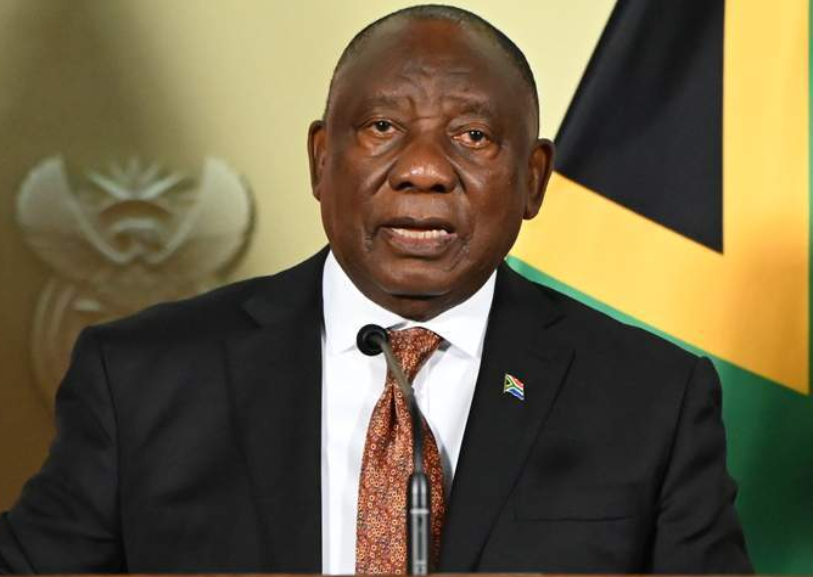
President Cyril Ramaphosa is preparing to launch an urgent court application to halt the impeachment proceedings against him.
As parliament this week took the first steps toward launching the process, sources close to the president revealed that securing an interdict is central to his strategy to stall MPs until a court reviews the section 89 panel report at the heart of the impeachment crisis.
While Ramaphosa indicated in Monday's address to the nation that he would not resign and intends to take the report on review, an interdict would represent a dramatic escalation—effectively allowing the president to freeze parliament's accountability processes.
The move is likely to trigger fierce backlash from opposition parties, who view it as yet another attempt to dodge or delay accountability.
Presidential spokesperson Vincent Magwenya declined to comment on the matter.
"The President Must and Will Interdict"
A source close to Ramaphosa said the interdict option has been discussed extensively following the Constitutional Court's May 8 judgment, which found parliament had mishandled and improperly aborted the impeachment process in December 2022.
"When you file for a review it can take time. It can even take a year. As long as it's not on the court roll there's nothing you can do. So the only thing to do right now is to interdict it first and then take it to review," the source explained.
"The president must and will interdict the process next week. So he's going to interdict first and then do a review at a later stage because if he doesn't it means the impeachment process continues."
The source added that filing a review application alone wouldn't stop parliament. "You can file your review but there's a backlog in courts and it can even take a year before it's heard and by that time the impeachment would have continued."
Another source described allowing the parliamentary process to proceed as "wasteful expenditure," arguing there was "really nothing to lose" by freezing proceedings "for a short period" until the review outcome is known.
A third source confirmed the interdict remains "an option," with a final decision dependent on legal advice once the president's papers are finalized.
ANC spokesperson Mahlengi Bhengu said the party was only aware of positions outlined in its official statement, which makes no mention of an interdict application.
Opposition Fury Expected
Any attempt to interdict parliament is certain to face fierce resistance from MPs, particularly those outside the Government of National Unity (GNU), including the ATM and EFF—the party that brought the Constitutional Court application ensuring the impeachment process proceeds.
EFF chief whip Nontando Nolutshungu has warned that any future delay would constitute an "abrogation of parliament's duties."
ATM leader Vuyo Zungula criticized Ramaphosa's review plan, saying: "It is worrying that a person who came to office on the ticket of clean governance, anti-corruption and ethical leadership is fighting hard from being held accountable by the National Assembly."
"The president as a constitutionalist as people claim, must subject himself to the constitutional provisions of accountability by the only institution that elected him and he is accountable to. The courts must dismiss the review application, done in bad faith."
The DA, parliament's second-largest party and the ANC's main GNU partner, said it "will never be party to protecting misconduct" and would "participate fully and constructively in the process."
DA leader Geordin Hill-Lewis told the Sunday Times: "We're keen to get the committee started as soon as possible, so we can get to the truth. Everyone is entitled to pursue their legal rights, but we hope there'll be no major delay."
Parliament Moves Forward
As Ramaphosa weighed his options with top ANC leaders this week, parliament was discussing composition of the 31-member impeachment committee. The ANC will hold the largest share of seats, but no longer commands the outright majority it wielded in 2022 when it could override opposition parties.
The president is expected to file court papers early this week contesting the section 89 inquiry report, which found prima facie evidence against him in his handling of the aftermath of the 2020 robbery of more than $500,000 from a couch at his Phala Phala game farm.
Ramaphosa is also reportedly considering approaching the Western Cape High Court judge president to request a preferential hearing date for the review.
Speaker Didiza's Dilemma
National Assembly Speaker Thoko Didiza now faces mounting political and legal pressure over whether parliament should oppose Ramaphosa's application for judicial review and any potential interdict.
Senior ANC and parliamentary insiders told the Sunday Times that Didiza finds herself caught between a rock and a hard place as legal advisers and political figures debate whether her office, as custodian of the section 89 process, has a duty to oppose Ramaphosa's legal action.
In her capacity as Speaker, Didiza will be among the central respondents in any legal challenge. Her office established the independent panel of three jurists that produced the contentious report.
"The dilemma for the Speaker is not necessarily the review itself," explained one insider familiar with discussions around the matter. "The real issue is what happens if there is an urgent interdict. A review does not automatically stop impeachment proceedings. The president would have to seek an interdict. The question then becomes: what position should the institution being interdicted take, because the Speaker leads that institution."
Options Under Consideration
Sources with knowledge of parliamentary discussions said one option being considered is for the Speaker to file a notice to abide by the court's decision rather than actively opposing Ramaphosa's applications. These sources pointed to approaches adopted by her predecessors, Baleka Mbete and Nosiviwe Mapisa-Nqakula, in related matters.
However, some insiders said Didiza is wary of the Mbete precedent—she drew criticism for how parliament protected former president Jacob Zuma from accountability in the Nkandla scandal.
Insiders said Didiza is concerned about protecting parliament's credibility and avoiding perceptions that her office is acting in the governing party's interests rather than serving the legislature itself.
ANC Debates Next Steps
The ANC national executive committee (NEC) discussed the crisis facing Ramaphosa at its Wednesday meeting.
According to insiders, one proposed strategy to postpone the day of reckoning was for parliament to prioritize amending rule 129I, which the Constitutional Court ruled inconsistent with the constitution and invalid.
But some NEC members argued that focusing on rule amendments wouldn't halt the impeachment process, as Chief Justice Mandisa Maya had already indicated both matters could be addressed concurrently.
"The [top seven] were sliding in that direction in their presentations," said one insider. "There is no way out for parliament."
ANC secretary-general Fikile Mbalula on Friday defended Ramaphosa's decision to pursue judicial review.
"Section 89 gives us the pathway in relation to what options are at the disposal of the president, which is the review," he said, adding that the NEC unanimously supported Ramaphosa's approach.
What's at Stake
Section 89 of the constitution grants the National Assembly authority to impeach a president. The independent panel's report found prima facie evidence of potential misconduct by Ramaphosa in his handling of the Phala Phala farm theft aftermath.
The December 2022 impeachment attempt was aborted after the ANC used its then-majority to vote against adopting the panel's report. The Constitutional Court's May 8 ruling found this approach unconstitutional, forcing parliament to restart the process.
With the ANC no longer holding an outright majority following recent elections and the formation of the GNU, Ramaphosa cannot rely on his party alone to block impeachment proceedings—making the legal route potentially his most viable option to avoid accountability.
The coming week promises to be pivotal, with court papers expected to be filed and parliament preparing to constitute the impeachment committee that could ultimately determine the president's political fate.