

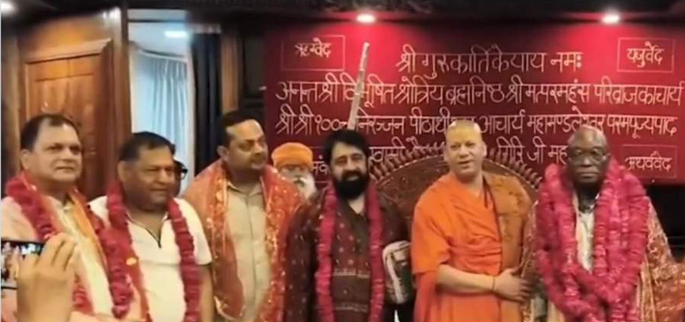
Haridwar, India – Former South African President Jacob Zuma has emerged in the Indian media spotlight following a high-profile visit to a renowned Hindu temple in Haridwar, where he was accompanied by his long-standing friend and corruption-accused businessman, Ajay Gupta. The visit, which took place at the Siddhpeeth Shri Dakshin Kali Temple, has raised eyebrows back home, particularly as it featured the presence of South Africa’s High Commissioner to India, Anil Sooklal.
Zuma, who appeared in photographs and videos flanked by Ajay Gupta and Swami Kailashanand Giri, told reporters that he felt certain of a political comeback in South Africa after receiving blessings at the revered site. The visit was widely reported by India’s major news organisations, many of which did not shy away from highlighting the deep-seated links between Zuma and the Gupta family, who remain at the centre of South Africa’s state capture allegations.
Accompanied by his close confidante Mzwanele Manyi, Zuma’s trip was described by Manyi as a “private visit,” for which he claimed to have “no mandate” to discuss further. However, the presence of High Commissioner Sooklal has added a layer of diplomatic intrigue. Sooklal was reportedly not in his office at the High Commission in Delhi on Tuesday and could not be reached for comment regarding his decision to appear alongside a man who has successfully evaded South African justice for years.
The Department of International Relations and Cooperation (DIRCO) has remained silent on the matter, while Deputy High Commissioner Cedrick Crowley declined to comment without Sooklal’s direct consent. According to Indian news reports, Ajay Gupta is regarded as a “disciple and member of the ashram family,” a status that seemingly affords him a level of spiritual sanctuary in Haridwar.
During the visit, a seated Zuma, his face adorned with rose petals, spoke candidly to broadcasters about his motivations. He referred to Ajay Gupta as his “brother and friend,” lamenting the circumstances that forced the businessman to leave South Africa. Zuma described the situation as “unfortunate,” suggesting that South African authorities had taken issue with their shared activities and had attempted to follow Gupta “even to the wrong places.”
Zuma’s primary focus, however, appeared to be his aspirations for a return to power. “I had led the country at one point, but they put me aside, and I remained there. I realised that they were messing up the country. They were not taking the country forward,” he stated, reflecting on his departure from office. He further explained his resolve to challenge the status quo: “I decided to take a decision to retake the country forward… I feel I am going to win the elections because people of God have been with me.”
The former president’s confidence was palpable as he addressed the media, promising a more significant return to India in the future. “After we finish what we are doing in our country, I will pay a visit here, which will not be just two to three days but a big one. So that I can say ‘thank you’ to my brothers and friends here for giving me this opportunity to come here,” he added.
The timing of this visit is particularly noteworthy as the National Prosecuting Authority (NPA) currently has no active extradition proceedings against any of the three Gupta brothers. A previous attempt to extradite Ajay’s brothers, Atul and Rajesh, from the United Arab Emirates in 2023 failed on a legal technicality, leaving the brothers free to move between jurisdictions that do not have extradition treaties with South Africa.
Niranjani Akhara Mahamandaleshwar Swami Kailashanand Giri, who hosted the delegation, noted that this was Zuma’s first visit to Haridwar. He confirmed that the visit was facilitated by Ajay Gupta, whom he described as a dedicated member of the ashram. Giri also touched upon the upcoming political landscape in South Africa, mentioning the local elections in November and the presidential elections in 2029 as the backdrop for Zuma’s spiritual quest.
As Zuma seeks divine favour in the foothills of the Himalayas, the political fallout in South Africa is likely to be significant. The sight of a former head of state consorting with a central figure of state capture, while being supported by a sitting high-ranking diplomat, is certain to reignite the debate over accountability and the enduring influence of the Zuma-Gupta alliance. Whether this spiritual endorsement translates into electoral success remains to be seen, but the visit has undeniably sent a clear message of defiance to his political opponents at home.
The story continues to develop as South African authorities face renewed pressure to explain the presence of a top diplomat at a private gathering with a fugitive from justice. For now, Zuma remains steadfast in his belief that his path back to the Union Buildings is being paved by both his loyal friends and a higher power.
The National Prosecuting Authority’s inability to secure the Gupta brothers remains a point of contention for many South Africans who are still grappling with the economic and social consequences of the state capture era. Zuma’s open embrace of Ajay Gupta in a foreign land serves as a stark reminder of the complexities involved in pursuing justice in a globalised world where political and spiritual alliances often transcend national borders.
As the sun sets over the Ganges, the images of Jacob Zuma and Ajay Gupta together in Haridwar will continue to resonate across the Indian Ocean, serving as a powerful visual testament to a relationship that once defined an era of South African politics and continues to cast a long shadow over its future. The former president's journey from the courtroom to the temple is a narrative of resilience, controversy, and an unwavering ambition to reclaim the highest office in the land, no matter the cost or the company he keeps.
In the coming weeks, the focus will undoubtedly shift back to the South African political arena, where Zuma’s MK Party and his supporters will look to capitalise on this spiritual narrative. Meanwhile, the diplomatic community will be watching closely for any official word from DIRCO or the High Commission in Delhi. The Haridwar visit is not just a personal pilgrimage; it is a calculated political move designed to signal strength, loyalty, and a divine mandate to lead once again.
Whether the "people of God" are indeed with Jacob Zuma will be tested at the ballot box. For now, the former president is basking in the spiritual glow of Haridwar, seemingly unbothered by the controversies that follow him across continents. The Zuma-Gupta saga has entered a new chapter, one written in the sacred halls of an Indian temple, far from the reaches of South African law but very much at the heart of its ongoing political drama.
As South Africans prepare for the upcoming elections, the images from Haridwar will serve as a reminder of the unfinished business of the past and the uncertain road that lies ahead. The intersection of faith, friendship, and power has never been more visible than in the sight of Jacob Zuma and Ajay Gupta, side by side, seeking a blessing for a future that many thought was behind them. The "big visit" Zuma promised may yet come, but its significance will depend entirely on whether his prayers in Haridwar are answered by the voters of South Africa.
The story of the Haridwar pilgrimage is a testament to the enduring nature of political alliances and the lengths to which leaders will go to reclaim their legacy. For Jacob Zuma, the road to redemption—or a return to power—clearly runs through India, and specifically through the support of a man who remains one of South Africa's most wanted. The saga continues, and the world is watching.
This in-depth report highlights the complex interplay of personal loyalty, spiritual seeking, and political ambition that defines Jacob Zuma's current trajectory. As he prepares for the next phase of his political career, the Haridwar visit will undoubtedly remain a focal point of discussion, symbolising both his defiance and his determination to lead South Africa once again.
The National Prosecuting Authority and the South African government now face the challenge of navigating the diplomatic and legal fallout of this high-profile encounter. With no active extradition proceedings and a high-ranking diplomat involved, the path forward is fraught with difficulty. The Haridwar visit has once again put the Zuma-Gupta relationship at the centre of the national conversation, ensuring that the legacy of state capture remains a potent and divisive issue in South African politics.
In conclusion, Jacob Zuma's visit to the Siddhpeeth Shri Dakshin Kali Temple is more than a spiritual journey; it is a powerful statement of intent. By reconnecting with Ajay Gupta and seeking divine blessings for an election win, Zuma has shown that he is far from finished with South African politics. The images from Haridwar will continue to haunt his opponents and inspire his supporters, serving as a reminder that in the world of Jacob Zuma, faith and friendship are the ultimate political tools.
The Haridwar pilgrimage is a masterclass in political theatre, blending the sacred with the scandalous to create a narrative of resilience and divine mandate. As the country moves closer to the elections, the impact of this visit will be felt across the political spectrum, challenging the government's narrative of accountability and highlighting the enduring power of the Zuma-Gupta alliance. The story of Jacob Zuma and Ajay Gupta in India is a reminder that some relationships are simply too strong to be broken by distance or the law.
For the people of South Africa, the Haridwar visit is a call to reflect on the past and consider the future. As they prepare to cast their votes, the images of Zuma and Gupta together will be fresh in their minds, a visual representation of the choices they face and the legacy they must grapple with. The "massive shutdown" promised by other movements may be one form of protest, but the Haridwar pilgrimage is a different kind of statement—one that speaks of power, legacy, and a divine right to rule.
The final word on Jacob Zuma's political future will be written by the voters, but for now, the former president is content to let the spiritual leaders of Haridwar and his "brother and friend" Ajay Gupta guide his path. The saga continues, and as always with Jacob Zuma, the unexpected is the only thing that is certain.
Haridwar, India – Former South African President Jacob Zuma has emerged in the Indian media spotlight following a high-profile visit to a renowned Hindu temple in Haridwar, where he was accompanied by his long-standing friend and corruption-accused businessman, Ajay Gupta. The visit, which took place at the Siddhpeeth Shri Dakshin Kali Temple, has raised eyebrows back home, particularly as it featured the presence of South Africa’s High Commissioner to India, Anil Sooklal.
Zuma, who appeared in photographs and videos flanked by Ajay Gupta and Swami Kailashanand Giri, told reporters that he felt certain of a political comeback in South Africa after receiving blessings at the revered site. The visit was widely reported by India’s major news organisations, many of which did not shy away from highlighting the deep-seated links between Zuma and the Gupta family, who remain at the centre of South Africa’s state capture allegations.
Accompanied by his close confidante Mzwanele Manyi, Zuma’s trip was described by Manyi as a “private visit,” for which he claimed to have “no mandate” to discuss further. However, the presence of High Commissioner Sooklal has added a layer of diplomatic intrigue. Sooklal was reportedly not in his office at the High Commission in Delhi on Tuesday and could not be reached for comment regarding his decision to appear alongside a man who has successfully evaded South African justice for years.
The Department of International Relations and Cooperation (DIRCO) has remained silent on the matter, while Deputy High Commissioner Cedrick Crowley declined to comment without Sooklal’s direct consent. According to Indian news reports, Ajay Gupta is regarded as a “disciple and member of the ashram family,” a status that seemingly affords him a level of spiritual sanctuary in Haridwar.
During the visit, a seated Zuma, his face adorned with rose petals, spoke candidly to broadcasters about his motivations. He referred to Ajay Gupta as his “brother and friend,” lamenting the circumstances that forced the businessman to leave South Africa. Zuma described the situation as “unfortunate,” suggesting that South African authorities had taken issue with their shared activities and had attempted to follow Gupta “even to the wrong places.”
Zuma’s primary focus, however, appeared to be his aspirations for a return to power. “I had led the country at one point, but they put me aside, and I remained there. I realised that they were messing up the country. They were not taking the country forward,” he stated, reflecting on his departure from office. He further explained his resolve to challenge the status quo: “I decided to take a decision to retake the country forward… I feel I am going to win the elections because people of God have been with me.”
The former president’s confidence was palpable as he addressed the media, promising a more significant return to India in the future. “After we finish what we are doing in our country, I will pay a visit here, which will not be just two to three days but a big one. So that I can say ‘thank you’ to my brothers and friends here for giving me this opportunity to come here,” he added.
The timing of this visit is particularly noteworthy as the National Prosecuting Authority (NPA) currently has no active extradition proceedings against any of the three Gupta brothers. A previous attempt to extradite Ajay’s brothers, Atul and Rajesh, from the United Arab Emirates in 2023 failed on a legal technicality, leaving the brothers free to move between jurisdictions that do not have extradition treaties with South Africa.
Niranjani Akhara Mahamandaleshwar Swami Kailashanand Giri, who hosted the delegation, noted that this was Zuma’s first visit to Haridwar. He confirmed that the visit was facilitated by Ajay Gupta, whom he described as a dedicated member of the ashram. Giri also touched upon the upcoming political landscape in South Africa, mentioning the local elections in November and the presidential elections in 2029 as the backdrop for Zuma’s spiritual quest.
As Zuma seeks divine favour in the foothills of the Himalayas, the political fallout in South Africa is likely to be significant. The sight of a former head of state consorting with a central figure of state capture, while being supported by a sitting high-ranking diplomat, is certain to reignite the debate over accountability and the enduring influence of the Zuma-Gupta alliance. Whether this spiritual endorsement translates into electoral success remains to be seen, but the visit has undeniably sent a clear message of defiance to his political opponents at home.
The story continues to develop as South African authorities face renewed pressure to explain the presence of a top diplomat at a private gathering with a fugitive from justice. For now, Zuma remains steadfast in his belief that his path back to the Union Buildings is being paved by both his loyal friends and a higher power.
The National Prosecuting Authority’s inability to secure the Gupta brothers remains a point of contention for many South Africans who are still grappling with the economic and social consequences of the state capture era. Zuma’s open embrace of Ajay Gupta in a foreign land serves as a stark reminder of the complexities involved in pursuing justice in a globalised world where political and spiritual alliances often transcend national borders.
As the sun sets over the Ganges, the images of Jacob Zuma and Ajay Gupta together in Haridwar will continue to resonate across the Indian Ocean, serving as a powerful visual testament to a relationship that once defined an era of South African politics and continues to cast a long shadow over its future. The former president's journey from the courtroom to the temple is a narrative of resilience, controversy, and an unwavering ambition to reclaim the highest office in the land, no matter the cost or the company he keeps.
In the coming weeks, the focus will undoubtedly shift back to the South African political arena, where Zuma’s MK Party and his supporters will look to capitalise on this spiritual narrative. Meanwhile, the diplomatic community will be watching closely for any official word from DIRCO or the High Commission in Delhi. The Haridwar visit is not just a personal pilgrimage; it is a calculated political move designed to signal strength, loyalty, and a divine mandate to lead once again.
Whether the "people of God" are indeed with Jacob Zuma will be tested at the ballot box. For now, the former president is basking in the spiritual glow of Haridwar, seemingly unbothered by the controversies that follow him across continents. The Zuma-Gupta saga has entered a new chapter, one written in the sacred halls of an Indian temple, far from the reaches of South African law but very much at the heart of its ongoing political drama.
As South Africans prepare for the upcoming elections, the images from Haridwar will serve as a reminder of the unfinished business of the past and the uncertain road that lies ahead. The intersection of faith, friendship, and power has never been more visible than in the sight of Jacob Zuma and Ajay Gupta, side by side, seeking a blessing for a future that many thought was behind them. The "big visit" Zuma promised may yet come, but its significance will depend entirely on whether his prayers in Haridwar are answered by the voters of South Africa.
The story of the Haridwar pilgrimage is a testament to the enduring nature of political alliances and the lengths to which leaders will go to reclaim their legacy. For Jacob Zuma, the road to redemption—or a return to power—clearly runs through India, and specifically through the support of a man who remains one of South Africa's most wanted. The saga continues, and the world is watching.
This in-depth report highlights the complex interplay of personal loyalty, spiritual seeking, and political ambition that defines Jacob Zuma's current trajectory. As he prepares for the next phase of his political career, the Haridwar visit will undoubtedly remain a focal point of discussion, symbolising both his defiance and his determination to lead South Africa once again.
The National Prosecuting Authority and the South African government now face the challenge of navigating the diplomatic and legal fallout of this high-profile encounter. With no active extradition proceedings and a high-ranking diplomat involved, the path forward is fraught with difficulty. The Haridwar visit has once again put the Zuma-Gupta relationship at the centre of the national conversation, ensuring that the legacy of state capture remains a potent and divisive issue in South African politics.
In conclusion, Jacob Zuma's visit to the Siddhpeeth Shri Dakshin Kali Temple is more than a spiritual journey; it is a powerful statement of intent. By reconnecting with Ajay Gupta and seeking divine blessings for an election win, Zuma has shown that he is far from finished with South African politics. The images from Haridwar will continue to haunt his opponents and inspire his supporters, serving as a reminder that in the world of Jacob Zuma, faith and friendship are the ultimate political tools.
The Haridwar pilgrimage is a masterclass in political theatre, blending the sacred with the scandalous to create a narrative of resilience and divine mandate. As the country moves closer to the elections, the impact of this visit will be felt across the political spectrum, challenging the government's narrative of accountability and highlighting the enduring power of the Zuma-Gupta alliance. The story of Jacob Zuma and Ajay Gupta in India is a reminder that some relationships are simply too strong to be broken by distance or the law.
For the people of South Africa, the Haridwar visit is a call to reflect on the past and consider the future. As they prepare to cast their votes, the images of Zuma and Gupta together will be fresh in their minds, a visual representation of the choices they face and the legacy they must grapple with. The "massive shutdown" promised by other movements may be one form of protest, but the Haridwar pilgrimage is a different kind of statement—one that speaks of power, legacy, and a divine right to rule.
The final word on Jacob Zuma's political future will be written by the voters, but for now, the former president is content to let the spiritual leaders of Haridwar and his "brother and friend" Ajay Gupta guide his path. The saga continues, and as always with Jacob Zuma, the unexpected is the only thing that is certain.