

THE SILENT WAR FOR THE TOWNSHIP ECONOMY: THE ORDEAL OF MAZWI KUBHEKA
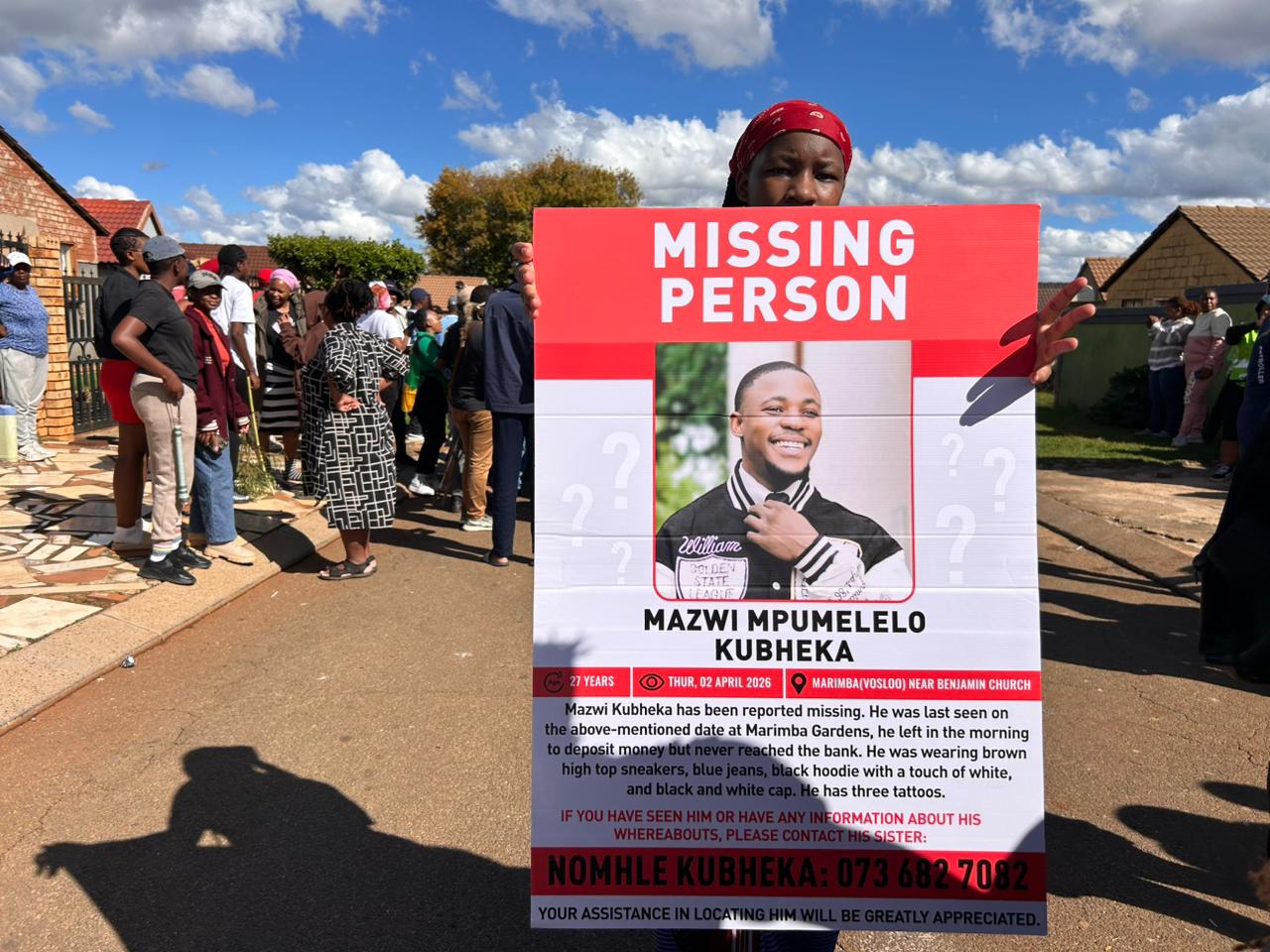
The air in Vosloorus has been thick with a palpable tension for weeks, a heavy silence that only those who live in the shadow of the "spaza shop mafias" truly understand. For thirty agonizing days, that silence was personified by the empty seat at the dinner table of the Kubheka family. Mazwi Mpumelelo Kubheka, a 27-year-old local entrepreneur with a reputation for hard work and a quiet demeanour, had vanished into the ether on the morning of April 2, 2026. He had left his home early, carrying rent money for his tuck shop business, a simple errand that should have taken an hour. Instead, it became the catalyst for a month-long saga of terror, community uprising, and a stark reminder of the lawlessness currently gripping Gauteng.
On Saturday evening, May 2, 2026, that silence was finally broken. In a scene that felt more like a scripted thriller than reality, a disoriented and physically fragile Mazwi Kubheka walked into the Vosloorus police station. His reappearance was as dramatic as his disappearance, marking the end of a month of fear, unanswered questions, and mounting public pressure that had threatened to boil over into full-scale communal violence.
"The individual presented himself at Vosloorus police station on the evening of 02 May 2026. His identity has been verified and will be reunited with his family after receiving medical assessment," confirmed police spokesperson Colonel Dimakatso Nevhuhulwi. While the police spoke in the measured, clinical tones of bureaucracy, the reality for Mazwi was far more harrowing. For the better part of a month, he had been kept in a hijacked building, blindfolded and isolated, a pawn in a dangerous game for control over the township's informal economy.
The kidnapping of Mazwi Kubheka was never just a missing person's case. It was a flashpoint for a community already on edge. In the weeks following his abduction, Vosloorus became a theatre of protest. Residents, political leaders, and civic groups took to the streets, their anger directed not just at the kidnappers, but at a perceived "spaza shop mafia" that many believe is systematically targeting local South African business owners. Some protesters issued chilling warnings: if Mazwi was not found, foreign-owned spaza shops would be forced to close.
The investigation has since revealed a complex web of suspects that bridges the gap between local criminality and international syndicates. Gauteng Premier Panyaza Lesufi, speaking at a media briefing at the Vosloorus police station on Sunday, provided a sobering update on the nature of the perpetrators.
"We can confirm that a South African and foreign nationals are involved, including individuals of Ethiopian origin," Lesufi told reporters. He further detailed that the alleged mastermind, a man known to Mazwi, is a South African national. During his month of captivity, Mazwi was reportedly guarded by two Malawian nationals in a hijacked building. The involvement of various nationalities has added a layer of complexity to a case that is already fraught with xenophobic undertones and economic desperation.
"Whether it is related to spaza shop activity or simply criminality remains a grey area under police investigation," Lesufi added, cautious not to ignite further tensions while acknowledging the community's suspicions.
The details of Mazwi's release remain a subject of some contention, highlighting the "sketchy" nature of the circumstances the police are currently untangling. According to a statement from the Kubheka family, Mazwi was released by his captors on May 2 in an open veld in Ekurhuleni. He was assisted by a taxi driver and later approached a police roadblock, where officers helped him after he identified himself. However, a discrepancy emerged during the Sunday briefing. While police suggested Mazwi had been dropped off at Carnival City, his sister, Nonhle Kubheka, offered a slightly different version, stating he had been dropped elsewhere and had to hitch-hike to reach safety.
Nonhle's voice was one of both relief and righteous indignation as she addressed the media. She took particular aim at social media commentary that she felt trivialised her brother's trauma. "Some people were saying Mazwi just rocked up at the police station. It is wrong to say he rocked up. It's like saying my brother was just somewhere out there enjoying himself," she lamented, her words reflecting the deep emotional scars the family now carries. "While he is safe, Mazwi is currently in a fragile condition and is receiving medical care and emotional support".
The Kubheka case is not an isolated incident but rather a symptom of a much larger, more violent trend. Gauteng is currently in the grip of what law enforcement and politicians alike are calling a "scourge of kidnappings". Provincial Police Commissioner Lieutenant-General Tommy Mthombeni revealed that the police head office in Gauteng has been forced to set up a specialised unit focused solely on these cases.
To illustrate the scale of the problem, Mthombeni pointed to another recent success. "We have just cracked a case of kidnapping involving a Chinese girl. We have managed to recover the car that was used in the kidnapping as well as an AK 47 rifle," he said. The mention of high-calibre weaponry like an AK-47 underscores the level of sophistication and lethality these syndicates possess. In March 2026, a similar operation in Moffat View saw the rescue of a 28-year-old victim and the recovery of another AK-47, further cementing the link between these kidnappings and organised, heavily armed criminal groups.
The "spaza shop mafia" phenomenon is particularly insidious. In townships across South Africa, local shop owners report being pressured to sell their businesses or pay "protection fees" to syndicates. Those who refuse often face intimidation, violence, or, as in Mazwi's case, abduction. Deli Mofokeng, another of Mazwi's sisters, had previously recounted how Mazwi had been under immense pressure to sell his business and had been subjected to intimidation linked to a dispute over his tuck shop. Reports of suspicious vehicles idling near his shop in the days leading up to April 2 had been ignored, a failure that the family believes led directly to his disappearance.
ActionSA president Herman Mashaba, who has been vocal about the case, handed a memorandum to the Police Ministry during the search, warning that the slow pace of the investigation was eroding public trust. At the Sunday briefing, ActionSA's Ekurhuleni mayoral candidate, Xiolani Khumalo, a man known for his own history as a crime buster, was blunt in his assessment.
"The community needs to be applauded. It was the noise that the people made that applied the necessary pressure that brought about this outcome. We cannot sit back while people are making money through crime," Khumalo said. His sentiment was echoed by many in Vosloorus who believe that without the protests and the political spotlight, Mazwi might never have come home.
The economic impact of this criminal activity is devastating. The informal economy, once a lifeline for township residents, is being hollowed out by extortion. Between April 2019 and March 2024, over 6,000 extortion cases were reported in South Africa, a figure that many experts believe represents only the tip of the iceberg, as many victims are too terrified to come forward. The "protection fee" model has spread from construction sites to schools, and now, it seems, to the humble corner spaza shop.
For the Kubheka family, the nightmare is far from over. While Mazwi is physically back, the psychological toll of being blindfolded and held captive for thirty days is immense. The family has expressed their profound gratitude to the community and even to "people with spiritual gifts" who offered divine assistance, but they remain wary. The suspects, though "known" to the police, remain at large.
"I want to state it categorically clear that this case is not closed. We believe that this case will assist us in resolving many other similar cases," Premier Lesufi asserted. "We might have not arrested the said individuals yet, but the individuals are now known".
This promise of future arrests provides little immediate comfort to a community that feels abandoned by the state and preyed upon by syndicates. The Vosloorus protests were a warning shot—a sign that the patience of the people is wearing thin. The "grey area" Lesufi mentioned—the overlap between simple criminality and organised spaza shop syndicates—is where the battle for the soul of the township economy is being fought.
The police have used the resolution of the Kubheka case to remind the public of the importance of reporting missing persons immediately. "There is no waiting period to report a missing person. Immediately you suspect your family member or relative is missing notify the police on 08600 10111 or at the nearest police station," Colonel Nevhuhulwi advised. It is a necessary reminder, but one that rings somewhat hollow for families who feel that even when they do report, the wheels of justice turn far too slowly.
As Mazwi Kubheka begins his long road to recovery, the questions he leaves behind are more urgent than ever. Who are the masterminds behind these "hijacked buildings" used as dungeons? How have AK-47s become a standard tool for township extortion? And most importantly, can the South African state protect its smallest entrepreneurs from a "silent war" that threatens to consume them?
The story of Mazwi Kubheka is a story of survival, but it is also a cautionary tale. It is a story of a young man who wanted nothing more than to run a successful business in his own community, only to find himself a prisoner of a system that rewards the ruthless and punishes the industrious. The silence in Vosloorus may have been broken by his return, but the underlying tensions remain, simmering just beneath the surface, waiting for the next spark.
The authorities may claim the case is "not closed," but for the people of Gauteng, the real investigation into the systemic failure of township security has only just begun. The "spaza shop mafias" are still there, the hijacked buildings are still standing, and the fear that took Mazwi Kubheka for thirty days still lingers in every alleyway and on every street corner of Vosloorus.
The Kubheka family's gratitude is "overwhelming," but their vigilance is even greater. They have taken Mazwi to a place of safety, away from the shop that nearly cost him his life. In the end, the victory of his return is a hollow one if the conditions that allowed his kidnapping remain unchanged. As the sun sets over Vosloorus, the community watches and waits, knowing that while one son has returned, the war for their streets is far from won.
Key Figures and Statements
|
Name
|
Role
|
Key Statement/Action
|
|
Mazwi Mpumelelo Kubheka
|
Victim / Spaza Owner
|
Walked into Vosloorus police station after 30 days in captivity .
|
|
Panyaza Lesufi
|
Gauteng Premier
|
Confirmed suspects include South Africans and foreign nationals .
|
|
Tommy Mthombeni
|
Police Commissioner
|
Revealed Mazwi was kept in a hijacked building guarded by Malawians .
|
|
Nonhle Kubheka
|
Victim's Sister
|
Corrected the narrative of his release and criticised social media trivialisation .
|
|
Deli Mofokeng
|
Victim's Sister
|
Highlighted the pressure Mazwi faced to sell his business .
|
|
Herman Mashaba
|
ActionSA President
|
Applied political pressure on the Police Ministry to expedite the case .
|
|
Dimakatso Nevhuhulwi
|
Police Spokesperson
|
Confirmed Mazwi's identity and ongoing medical assessment .
|
|
Xiolani Khumalo
|
ActionSA Candidate
|
Applauded community pressure for forcing a resolution .
|
Timeline of the Ordeal
- April 2, 2026: Mazwi Kubheka disappears while on his way to deposit rent money.
- Mid-April 2026: Family expresses growing desperation; reports of intimidation surface.
- Late April 2026: Protests erupt in Vosloorus; community threatens foreign-owned shops.
- May 2, 2026: Mazwi is released in an open veld and walks into Vosloorus police station.
- May 3, 2026: Premier Lesufi and Commissioner Mthombeni brief the media on the investigation.
The investigation continues as authorities hunt for the mastermind and his accomplices, while the broader issue of township extortion remains a critical challenge for Gauteng's law enforcement.