The Macabre Quest for Proof: When Bureaucracy Demands the Undeniable
In a world increasingly governed by paperwork and digital records, the human element often finds itself at odds with the cold, unyielding demands of bureaucracy. This clash can lead to truly extraordinary, and at times macabre, situations, as recently exemplified by a distressing incident in India. A man, driven to desperation by the relentless demands of a banking system, resorted to an act that has since captured global attention: he presented his deceased sister's skeletal remains at a bank to prove her death and access her modest savings.
This shocking event, which unfolded in the Keonjhar district of Odisha, India, is not an isolated anomaly. It serves as a stark reminder of the profound challenges individuals face when navigating complex administrative procedures, particularly in vulnerable communities. Across the globe, similar tales of individuals taking extreme measures to satisfy official requirements for proof of death or identity underscore a systemic issue that often overlooks human dignity and the realities of grief and poverty.
The Indian Ordeal: A Brother's Desperate Act
The central figure in this harrowing narrative is Jitu Munda, a 52-year-old man whose struggle to retrieve his late sister Kalara's savings culminated in an act of profound frustration. Kalara, aged 56, had been a daily wage labourer. After the tragic deaths of her husband and son, she returned to her maternal home, seeking solace and stability. A few months before her own passing earlier this year, she had sold her livestock and deposited approximately 19,300 rupees (around R3,383 or $203) into an account at the Odisha Grameen Bank. This sum, though seemingly small, represented a significant portion of her life's work and was crucial for her family.
Following Kalara's death, Jitu Munda embarked on what would become a protracted and ultimately futile quest to access her funds. He visited the bank branch multiple times, each visit met with requests for official proof of death – documents that were either difficult to obtain or deemed insufficient by the bank's stringent protocols. The bureaucratic labyrinth, designed to prevent fraud, instead became an impenetrable barrier for a grieving brother seeking his sister's rightful inheritance.
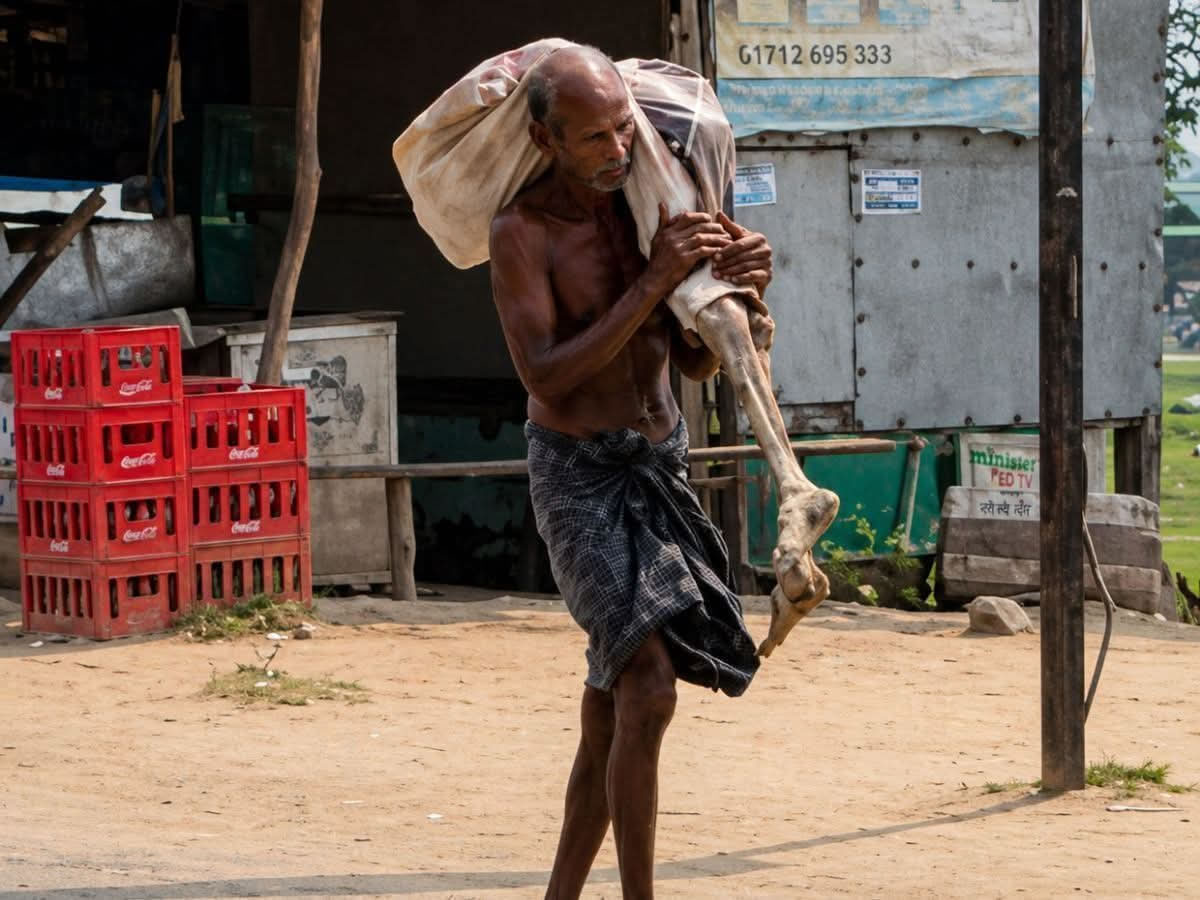
His patience, and perhaps his understanding of the formal procedures, eventually wore thin. In a moment of sheer desperation, Munda made a decision that would reverberate across national and international headlines. He exhumed his sister's skeletal remains from her burial ground, wrapped them in a sack, and carried them three kilometres to the bank. The scene, captured in a video that quickly went viral, showed him placing the bundle of bones outside the building's entrance, a grim testament to his frustration.
Speaking to BBC Hindi, Munda articulated his despair: "When the bank manager refused to listen and kept asking for proof, I got frustrated. I brought the skeleton to show that she had died."
This raw statement encapsulates the agony of an individual pushed to the brink by a system that seemed incapable of empathy or flexibility. The viral video ignited widespread outrage, prompting criticism of both local authorities and the bank for their perceived failure to assist Munda. Many observers highlighted the inherent bureaucratic hurdles in India for accessing funds after a person's death, especially when no nominee has been registered. The broader difficulties faced by rural families in navigating the formal banking system, often compounded by illiteracy and lack of access to official documentation, were also brought into sharp focus.

In India, the process for claiming funds when an account holder dies without naming a nominee is notoriously complex. Families are typically required to provide a death certificate and proof of legal heirship. This can be an arduous and time-consuming process, particularly in remote villages where access to government offices and legal services is limited. The absence of a nominee, a common oversight in less financially literate communities, transforms a straightforward transaction into a bureaucratic nightmare.
Following the public outcry, Indian Overseas Bank, which operates the Odisha Grameen Bank, issued a statement. They denied reports that staff had explicitly asked for the physical presence of the deceased, labelling such claims as "incorrect." The bank asserted that Munda had been informed of the correct procedures but had failed to follow them. They further alleged that Munda had initially arrived at the bank in an "inebriated state" and became disruptive, returning later with the remains – a situation they described as "distressing."
Branch manager Sushant Kumar Sethi offered a different perspective to BBC Hindi, stating that Munda had initially claimed his sister was paralysed and unable to visit the bank, prompting staff to offer a home visit. Sethi also disputed Munda's account of his frequent visits, claiming he had not been to the branch in the preceding two months. He added that other legal heirs had come forward, necessitating the request for proper documentation.
Ultimately, police and local officials intervened. They persuaded Munda to return the remains to the burial ground and assured him that his request would be addressed. As a gesture of assistance, officials also offered him 30,000 rupees. By the following Wednesday, a death certificate and legal heir documents were issued, and the bank confirmed that Kalara's money had been released to her family members. While the immediate crisis was resolved, the incident left an indelible mark, exposing the fault lines in the system.
Global Echoes: Other Desperate Measures
The Indian incident, while uniquely disturbing, is not without precedent in its demonstration of the lengths to which people will go when confronted by bureaucratic intransigence. Similar stories from around the world highlight a recurring theme: the desperation born of poverty and administrative hurdles can lead individuals to undertake actions that defy belief.
The Brazilian Bank Loan Attempt
Just months before the Indian incident, in April 2024, Brazil witnessed a bizarre event that quickly garnered international headlines. Erika de Souza Vieira Nunes, a 42-year-old woman, was detained by police in Rio de Janeiro after she wheeled a deceased man, whom she claimed was her 68-year-old uncle, Paulo Roberto Braga, into an Itau Bank branch. Her objective was to secure his signature for a loan equivalent to 17,000 reais (approximately R50,000 or $3,000) that had already been approved but required his formal consent.
Footage from the bank, which went viral on social media, showed Nunes attempting to prop up the elderly man's head and guide his hand to clasp a pen. The man, however, remained unresponsive, his arm limp, his head repeatedly falling back. Nunes's dialogue with her deceased uncle, captured on video, was chilling: "Uncle, are you listening? You need to sign. If you don’t sign, there’s no way. I can’t sign for you, it has to be you. What I can do, I do."
She continued, her voice tinged with frustration: "Sign it so you don’t give me any more headaches, having to go to the registry office. I can’t take it anymore."
Bank attendants, noticing the man's alarming condition, grew suspicious. One remarked, "I think he isn’t feeling well," a sentiment echoed by another. An ambulance was called, and paramedics quickly determined that Paulo Roberto Braga had been dead for several hours, meaning he was deceased upon arrival at the bank. Nunes was subsequently arrested and charged with violating a corpse and attempted theft through fraud. The incident sparked a nationwide discussion in Brazil about elder abuse and the desperation that can drive such acts.
The Irish Post Office Pension Claim
Another striking example occurred in January 2022 in Carlow, Ireland. Two men in their 30s attempted to claim a pension payment for a deceased relative, 66-year-old Peadar Doyle, by propping up his body and carrying him into Hosey’s post office. The "outlandish series of events," as described by The Guardian, began when one man initially tried to collect the pension alone but was informed that the pensioner needed to be present.
He returned shortly after with another man, supporting Doyle between them. A witness, whose daughter saw the trio approach, noted that Doyle "looked unwell as his feet were dragging on the ground." Inside the post office, staff enquired about Doyle's wellbeing. The two men reportedly claimed he was "having a heart attack" before abandoning his body and fleeing the scene. Doyle was later declared dead at the scene by ambulance personnel.
Authorities launched an investigation focusing on alleged attempted fraud and failure to report a death. A post-mortem examination ruled out foul play, but evidence suggested Doyle had been alive earlier that day. The Mayor of Carlow, Ken Murnane, expressed his disbelief, stating, "It’s like a Hitchcock movie." This incident, like the others, highlighted the extreme lengths to which individuals might go to access financial entitlements, often driven by dire circumstances and a profound misunderstanding or disregard for legal processes.
The Unseen Costs of Bureaucracy
These incidents, spanning continents and cultures, paint a grim picture of the human cost of rigid bureaucratic systems. While designed to ensure accountability and prevent fraud, these systems often become impenetrable fortresses for those who lack the resources, education, or support to navigate them effectively. The common threads running through these cases are undeniable:
- Desperation and Poverty: In each instance, the individuals involved were attempting to access relatively modest sums of money – savings, a loan, a pension – that likely represented vital financial lifelines. Poverty and the urgent need for funds can push people to desperate and ill-conceived actions.
- Bureaucratic Inflexibility: Financial institutions and government agencies often operate with strict protocols that leave little room for discretion or empathy. The demand for specific documents, without consideration for the practical difficulties of obtaining them in certain contexts, creates insurmountable barriers.
- Lack of Awareness: Particularly in rural or less educated communities, there can be a significant gap in understanding formal legal and financial procedures, such as the importance of registering a nominee for bank accounts or the correct process for reporting a death and claiming entitlements.
- Erosion of Dignity: The acts themselves – exhuming a body, propping up a corpse – represent a profound erosion of human dignity, both for the deceased and for the living relatives forced into such extreme measures. The systems that inadvertently compel such actions bear a moral responsibility to examine their impact.
These events serve as a powerful indictment of systems that, in their pursuit of order and security, inadvertently create conditions for chaos and despair. They underscore the urgent need for financial institutions and government bodies to review and humanise their processes, particularly for vulnerable populations. Simplifying procedures, providing accessible information, and offering compassionate assistance could prevent future tragedies and ensure that no one is forced to desecrate the memory of a loved one in a macabre quest for proof.
The stories of Jitu Munda, Erika de Souza Vieira Nunes, and the men in Carlow are more than just sensational headlines. They are poignant narratives of human struggle against impersonal systems, a stark reminder that behind every policy and procedure lies a human being with real needs and emotions. It is a call to action for greater empathy and accessibility in the mechanisms that govern our lives, ensuring that dignity is preserved, even in death.