

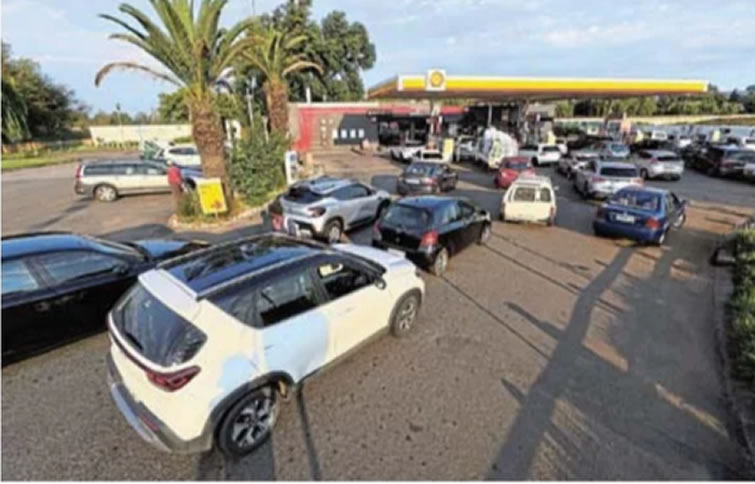
The government has moved to blunt the sharp rise in petrol and diesel this month by temporarily cutting the general fuel levy, but the measure comes with a bitter trade‑off: paraffin prices will double, a heavy blow for millions of poor South Africans who rely on it for cooking, heating and lighting.
After intense lobbying from unions, business groups and opposition parties, National Treasury and the mineral and petroleum resources department announced a R3/l reduction in the general fuel levy from today until 5 May. The temporary relief is estimated to cost the fiscus about R6 billion in foregone tax revenue for the period. “The relief measure is designed to be fiscally neutral and the government will implement mechanisms to recoup the forgone revenue within the fiscal framework approved during the 2026 budget,” the two departments said in a joint statement.
Finance minister Enoch Godongwana told Parliament last week that cabinet had set up a committee to consider temporary relief mechanisms and that he and Gwede Mantashe, the minister of mineral and petroleum resources, would brief cabinet on the committee’s recommendations. In his February budget speech the finance minister had already signalled a modest increase in fuel levies in line with inflation — but the global shock to oil markets from the Middle East conflict pushed projected retail fuel jumps well beyond what households could absorb.
Before the relief, estimates from the Central Energy Fund suggested the retail price of 95‑grade petrol would have surged by R5.81/l and the wholesale price of diesel by R10.27/l. With the R3/l levy reduction, the petrol increase is now capped at R3.06/l and diesel’s wholesale rise is down to R7.51/l — still painful but less severe than forecast.
But paraffin has not benefited from the levy cut. In fact, its price has shot up by R11.67/l under the new calculations, taking the Gauteng price to R24.21/l. That means paraffin now costs more than 95‑grade petrol in Gauteng, where petrol sits at R23.36/l. The same pattern has been recorded in coastal regions as well.
Government officials emphasised that only the general fuel levy was reduced and that other levies built into pump prices remain intact. The Road Accident Fund (RAF) levy will stay at R2.25/l, and the carbon fuel levy remains at roughly 14c/l for petrol and 17c/l for diesel. These levies continue to support broader public policy aims such as compensation for crash victims and measures to discourage high carbon emissions.
The policy choice exposed a stark distributional tension. The general fuel levy supports national priorities — from health and education to policing — and Treasury said the decision balanced “the socio‑economic impact on the country and welfare impact on South African consumers, specifically regarding food and transport inflation, with the fiscal objectives announced in the February budget.”
But trade unions and civil society warned the relief was uneven. Trade union Uasa welcomed the temporary fuel‑levy cut but warned that many households would be left worse off by the hike in paraffin. “Uasa reminds the government that many households, particularly those with low incomes, depend on paraffin for cooking, heating and other needs. These households also require relief measures to address the rising cost of living,” spokesperson Abigail Moyo said.
The Congress of South African Trade Unions (Cosatu) described the new prices as unaffordable for workers and the economy. “Diesel is critical for the public transport that workers depend on, as is paraffin for millions of working‑class families,” the federation said, adding that many workers already support extended households and spend a large share of wages on transport.
The decision recalls the 2022 response to global energy shock after Russia’s invasion of Ukraine, when Treasury extended temporary relief on fuel levies for several months and forewent roughly R4.5bn in revenue. This time, Treasury says the R6bn cost will be managed without breaching the fiscal framework set out in the 2026 budget, and that mechanisms will be put in place to recoup the revenue later.
For ordinary South Africans the arithmetic is clear and painful. Capping steep petrol and diesel spikes helps limit transport and food inflation in the short term, cushioning drivers, commuters and businesses. Yet the doubling of paraffin — long kept deliberately cheaper to shield the poorest households — threatens to push many into energy insecurity. Rural households and low‑income urban families who rely on paraffin for basic energy needs face higher living costs at a time when wage pressures and debt burdens remain significant.
Economists and policy analysts will be watching how Treasury intends to make the relief “fiscally neutral”. The details of the recoupment plan — the timing, the instruments and whether the burden will fall on future budgets or through compensatory measures elsewhere — have not been set out publicly. That uncertainty has worried critics who argue temporary relief must not translate into longer‑term cuts to essential services or increased fiscal strain that could feed back into inflation.
The timing of the intervention — a short window to 5 May — also raises political and practical questions. Lobby groups such as the DA, Cosatu, Business Leadership South Africa and the Fuel Industry Association had pressured Treasury to act after international supply disruptions made steep monthly rises likely. The government’s move shows responsiveness, but the uneven impact makes it a fraught compromise.
For households that burn paraffin to cook their food, heat rooms and light homes, the price jump will be immediate and real. For commuters and businesses, the smaller petrol and diesel increases are welcome relief, but the short‑term nature of the policy means the market will be watching for fresh shocks once the measure expires.
As the fiscal and social implications unfold, South Africans will be looking for clarity on how the government plans to recoup the R6bn and whether further support for vulnerable households — particularly those who use paraffin — will follow. The choice to soften one pain while deepening another will shape public debate in the weeks ahead, as unions, opposition parties and communities press for more sustainable ways to shield the poor from volatile global energy markets.