

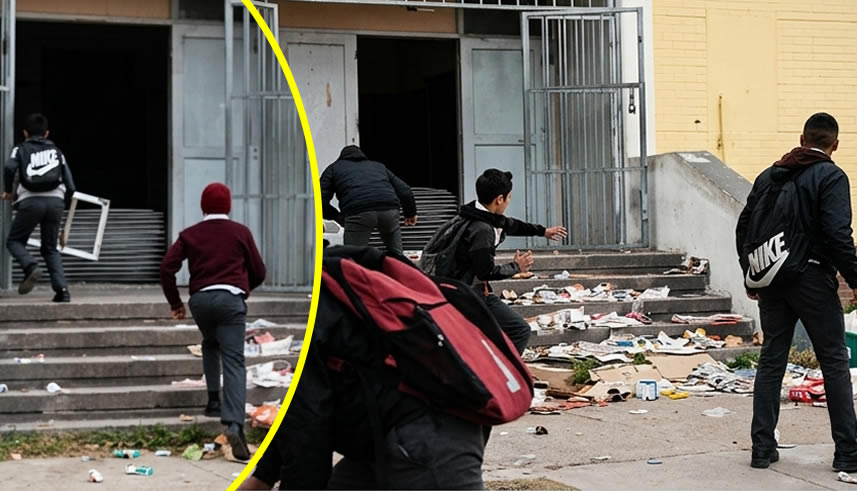
KENSINGTON, CAPE TOWN – The morning bell at Windermere High School usually signals the start of another day of learning in the heart of Kensington. But this past Wednesday, the rhythm of the school day was shattered not by a bell, but by the frantic shouts of learners and the dull thud of stones hitting pavement. By the time the dust settled, three pupils had been rushed to hospital with stab wounds, leaving a community searching for answers in the wake of a clash that turned a place of education into a pitch battleground.
Disturbing video footage, which has since circulated widely on social media, paints a harrowing picture of the chaos that erupted on the school grounds. In a series of three separate clips, the escalating unrest is captured in raw, unfiltered detail. The first video shows groups of learners, described by locals as "laaities," engaged in a violent confrontation. They are seen pelting rocks and "klippe" at one another with such ferocity that parts of the school's front section were reportedly damaged. Pupils can be seen scattering and regrouping as objects are hurled across the premises, the air thick with tension and the sound of breaking glass.
The second clip offers an even more surreal sight: school bags being flung out of upper-storey classroom windows. Below, the sterile white and red of an ambulance stands as a grim sentinel, its presence confirming that the "gaaning aan" in the background had already crossed the line from schoolyard scuffle to a medical emergency. By the time the third video begins, police officers have arrived on the scene, their uniforms a stark contrast to the school blazers as they attempt to restore some semblance of order amidst the shouting and continued unrest.
The Western Cape Education Department (WCED) was quick to confirm the severity of the incident. Millicent Merton, a spokesperson for the WCED, provided a direct account of the morning's violence.
"Three learners sustained stab wounds during a fight between two groups of learners on the school premises this morning. Medical services were provided to the injured learners," Merton confirmed. "The incident was reported to Safe Schools, and the school received support from Law Enforcement."
While the physical wounds of the three stabbed learners are being treated in hospital, the psychological scars on the student body and the broader Kensington community run much deeper. This incident at Windermere High is not an isolated flare-up; it is a symptom of a growing crisis of violence that is gripping schools across the Western Cape. Just weeks earlier, on 12 February 2026, a similar scene played out at Eerste River Secondary School, where an assembly turned violent and two learners were stabbed.
The parallels are haunting. In both cases, the school's Code of Conduct and the presence of the "Safe Schools" programme were highlighted as the primary lines of defence. Yet, as the blood on the floor of Windermere High proves, these measures are increasingly struggling to contain the tide of aggression flowing from the streets into the classrooms.
Kensington itself has long been a flashpoint for gang activity and social unrest. In late 2025, residents reported that daily life was filled with fear as gang violence gripped the area. The Anti-Gang Unit (AGU) has been a frequent presence in the neighbourhood, yet the lure of gangs remains a potent force for young boys in the community. Investigative findings suggest that the clash at Windermere High may be linked to these broader community tensions, with some sources hinting at underlying issues that have been simmering for months.
The statistics tell a grim story. According to the third-quarter crime statistics released in February 2026, while there has been a slight decrease in the overall murder rate in the Western Cape, the prevalence of violence on school grounds remains a critical concern. In December 2025, it was revealed that nearly 200 rapes had occurred on school premises nationwide, highlighting a crisis of gender-based violence and a general breakdown of the "sanctuary" status schools are supposed to hold.
For the parents of Windermere High, the "Safe Schools" programme—a cornerstone of the WCED's safety strategy—is under intense scrutiny. Despite a provincial budget that allocates a record R35.1 billion to education for the 2026/27 financial year—the single largest area of provincial spending—the reality on the ground feels vastly different. While the budget includes R799 million for 701 new educator posts and R330 million for school maintenance, the allocation for the "Safe Schools" initiative remains under intense scrutiny. Parents have expressed growing concern that the programme is reactive rather than proactive, often arriving only after the "klippe" have already been thrown. The Western Cape government has allocated R8.595 billion for safety over the next three years, but for schools like Windermere, the immediate need is for a visible deterrent to the violence that spills over from the streets.
One parent, who wished to remain unnamed for fear of reprisal, described the atmosphere at the school gates on Wednesday afternoon. "You send your child to school to get an education, to better themselves. You don't expect to get a phone call saying they've been stabbed or that they're hiding under a desk because of a gang fight in the quad. It's not right. The teachers are trying, but they aren't police officers. They can't stop a boy with a knife."
The WCED has maintained that the school will follow its internal disciplinary procedures. "The school would be following its Code of Conduct to address the matter," Merton added, echoing a sentiment often heard in the aftermath of such incidents. However, for many, a "Code of Conduct" feels like a paper shield against a blade.
The incident has also raised questions about the role of social media in modern school violence. The speed with which the videos of the Windermere clash spread—often accompanied by inflammatory comments—can serve to escalate tensions further. These digital "war rooms" allow groups to coordinate and taunt one another, turning a local disagreement into a public spectacle that demands a violent response to "save face."
As Kensington police continue to monitor the situation at Windermere High, the focus shifts to the long-term recovery of the school. Tests have reportedly been rescheduled, and counselling services are being offered to those who witnessed the "wild boys" in action. But the question remains: how do we reclaim our schools from the cycle of violence?
The challenge, however, is not just one of funding. It is a challenge of community, of addressing the poverty and unemployment that drive young men toward gangs, and of ensuring that when a child enters a school gate, they are entering a space where the only thing they need to worry about is their next exam. As Premier Alan Winde noted in his 2026 State of the Province Address, the provincial government continues to demand proper policing resources from the national government, even as the SAPS budget exceeds R120 billion. Yet, for the learners at Windermere, these high-level debates offer little protection against a sharpened blade in the school quad.
For now, the front section of Windermere High stands as a silent witness to the clash, the damaged masonry a physical reminder of a morning when the lessons were not found in textbooks, but in the harsh reality of a blade. The three learners in hospital are expected to recover, but for the rest of the school, the healing process has only just begun. The "disturbing videos" will eventually fade from the social media feeds, but the memory of the rocks, the bags flying from windows, and the sound of sirens will linger in the corridors of Windermere High for a long time to come.
In the words of the WCED, the incident was a "clash between two groups." To the people of Kensington, it was a warning—a sign that the walls of the school are no longer high enough to keep the violence of the world outside at bay. As we look toward the 2026 academic year, the events of this Wednesday serve as a stark reminder that safety is not a line in a budget or a paragraph in a code of conduct; it is a fragile peace that requires constant, vigilant protection.
The "Safe Schools" programme and Law Enforcement will continue their patrols, and the "laaities" will return to their desks. But until the root causes of this unrest are addressed, the threat of another "pitch battle" remains. For the sake of the 1.2 million learners in the Western Cape, we must ensure that the next time the bell rings at Windermere High, it is for a lesson in hope, not a cry for help.