

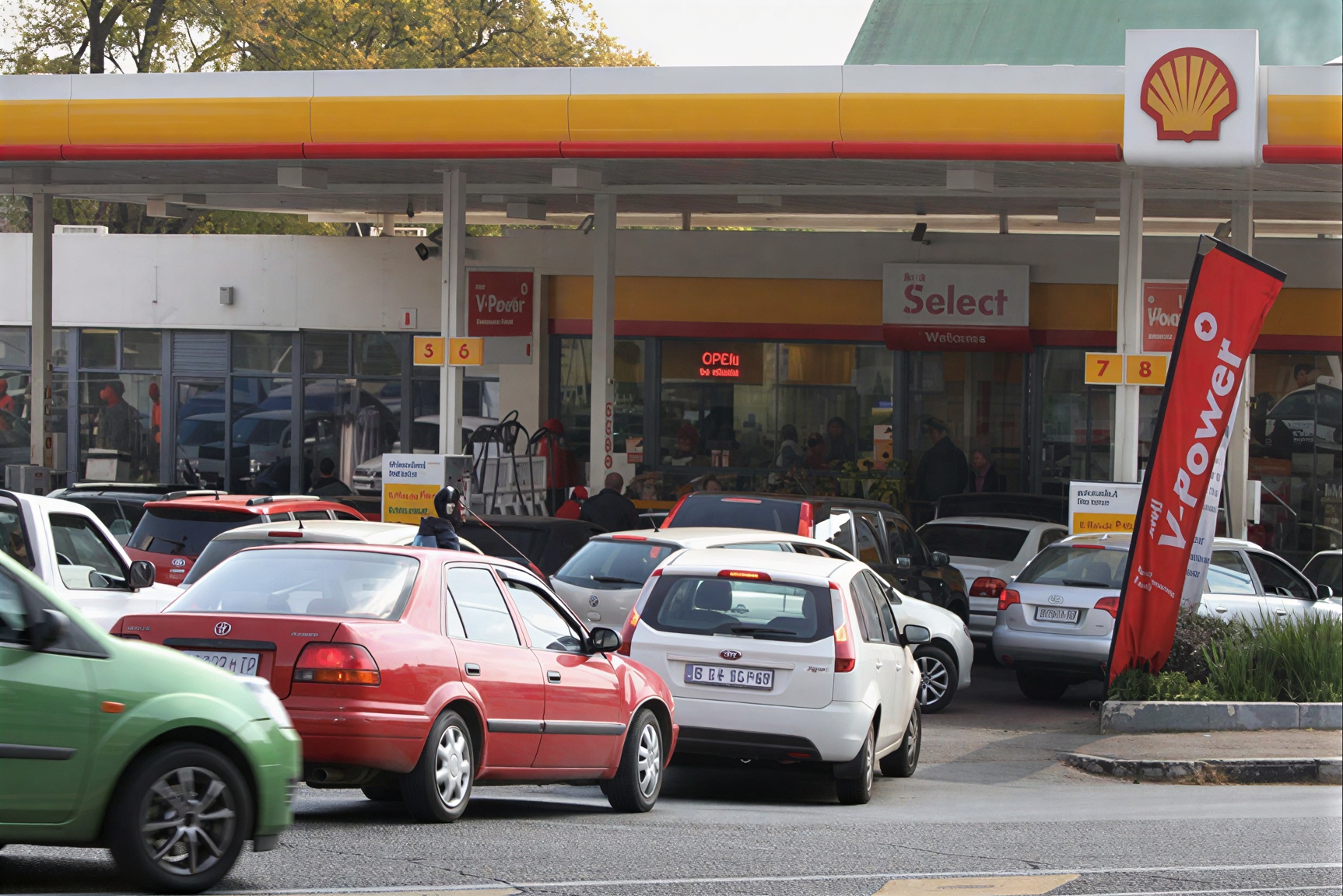
JOHANNESBURG – South Africans are facing a period of severe economic uncertainty as energy experts warn of a "helse" petrol price hike and the potential for fuel rationing if the conflict between US-Israeli forces and Iran continues to intensify. With the country's fuel security already at its most fragile point in decades following the closure of major domestic refineries, any further disruption to global supply chains could leave motorists facing lengthy queues and empty pumps.
The warning comes as the latest analysis from the Central Energy Fund (CEF) reveals a staggering gap between current pump prices and the soaring cost of international fuel. If current market trends persist, South Africans could see a price increase of approximately R3.98 per litre for 95-octane petrol and R3.62 per litre for 93-octane.
The outlook for diesel is even more grim, with projected hikes ranging between R6.63 and R6.75 per litre. Households relying on illuminating paraffin—a staple for many of the country's poorest citizens—could face a devastating under-recovery of about R8.53 a litre.
A Fragile Energy Backbone
The looming crisis has cast a harsh spotlight on South Africa's diminished refining capacity. In recent years, the nation's energy landscape has been transformed by the shuttering of several key facilities. The 180,000 barrel-per-day (bpd) SAPREF refinery in Durban, once the country's largest, has been dormant since March 2022 after its owners, BP and Shell, ceased operations. Although the state-owned Central Energy Fund announced a deal to purchase SAPREF in 2024, the facility has yet to return to full production.
Similarly, the Engen refinery (ENREF) in South Durban has been converted into a storage terminal, while the PetroSA gas-to-liquids refinery in Mossel Bay has remained largely inactive for nearly two years.
Today, South Africa relies on just two operational crude oil refineries: NATREF in Sasolburg and the Astron Energy plant in Cape Town. These are supplemented by the Sasol Secunda coal-to-liquids plant.
Professor Vally Padayachee, a renowned energy and power expert, warned that this reliance on a handful of facilities leaves the country dangerously susceptible to supply chain shocks.
"South Africa's reliance on only two operational crude oil refineries, combined with the Sasol Secunda plant, still leaves us susceptible to the risk of disruptions in the supply chain, especially given our dependence on imported crude oil," Padayachee told IOL.
He cautioned that any escalation in the Gulf of Arabia could have immediate and dire consequences for local availability. "It would be prudent for South Africans to remain vigilant, as any sudden geopolitical escalation could lead to potentially fuel rationing and lengthy queues at petrol stations," he added.
The Shadow of the Strait of Hormuz
At the heart of the global price volatility is the Strait of Hormuz, a narrow maritime passage through which nearly a fifth of the world's oil supply passes daily. As the US-Israeli conflict with Iran deepens, the threat of a blockade or significant disruption in these waters has sent tremors through international markets.
Since the onset of major hostilities on February 28, 2026, global oil prices have surged by an estimated 20% to 25%. Some analysts have warned that if shipping routes are restricted, crude oil could climb toward a "psychologically devastating" threshold of $200 per barrel.
James Lorimer, the Democratic Alliance (DA) spokesperson on Mineral and Petroleum Resources, offered a slightly more tempered view on the immediate threat of a physical shortage, noting that South Africa's crude sources are somewhat diversified.
Lorimer stated that South Africa is "not too badly off" regarding its direct crude oil supply, pointing out that only 18% of the country's imports travel through the Strait of Hormuz. "Most of the country's crude oil comes from West African nations such as Nigeria, Angola, and Ghana," Lorimer explained.
However, even if the physical oil reaches South African shores, the country's inability to refine it domestically in large quantities means it remains at the mercy of the global market for refined petroleum products.
The Economic Ripple Effect
For South Africans, the "fuel shock" is more than just a figure on a petrol station sign; it is an economic event that threatens to erode the living standards of millions. Because fuel is the "bloodstream" of the economy, a R4-a-litre hike will inevitably filter through to every sector.
Dr Clyde N.S. Ramalaine, writing for IOL, noted that South Africa stands particularly exposed because of its structural dependence on imports and the volatility of the rand.
"In practical terms, South Africans pay the price twice: once through the global oil increase and again through currency depreciation," Ramalaine observed. "Fuel occupies a unique position within modern economies because it influences nearly every sector of economic activity. Transport systems depend on it. Agricultural production requires it. Manufacturing relies on it. Retail supply chains cannot function without it."
The most immediate secondary impact is expected in food prices. South Africa's food system relies heavily on long-distance road transport to move goods from rural farms to urban centres. When diesel prices climb by nearly R7 per litre, the cost of moving maize, bread, and fresh produce becomes unsustainable for many distributors.
"This is where the economic shock reveals its most troubling dimension: its unequal impact on society," Ramalaine argued. "While a national economic crisis affects all citizens in some measure, its consequences are rarely distributed equally. In South Africa's highly unequal society, the burden of rising fuel and food prices will fall disproportionately on the poor."
Government Reassurance Amidst Maintenance
In an attempt to manage public anxiety, the Department of Mineral and Petroleum Resources (DMPR) issued a statement on March 10, 2026, reassuring the public that there is "no immediate risk" of a fuel shortage.
The department confirmed that it remains in "continuous contact" with oil companies to ensure the stability of the supply. However, it acknowledged a significant operational hurdle: the Astron Energy refinery is currently undergoing a planned maintenance shutdown.
"The Astron Energy refinery is currently undergoing a planned maintenance shutdown," the DMPR stated. "However, as part of standard operational planning, the company has secured sufficient fuel imports to cover supply requirements during this maintenance period."
Despite these assurances, the department admitted that higher prices at the pump are almost certain from April 2026. "The under-recovery on fuel prices has been fluctuating since the onset of the conflict, and the Department will continue to monitor the situation closely," the statement read.
A History of Vulnerability
The current crisis is not an isolated incident but the latest chapter in a long-running struggle for energy independence. Critics argue that the government's failure to modernise or expand the country's fuel storage and refining infrastructure has left the nation exposed.
In mid-2025, industry leaders warned that economic and regulatory constraints were putting the country's fuel supply at risk. The decision by major players like Shell and BP to exit the refining business in South Africa was seen by many as a vote of no confidence in the local regulatory environment.
Furthermore, environmental concerns continue to plague the legacy of the closed refineries. In the South Durban Basin, the communities surrounding the old SAPREF and ENREF sites are still dealing with the environmental and health damage left behind by decades of refining, even as the facilities stand silent.
The Road Ahead
As of mid-March 2026, the situation remains fluid. While some reports suggest that oil prices dipped slightly after US officials claimed certain phases of the conflict were "pretty much" complete, the underlying volatility remains.
For the ordinary South African commuter or taxi driver, the "petrol shock" is a looming reality that threatens to make the simple act of getting to work or putting food on the table a daily struggle. If Professor Padayachee's warnings of rationing come to pass, the country could see a return to the fuel-restricted days of the past—a scenario that would test the resilience of an already strained nation.
The Department of Mineral and Petroleum Resources has promised further updates ahead of the official April price adjustment. Until then, motorists are being advised to remain vigilant and prepare for a significant hit to their pockets.
As Dr Ramalaine concluded: "What might appear in economic reports as 'inflationary pressure' becomes, in lived reality, the erosion of household survival."
|
Fuel Type
|
Projected Increase
|
|
Petrol 95
|
~R3.98 per litre
|
|
Petrol 93
|
~R3.62 per litre
|
|
Diesel
|
~R6.63 – R6.75 per litre
|
|
Illuminating Paraffin
|
~R8.53 per litre
|
- NATREF (Sasolburg)
-
Astron Energy (Cape Town – Currently under maintenance)
-
Sasol Secunda (Coal-to-liquids)