

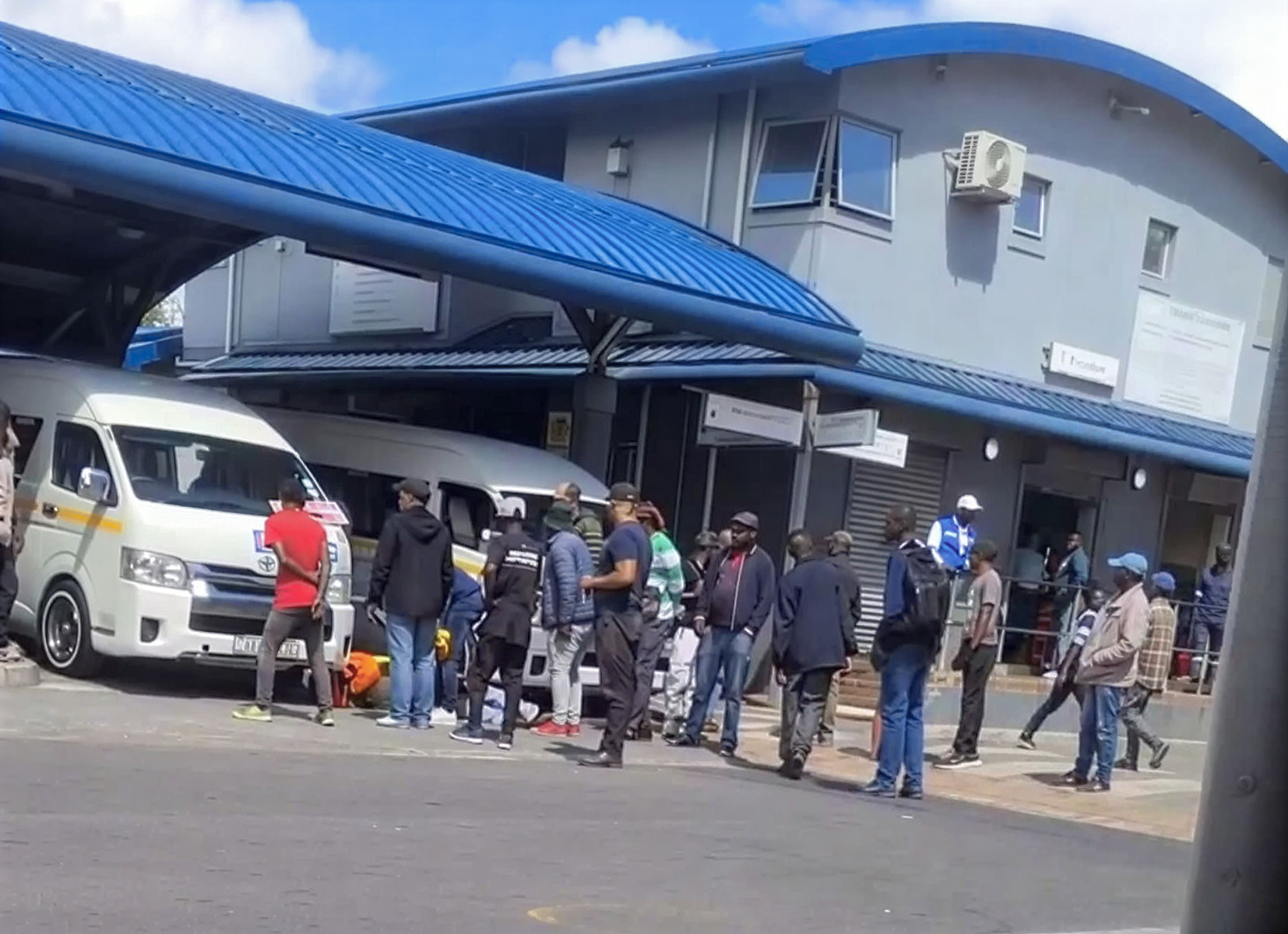
The Friday afternoon rush at the Killarney taxi rank is usually a cacophony of shouting marshals, the rhythmic sliding of van doors, and the persistent hum of engines. But at approximately 2.40pm on 13 February 2026, the familiar sounds of the daily commute were replaced by the sharp, unmistakable cracks of high-calibre gunfire. When the smoke cleared at the corner of Koeberg and Blaauwberg Roads in Table View, the reality of a brutal execution began to set in. One man lay dead on the asphalt, while three others clung to life, their blood pooling near the very vehicles that provided their livelihoods.
This was not a random act of urban crime. The victims were not commuters caught in a crossfire, nor were they low-level operators. All four men were taxi business owners, high-ranking members of the Cape Amalgamated Taxi Association (CATA). Their targeting represents a calculated escalation in what many fear is the return of the "Taxi Wars"—a cycle of violence that has haunted the Western Cape for decades.
The Killarney Execution
Sergeant Wesley Twigg, a spokesperson for the South African Police Service (SAPS), confirmed the grim details of the afternoon. Table View police have since registered a murder case and three counts of attempted murder. "Police members were called to the crime scene, where they found the victims with gunshot wounds to their bodies," Twigg reported. The deceased, a 39-year-old male whose name has been withheld pending further family notifications, was declared dead at the scene by emergency medical personnel. The three other victims, aged between 30 and 43, were rushed to a nearby medical facility.
The efficiency of the attack suggests a professional hit. Witnesses described unknown gunmen who opened fire with precision before vanishing into the Friday traffic. "The motive for the attack is believed to be taxi-related," Twigg added, a phrase that has become a chillingly common refrain in provincial police briefings. As of this writing, the three survivors remain in a critical but stable condition, guarded by the silent walls of a hospital and the looming threat of those who might wish to finish the job.
A Pattern of Bloodshed
For those who follow the industry, the Killarney shooting was a horrifying sense of déjà vu. Just four days earlier, on Monday, 9 February 2026, a similar scene of carnage played out in Macassar. At around 4.20pm, as the sun began to dip over the Magdaline Gilla Road, gunmen ambushed a minibus taxi in broad daylight.
In that instance, the target was a 36-year-old CATA driver. He was executed behind the wheel. The gunmen showed no regard for the passengers inside; an adult female and two adult males were wounded in the hail of bullets. The Macassar incident served as a precursor to the Killarney attack, marking two fatal taxi-related shootings within a single week. The common denominator in both cases was CATA.
Nkululeko Sityebi, the spokesperson for CATA, spoke with a voice heavy with both grief and frustration. "I can confirm that one fatality was reported at the scene and three others were injured and transported to a medical facility for treatment," Sityebi said, referring to the Killarney incident. He was quick to clarify the status of the victims: "They are not drivers; they are taxi business owners."
Sityebi’s concern extends beyond the loss of life to the systematic nature of the killings. "We are deeply concerned by the way our members are being gunned down whether it be a driver, a marshal, a working committee member or an owner," he stated. "One life is too many." His words reflect an industry on edge, where the simple act of overseeing a transport route has become a death sentence.
The Historical Rivalry: CATA vs. CODETA
To understand why men are being murdered at taxi ranks in 2026, one must look back at the fractured history of the industry in the Western Cape. The conflict primarily involves two giants: the Cape Amalgamated Taxi Association (CATA) and the Congress of Democratic Taxi Associations (CODETA).
For years, these two associations have fought a bitter, often bloody battle for control over lucrative routes, particularly those connecting the sprawling townships of Khayelitsha and Nyanga to the economic hubs of the City Bowl and the northern suburbs. The "Taxi Wars" are defined by "mother-body" associations competing for territory, where every new route or shopping centre development becomes a potential flashpoint for violence.
In September 2025, the Western Cape Government was forced to take "extraordinary measures." Following a surge in violent clashes that claimed several lives in Philippi East and Khayelitsha, the provincial Department of Mobility announced the closure of several key routes for 30 days. The goal was to "slam the brakes" on the violence by removing the financial incentive—the routes themselves.
While these closures brought a temporary, uneasy calm, they also penalised thousands of law-abiding commuters who rely on taxis as their only means of transport. The industry showed signs of stability toward the end of 2025, bolstered by a significant court ruling in December. The Western Cape High Court granted a permanent interdict aimed at curbing violence, intimidation, and unlawful operations within the industry. This ruling was hailed by the provincial government as a landmark victory for commuter safety.
The Failure of Deterrence
However, the events of February 2026 suggest that legal interdicts and temporary route closures may be nothing more than paper shields against the lead of a hitman’s bullet. Isaac Sileku, the Western Cape Mobility MEC, has repeatedly called on operators to comply with operating licence conditions, yet the "shadow economy" of the taxi industry continues to operate by its own rules.
The challenge for law enforcement is immense. Taxi violence is rarely the result of a heated argument; it is a business strategy. Hitmen are often hired from outside the province, making them difficult to track. Witnesses, fearing for their lives, are notoriously reluctant to testify. This creates a culture of impunity where the masterminds behind the killings remain untouched, hidden behind the legitimate front of transport associations.
The impact on the community is profound, though it is often measured in silence rather than noise. In Macassar, a young man spoke to local media about how his father narrowly escaped the gunfire that killed the CATA driver. The trauma of such events lingers long after the police tape is removed. Commuters now scan the ranks with suspicion, wondering if their morning trip to work will be the one that ends in tragedy.
The Economic Toll
Beyond the human cost, the instability of the taxi industry threatens the economic heartbeat of Cape Town. The minibus taxi industry is the backbone of South African public transport, moving millions of people who are underserved by the failing rail system and the limited reach of formal bus services. When a rank like Killarney becomes a crime scene, the ripple effects are felt in every office, factory, and shop that relies on those workers.
The Western Cape Government’s "extraordinary measures" are a double-edged sword. While they aim to stop the killing, they also paralyse the economy. If the violence continues to escalate, MEC Sileku may be forced to revisit these drastic steps, potentially shutting down more routes and further isolating communities.
A Call for Information
As the investigation into the Killarney and Macassar shootings continues, the police are desperate for leads. Sergeant Wesley Twigg has appealed to the public: "Anyone with any information about this incident is urged to contact Crime Stop on 08600 10111 or use the mobile application MySAPS anonymously."
But in the tight-knit and fearful world of the taxi industry, information is a dangerous currency. For now, the ranks remain open, the engines continue to idle, and the marshals continue to shout. But beneath the surface, there is a palpable tension. The owners of CATA are mourning their dead, the survivors are fighting for their lives, and the city waits to see if the next rush hour will bring another round of gunfire.
The story of the Killarney shooting is not just a report on a crime; it is a window into a systemic failure. It is a reminder that despite the court rulings and the government's "extraordinary measures," the battle for the streets of Cape Town is far from over. As an investigative journalist, one cannot help but conclude that until the underlying issues of route competition and industry regulation are solved, the tarmac of the Western Cape will continue to be stained with the blood of those who operate upon it.
Fact Box: Recent Timeline of Taxi Violence in the Western Cape
|
Date
|
Location
|
Incident
|
Outcome
|
|
09 Feb 2026
|
Macassar
|
Ambush on minibus taxi
|
1 dead (CATA driver), 3 wounded
|
|
13 Feb 2026
|
Killarney Rank
|
Shooting of CATA owners
|
1 dead, 3 wounded
|
|
Dec 2025
|
High Court
|
Permanent Interdict granted
|
Aimed at curbing industry violence
|
|
Oct 2025
|
R300, Cape Town
|
Shooting of taxi official
|
Condemned by Minister Sileku
|
|
Sept 2025
|
Various Routes
|
Route closures (30 days)
|
Imposed as "extraordinary measures"
|
|
Aug 2025
|
Philippi/Khayelitsha
|
Multiple fatal shootings
|
Linked to CATA vs. CODETA rivalry
|
The resilience of the industry is matched only by its volatility. For the people of Cape Town, the hope remains that the "Taxi Wars" will eventually become a thing of the past, rather than a recurring nightmare of the present.