

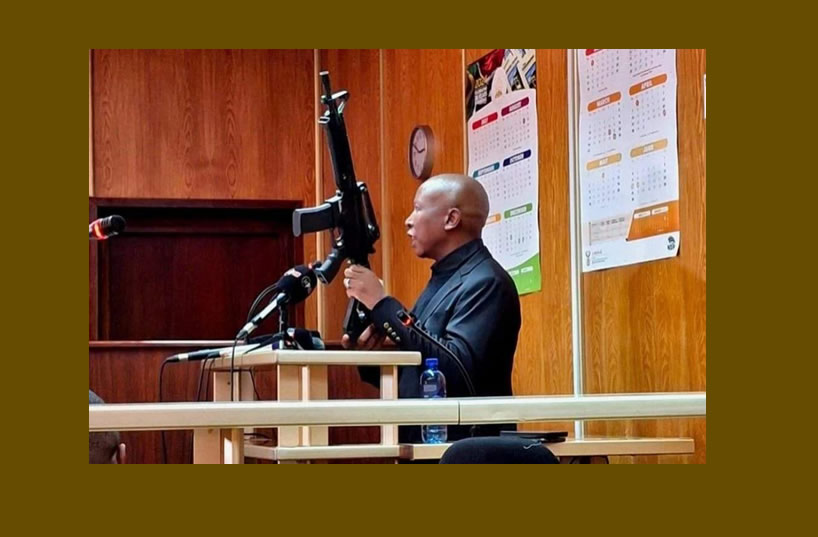
EFF leader Julius Malema faces a crucial week in court as he returns to the East London Magistrate’s Court for pre-sentencing hearings after being found guilty of violating several gun laws.
The pre-sentencing proceedings, set for this week, follow last year’s judgment in which the same court convicted Malema on charges linked to his conduct at the EFF’s fifth anniversary celebration in 2018. The matter relates to allegations that he fired live ammunition into the air, endangering those around him, and that he was in illegal possession of a firearm. Malema had initially claimed he was using a toy gun.
Some legal experts have suggested that, given the seriousness of the offences under the Firearms Control Act, he could face a sentence of up to 15 years in prison.
EFF mobilises, calls charges ‘politically trumped-up’
The EFF has called on its members to pack the courtroom on Friday, urging supporters to stand behind their leader. The party has dismissed the case as based on “politically trumped-up charges” and described the court’s ruling as an irrational judgment.
The visibly organised show of support is part of a broader political response as Malema, one of the country’s most recognisable politicians, fights to avoid a prison sentence that could also end his parliamentary career.
Possible end of Malema’s parliamentary career
Political analyst André Duvenhage believes the stakes could hardly be higher for the EFF leader.
“Malema is in real trouble; the only thing that he can do is what we have described as following the Stalingrad strategy. He can try to appeal and do what Zuma does in court, but that is going to be extremely difficult.
“I will not be surprised if we are in the last phase of Julius Malema.
“If he is found guilty, for more than a year, he will lose his position in parliament,” Duvenhage said.
Under section 47 of the Constitution, a person cannot be a member of the National Assembly if they have been convicted of a crime and sentenced to 12 months or more in prison, without the option of a fine. This means a sentence of a year or more would automatically cost Malema his seat.
Duvenhage warned that the final sentence could effectively dismantle Malema’s political career and remove him from Parliament, although he noted that Malema might still try every available legal avenue to delay or soften the outcome.
Shifting political fortunes and EFF’s fading edge
Beyond the courtroom, Duvenhage argued that Malema’s political influence has already weakened, particularly since the formation of the uMkhonto weSizwe (MK) party.
“Despite the firearm case, Malema appears to have lost his influence in the country’s political landscape, especially since the formation of the uMkhonto weSizwe party,” he said.
“The EFF is no longer the vibrant organisation we have come to know. It seems the tide is going against it. Where they still have support is in student communities like universities and colleges.
“There is also a huge leadership problem in the EFF with the departures of senior leaders.
“Malema is no more the figure he was, with the ability of filling stadiums and being able to mobilise 100 000 people. That time is gone and it seems to me that in health terms, he is not well.”
According to Duvenhage, if Malema ends up outside Parliament, he is still likely to explore “survival strategies” to keep both himself and the EFF politically relevant, while trying to avoid imprisonment.
Court to weigh seriousness of gun offences
Legal analyst Mpilonhle Baloyi, speaking to the SABC, said Malema’s case is being taken very seriously, given South Africa’s ongoing gun-related violence, including high levels of murders and shootings.
“There are incidents of shootings that we hear about on a dayto-day basis so, to answer the question on the seriousness of the offence, it’s around the Firearms Control Act, as well as what are the procedural steps to be followed in line with the Criminal Procedure Act,” he said.
Baloyi explained that the current phase is focused purely on what punishment should follow.
“According to Baloyi, the pre-sentencing hearing will help the magistrate arrive at a reasonable
and justifiable sentence for the crime committed.
“We are now beyond the trial. Conviction has been granted. The next step is sentencing. So in that sentencing, there are pre-sentencing considerations that the magistrate needs to take into account.”
What the magistrate will consider
Baloyi said the magistrate will be guided by three core pillars when deciding on an appropriate sentence:
- The nature of the offence committed
- The circumstances of the accused
- The interests of society
“The magistrate will take three things into consideration: the nature of the offence that has been committed, the circumstances of the accused and the interest of society,” said Baloyi.
He added that other factors will also be examined before a final decision is made. These include:
- A social worker’s report on Malema
- Whether he has shown remorse for his actions
- His personal circumstances, including whether he is a first-time offender
- Whether anyone was harmed during the incident
- What form of rehabilitation might be appropriate
“Other considerations will include a social worker’s report, whether the accused has shown remorse for their crime, the circumstances of the accused, including whether they are a firsttime offender, whether anyone was harmed and the type of rehabilitation that could take place,” Baloyi said.
A decisive moment for Malema and the EFF
As Malema heads to the East London Magistrate’s Court with EFF supporters expected to gather outside, the case now stands at a decisive point. The conviction is already on record; what remains is the length and nature of the sentence – and whether it will remove him from Parliament and further alter South Africa’s political landscape.
Whatever the outcome, the pre-sentencing hearings this week will not only shape Malema’s personal future, but also test the EFF’s ability to rally around its leader at a time when analysts say its momentum and internal stability are under strain.