

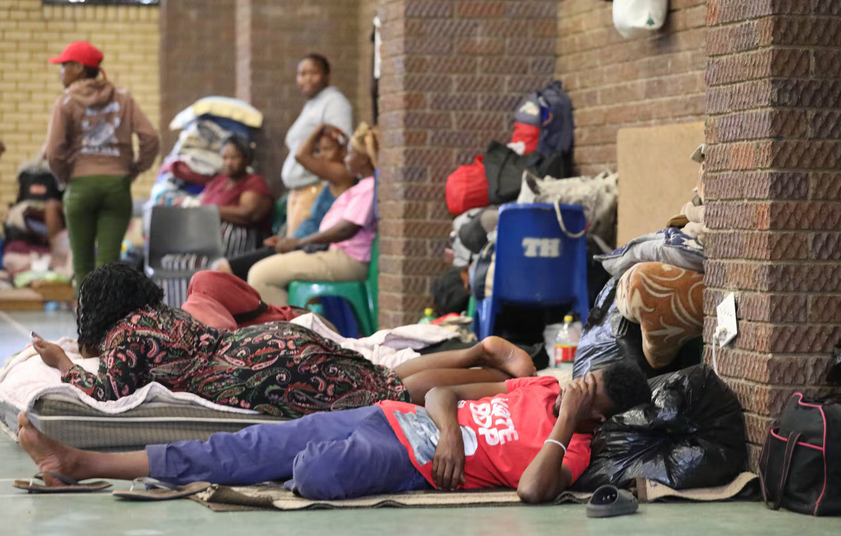
Hundreds of terrified families from the Sporong informal settlement in Randfontein have been forced to abandon their shacks and crowd into a community hall in town, saying they fled a reign of violence, robbery and extortion at the hands of zama-zamas.
More than 400 families – over 600 people – left Sporong 13 days ago, grabbing their children and whatever they could carry, and made their way to Randgate hall in the Randfontein CBD. Many say they walked away from all their belongings rather than risk another night under gunfire.
At the hall this week, women and men sat on the floor among folded blankets, with pots bubbling in the small kitchen as they tried to prepare food for their families. They share just two toilets – one for men and one for women – and have to bathe in full view of others. There are no cubicles, no privacy and little comfort.
Yet, despite the cramped and unhygienic conditions, residents say this is still better than the terror they escaped.
“For me, being here with my children is not a good experience, but at least we are safe from the zama-zamas,” said Johanna Bergman, who is living at the hall with her six children, including seven-week-old twins.
Bergman said there was not enough food at the hall and the conditions were far from healthy.
“We can’t complain because we feel safer here. There are no zama-zamas, no gunshots, no robberies or killings,” she said.
Bergman has lived in Sporong since 2017, but said everything changed last year when illegal miners started terrorising residents.
“We are scared to go back. When they start shooting, we lie on the floor with our children. We don’t know when it will stop, and we are scared to even leave our shacks,” she said.
She explained that in Sporong, residents had developed a simple warning system for some dangers – but not for the zama-zamas.
Bergman said residents at the informal settlement used whistles to alert each other when there was a fire. However, when the illegal miners opened fire, it was different.
“However, no one dared to make a sound when the zama-zamas were firing guns. We just lie on the floor, hoping they will go away,” she said.
Others at the hall shared similar stories of fear and violence. They said illegal miners regularly invaded their homes, beat them and demanded cash, and that there would be prolonged gunfire, sometimes lasting for hours.
Another resident, Esther Mhlongo, 40, said life in Sporong had become unbearable.
She recalled how the illegal miners stormed into her home and demanded money and cellphones.
“It was hard to live there. If you don’t have money, they take your child and force you to find the money. If you don’t have cash, they demand you transfer it,” she said.
Mhlongo said that at the beginning of the year, a group of men broke into her home while she and her children hid under the bed and her husband hid in another room.
“They found me under the bed, dragged me out, hit me with a gun and demanded money,” she said.
After she handed over all the cash she had, they turned on her husband.
“After handing over all the money she had, the men found her husband and assaulted him, she said.
“They hit him on the head and slit his arms with a knife. He was bleeding badly. We need help,” she said.

For Elsie Mokobane, 45, who has lived in Sporong for seven years, the trauma has been deep.
“They have been harassing us, killing people and sending others to hospital,” she said.
“When they came back, they targeted tuckshops and small businesses. They shoot people in the streets and go into homes, especially targeting the elderly and stealing their social grants.”
Residents said they had repeatedly asked the police for help, but the attacks continued.
Mokobane said the community had tried every avenue they could think of, yet nothing changed. With the gunfire and attacks getting worse, they turned to their councillor.
One of the displaced residents explained that when the situation reached breaking point, they approached ward councillor Alfred Thenjekwayo and begged him for assistance because they no longer felt safe.
“He first took us to Fitzbury hall, and the residents there chased us away and told us the hall belonged to them. They even told us that we are going to bring them zama-zamas. The councillor made a plan and took us to Randgate hall.”
The families say they have now submitted their names to officials from the human settlements department, who have been to Sporong to assess the situation. They are waiting for feedback on when and where they might be allocated homes.
When Sowetan visited Sporong, many of the shacks stood empty, with doors open and yards quiet. A few residents who had stayed behind said they refused to leave their homes and belongings, even with the danger posed by the illegal miners.
Government’s promise of extra security has so far brought little comfort. The defence force had previously indicated it would patrol areas affected by zama-zamas, but according to officials, they have not yet been called in for this particular area.
“We are not there until police request more assistance; we are not there [in the area],” said defence force spokesperson Siphiwe Dlamini.
Ward councillor Thenjekwayo was not available for comment as he was in training.
Sowetan reached out to Gauteng police spokesperson Lt-Col Mavela Masondo via text and a phone message, but he had not responded at the time of publication.
For now, the families of Sporong remain on thin mattresses and cold floors in Randgate hall, caught between a violent settlement they are too afraid to return to and an uncertain future as they wait for the state to decide their next move.