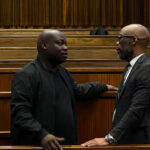
DA MP and newly appointed minister Willie Aucamp has approached the Public Protector with a formal complaint against his predecessor, Dion George, alleging an abuse of state resources and the fabrication of a whistleblower report in an attempt to derail his appointment as minister of forestry, fisheries and the environment.
Aucamp, who was sworn in as minister on 17 November, filed the complaint on Friday. In it, he asks the Public Protector to investigate George, as well as two officials who worked closely with him in the final days of his tenure: acting chief of staff Shelton Mollentze and personal assistant Traverse Le Goff.
At the heart of the complaint is an internal departmental investigation into Aucamp’s alleged involvement in “illegal lion farming”, which Aucamp insists was baseless and driven by political motives.
According to Aucamp, his deputy minister, ANC MP Bernice Swarts, informed him on 30 November that Mollentze had instructed officials in the department of forestry, fisheries and the environment to investigate claims that Aucamp was involved in unlawful lion farming activities.
“She also informed me that Mr Mollentze has apparently provided the employees of the department of forestry, fisheries and the environment with a list of my farms and/or companies that needed to be investigated by them,” Aucamp wrote in his complaint.
Aucamp has categorically denied ever being involved in lion farming or lion breeding.
He said the director-general of the department, Nomfundo Tshabalala, later confirmed that Mollentze had sent an email to senior departmental staff on 25 October requesting that an investigation be initiated. In that email, Mollentze claimed that a whistleblower had approached the ministerial office with serious allegations.
“May I kindly request that our team check our internal records to ascertain whether this individual or any of his entities are registered on the system as having lion facilities, or any other facilities, and if so, whether we can immediately initiate a process of inspecting these facilities to ensure compliance with the relevant legislative prescripts,” reads Mollentze’s email.
“We cannot have unlawful activities at lion or any other facilities, therefore we must treat these whistleblower complaints seriously.”
Aucamp told the Public Protector that when this request was made, it was not yet public knowledge that he was likely to be appointed as minister in George’s place. However, he said both he and George were aware that DA leader John Steenhuisen had put his name forward as a potential candidate.
Concerned about the investigation, Aucamp confronted Mollentze on 1 December and secretly recorded the conversation. According to Aucamp, Mollentze told him that he had read the whistleblower report and “took it to Dion”, after which George allegedly instructed that the matter be handled internally.
Mollentze also claimed during the conversation that neither he nor George realised that the allegations related to Aucamp. “It’s some farmer in the Free State,” Mollentze allegedly said, adding that they did not know it referred to Aucamp.
In the recording, Aucamp repeatedly asks whether Mollentze and George were unaware that he was the person being investigated. Mollentze answered in the negative each time.
Aucamp disputes this version strongly. He points out that Mollentze had attached a screenshot of his parliamentary register of interests to the investigation request. Aucamp is the only Member of Parliament with that surname, making it highly unlikely, he argues, that there was any confusion about his identity.
To bolster his claim, Aucamp submitted emails exchanged between Mollentze and Le Goff. In one email dated 24 October, Mollentze specifically asked Le Goff to trace companies “where Willie is director”.
Le Goff responded in two separate emails, listing companies where Aucamp is or was a director and attaching Aucamp’s parliamentary register of interests. Aucamp noted in his complaint that Le Goff went further in one email.
“In this email, Mr Le Goff even goes as far as to say that, ‘many of the entities that reflect as being deregistered with CIPC [the Companies and Intellectual Property Commission] are in fact still operational, meaning that they are operating illegally, and likely not tax compliant,’” Aucamp wrote.
Aucamp also raised serious concerns about the alleged whistleblower report itself. He said Mollentze later told him that the report was no longer in his possession.
“This is very strange, as according to Mr Mollentze’s own admission, it would have normally been attached to the complaint that is filed, but in this instance, he did not attach any whistleblower report,” Aucamp said.
He added that Nomonde Magagula, who normally receives whistleblower reports in the ministerial office, never saw such a document. Aucamp told the Public Protector that he does not believe a whistleblower report ever existed.
“Any fabrication of false whistleblower reports is unacceptable. We have real and bona fide whistleblowers in this country who are literally putting their lives on the line for the truth to come out,” Aucamp said.
“We have witnessed how real whistleblowers have been assassinated in recent years. Therefore, to falsely create the idea of a whistleblower report that does not exist in order to initiate a baseless investigation into an individual with the sole purpose of falsely discrediting such an individual, is a slap in the face of the real whistleblowers out there.”
Aucamp said the department ultimately found no evidence linking him to lion facilities. He described the investigation as a witch hunt aimed at influencing either the DA or President Cyril Ramaphosa’s decision to appoint him as minister.
George, who has been living in the United States since his removal from office, has denied all allegations. In response to enquiries from City Press’ sister publication Rapport, he said he did not approve or authorise any investigation into Aucamp, denied ever seeing a whistleblower report and said he was unaware that Aucamp was the subject of any investigation. He also dismissed claims that he abused state resources, describing them as “incorrect and untrue”.
Mollentze has similarly denied wrongdoing.
“The department receives many whistleblower complaints and tips from many different stakeholders, and we treat all of them with the utmost seriousness and sensitivity, designed to protect both the whistleblower and the integrity of the process,” he said.
Le Goff confirmed that Mollentze asked him to compile information about Aucamp’s business interests but insisted that everything he gathered was publicly available.
“I was not aware of what the information was to be used for, I was simply asked to collate it and submit it for review,” Le Goff said.
He added that he never saw a whistleblower report implicating Aucamp and did not know whether George was aware of Mollentze’s request. “… I inferred that the nature of the request was a form of due diligence, as Willie Aucamp was not yet the minister.”