

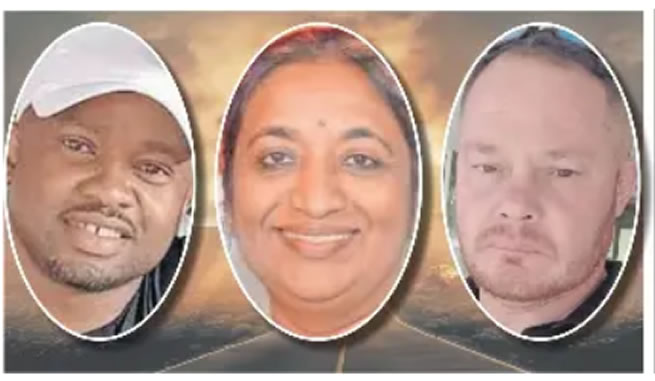
Whistle-blower's Murder Sparks Outrage and Demands for Enhanced Protection
The brutal murder of Marius “Vlam” van der Merwe, also known as Witness D, has ignited a fierce debate about the safety and protection afforded to whistle-blowers in South Africa. Van der Merwe, 41, was shot dead in front of his family outside their Brakpan, Ekurhuleni home on Friday night.
Van der Merwe's assassination has placed renewed scrutiny on the dangers faced by those who dare to expose corruption and criminal activity, adding his name to a growing list of individuals who have paid the ultimate price for speaking truth to power.
His testimony before the Madlanga Commission of Inquiry implicated suspended deputy chief of the Ekurhuleni metro police, Julius Mkhwanazi, in a murder cover-up and the disposal of a body. This revelation is believed to have made him a target.
President Cyril Ramaphosa has strongly condemned the attack, asserting that Van der Merwe's courageous testimony angered those seeking to undermine the rule of law. "As government, we will redouble our efforts to protect whistle-blowers, including witnesses before the Madlanga Commission and the commission itself, as they serve the nation with bravery in the face of criminal threats," said Ramaphosa.
The African National Congress (ANC) has also weighed in on the matter. ANC national spokesperson Mahlengi Bhengu labelled the killing a significant setback in the fight to strengthen the criminal justice system, adding, "The ANC condemns this crime and calls for strengthened protection for all witnesses participating in the commission and related investigations."
Glynnis Breytenbach, Democratic Alliance (DA) spokesperson on justice and constitutional development, described the murder as a direct assault on accountability and justice in South Africa. “This kind of mafia-state behaviour, where whistle-blowers are gunned down for telling the truth, is something our country has never experienced at this scale before. It is terrifying, it is brazen, and it is clearly intended to send a message of pure intimidation,” said Breytenbach.
The Economic Freedom Fighters (EFF) released a statement calling the killing an outright attack on the Madlanga Commission and a warning shot from the criminal underworld to halt exposure of corruption and criminal infiltration. “His assassination is, therefore, a calculated message intended to intimidate the commission, silence witnesses, and protect criminal syndicates and drug cartels that have deeply rooted themselves into South Africa’s law enforcement agencies,” the EFF stated.
The MK Party’s spokesperson, Nhlamulo Ndhlela, termed Van der Merwe’s assassination a damning indictment of the government’s failure to provide adequate protection. “The murder of Babita Deokaran should have served as a warning that negligence puts whistle-blowers’ lives in grave danger,” he added.
Actionsa MP Dereleen James echoed these concerns, stating that there was an urgent need for both Parliament’s Ad Hoc Committee and the Madlanga Commission to ensure that those at risk due to their testimonies receive adequate protection.
Brett Herron, Good Party Secretary-general, lamented the dangers of testifying, saying anonymity did not guarantee safety. “Their testimony can lead to their identification, which may well have been the case in this instance,” he said in reference to Van der Merwe, who testified without his voice being disguised.
The Institute of Security Studies’ Lizette Lancaster expressed deep concern and sadness that someone who spoke out with such bravery had been killed. “He is one of many people who have been killed for speaking the truth, and what we need is clearly a better system, one where there are more resources allocated to witnesses because we are talking hundreds of people who have been killed because they are trying to do the right thing,” Lancaster said. She also noted that it was unknown what protection Van der Merwe was afforded and whether he accepted it.
Van der Merwe's case is not an isolated incident. The assassinations of other whistle-blowers, such as Babita Deokaran, who was murdered in August 2021 after exposing corruption within the Gauteng Department of Health, and Mpho Mafole, the City of Ekurhuleni’s group divisional head of corporate and forensic audits and Ekurhuleni Metro’s chief auditor, serve as stark reminders of the risks involved. Mafole, 47, died in June in what appeared to be an execution while investigating a R1.8 billion tender scandal involving chemical toilets.
The calls for improved witness protection programmes are growing louder, with many questioning the effectiveness of existing measures. The focus is now on ensuring that those who come forward with information about corruption and crime are adequately protected from intimidation and violence. The future of justice and accountability in South Africa may well depend on it.