

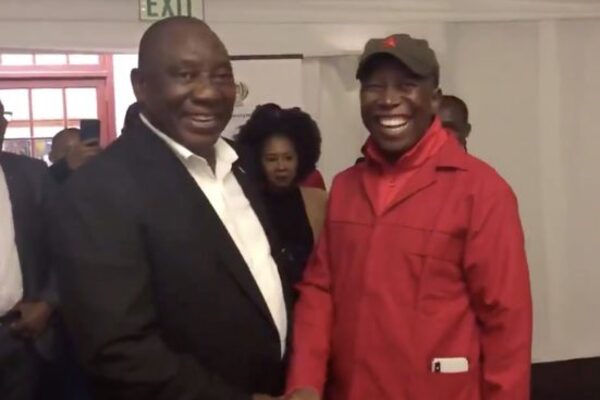
In a political landscape often defined by bitter rivalry and public spats, a new and unexpected dynamic is beginning to emerge at the heart of South African power. For years, the relationship between President Cyril Ramaphosa and Economic Freedom Fighters (EFF) leader Julius Malema has been nothing short of toxic. From the "Pay Back the Money" chants that once rocked Parliament to the frequent walkouts and personal insults, few could have predicted that 2026 would bring a "bromance" that is now sending ripples through the halls of the National Assembly.
The signs of this shifting tide have become increasingly impossible to ignore. What started as tentative cooperation on specific legislative matters has blossomed into a more robust alignment on key national issues, most notably the implementation of the National Health Insurance (NHI) Act, the insourcing of workers, and the establishment of 24-hour clinics across the country. For the average South African, this political pivot is not just about two men finding common ground; it represents a fundamental shift in how the country's most controversial policies might finally move from paper to practice.
At the centre of this newfound cooperation is the NHI, a policy that has long been a bone of contention for the private healthcare sector and opposition parties like the Democratic Alliance. While Ramaphosa has faced immense pressure to delay the Act's implementation due to ongoing litigation and constitutional concerns, Malema and the EFF have been its most vocal cheerleaders. In recent weeks, however, the President has seemingly leaned into the EFF's support to push the agenda forward. During a recent response in Parliament, Ramaphosa was seen nodding in agreement with several of Malema's points regarding the urgency of healthcare reform, a sight that would have been unthinkable just twenty-four months ago.
The "bromance" extends beyond healthcare. The issue of insourcing—the process of bringing outsourced government services back under direct state employment—has been a cornerstone of the EFF's manifesto for a decade. Now, it appears the African National Congress (ANC) under Ramaphosa is finally singing from the same hymn sheet. Sources within the tripartite alliance suggest that the President has been increasingly receptive to the EFF's proposals on insourcing, particularly within the security and cleaning sectors of various government departments. This alignment is not merely ideological; it is a pragmatic move that could secure the ANC much-needed support in a fractured political environment.
Furthermore, the push for 24-hour clinics has become a shared battle cry. Both leaders have recently championed the need for extended healthcare hours in townships and rural areas, where residents often have to travel long distances or wait until morning for basic medical attention. By championing this cause together, Ramaphosa and Malema are tapping into a deep-seated public need, presenting a united front that transcends their usual party-political bickering.
However, not everyone is convinced by this sudden show of unity. Critics argue that this is a marriage of convenience born out of political desperation. With the ANC's grip on power more tenuous than ever, Ramaphosa may be looking to the EFF as a potential kingmaker or a buffer against internal party rivals. For Malema, the benefits are equally clear: by aligning with the President on key "pro-poor" policies, he can claim credit for steering the national agenda while maintaining his image as a champion of the working class.
The economic impact of this alliance cannot be understated. The NHI and large-scale insourcing come with massive price tags that the National Treasury is already struggling to accommodate. Business leaders have expressed concern that this political alignment might lead to populist spending that the country simply cannot afford. Yet, for many South Africans who have felt left behind by the post-apartheid economy, the sight of the President and the Commander-in-Chief working together to deliver tangible services is a powerful and hopeful image.
As we move deeper into 2026, the question remains: is this a genuine partnership for the good of the country, or a temporary truce that will inevitably collapse under the weight of two massive egos? For now, the "Ramaphosa-Malema bromance" is the most fascinating story in South African politics, and its outcome will determine the direction of the nation for years to come. Whether it leads to a revolution in public service or a fiscal disaster, one thing is certain—the political landscape will never be the same again.