

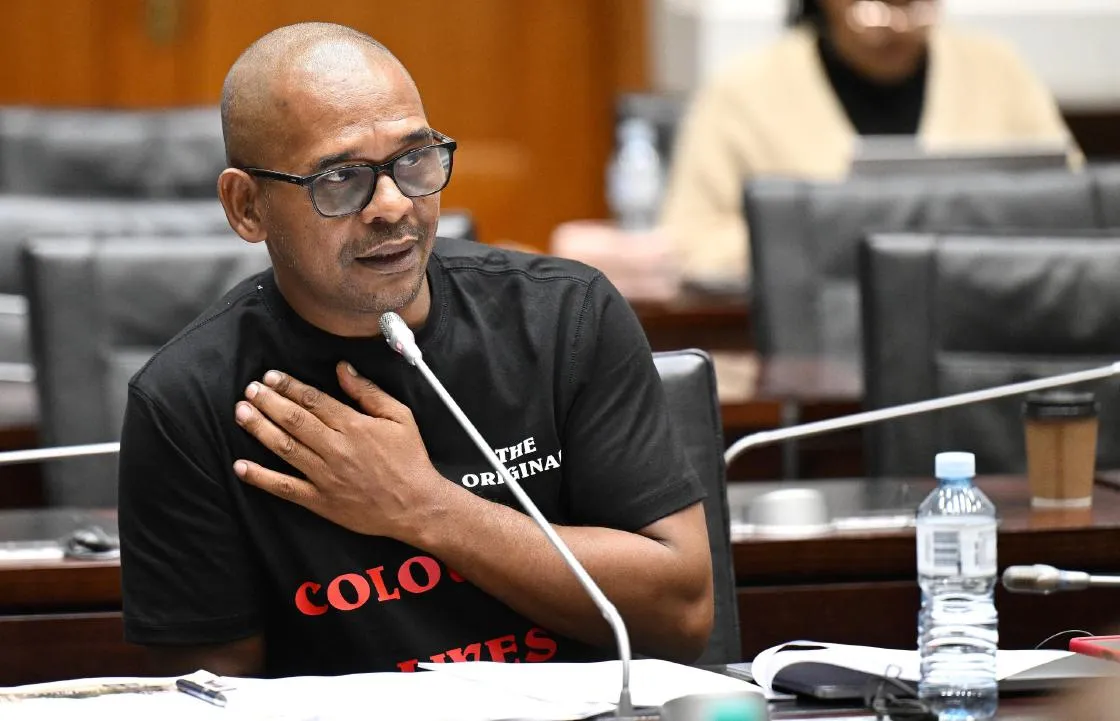
In the hallowed halls of Parliament, where political discourse often unfolds in hushed tones, National Coloured Congress (NCC) leader and Member of Parliament Fadiel Adams has found himself embroiled in a real-life nightmare. His recent testimony before the Ad Hoc Committee, tasked with investigating allegations of criminal infiltration within the South African Police Service (SAPS), laid bare a chilling account of classified documents, threats to his family, and a pervasive corruption he believes reaches the highest echelons of the nation's security apparatus.
Adams' ordeal began in the final week of October, when an unassuming envelope was slipped under his parliamentary office door. Inside, he discovered a cache of documents that would irrevocably alter his life. Initially, he grappled with the profound implications of possessing such sensitive information. "There was a big part of me that wishes I had torn those documents and just walked away," Adams confessed to the committee, his voice unwavering despite the gravity of his revelations. "But when I look at what the people have allegedly done, I am glad I did not do it."
What ensued was not a straightforward path to justice, but a descent into a world marked by paranoia and what he describes as state-sponsored intimidation. Adams recounted a life under constant threat, where even the routine act of taking his children to school transformed into a high-stakes security operation. "There was a stage where I would have armed people collect my kids at school, where I would ensure that my wife did not walk anywhere, not even to a shop, because it was hectic and a strain on my family," he revealed. He spoke of unidentified vehicles lingering outside his home, their occupants surreptitiously photographing his residence, compelling him to relocate his family multiple times to safeguard their well-being.
The documents, one of which was explicitly marked 'Top Secret', allegedly implicated senior Crime Intelligence officers in a complex web of corruption, fraud, and obstruction of justice. Adams, who describes himself as a high school dropout with a background in construction before entering politics, was initially uncertain how to proceed. He acknowledged he was not an investigator and harboured concerns that the documents might be fraudulent—a calculated 'trap' designed to discredit him if he prematurely approached the media.
Following the counsel of the late Major General André Lincoln, a revered figure in the Anti-Gang Unit whom Adams considered a mentor, he decided to entrust the information to the police. However, the response he received only intensified his suspicions. After lodging charges at the Grand Central Police Station in Cape Town, Lincoln informed him that his dockets had been irregularly collected by the provincial office. Adams recalled asking Lincoln, "General, is this procedural?" to which Lincoln's response was stark: "No. They are trying to cover it up."
Driven by a resolve to ensure the allegations were formally recorded and investigated, Adams undertook a journey to Johannesburg at his own expense. There, he opened identical cases at the Orlando and Langlaagte police stations. He further escalated the matter by writing to the Minister of Police, expressing his concerns that his dockets had been intercepted. Yet, the more he pressed for accountability, the more the system appeared to resist.
During his compelling testimony, Adams levelled explosive allegations against prominent figures within the SAPS. He accused KwaZulu-Natal Police Commissioner Nhlanhla Mkhwanazi of utilising a press conference on 6 July 2025, to defame him and other political figures, including former Minister Senzo Mchunu and the Democratic Alliance's Glynis Breytenbach. Adams asserted that Mkhwanazi and other high-ranking officials were actively shielding criminal cartels to prevent the arrest of National Commissioner Fannie Masemola.
Perhaps one of the most disturbing revelations concerned the alleged misuse of taxpayers' money through the procurement of obsolete technology and the operation of what Adams termed "washing machine" hotels. He claimed that Crime Intelligence acquired a redundant cellphone grabber—a device intended for intercepting communications—and that the Political Killings Task Team (PKTT) was accommodated in hotels that served as fronts for laundering illicit funds.
"They needed a washing machine… this is their washing machine," Adams declared, referring to the hotels where he alleged the PKTT was based. He critically questioned the unit's operational efficiency, highlighting that despite an annual budget of approximately R100 million, the PKTT had reportedly investigated only one politically motivated murder in the preceding year. Adams drew a stark comparison: "On the Cape Flats, we are losing 3,000 youngsters a year, and the Anti-Gang Unit gets R7 million. They put a different premium on a coloured life in this country, and I think it is disgusting."
The ongoing investigation into these allegations has ignited significant political tension. Economic Freedom Fighters (EFF) leader Julius Malema, who also provided testimony, publicly defended Adams' actions. "No one must tell you nonsense," Malema advised the committee. "When you come across information, you must go to the police. What the police do with it is none of your business." Malema cited a similar incident from 1998, where a report concerning a purported "rogue unit" within the South African Revenue Service (SARS) was anonymously delivered to his office, underscoring that the responsibility for authenticating such documents lies with the police, not the whistleblower.
However, the committee's rigorous questioning of Adams underscored a profound distrust between the MP and the SAPS leadership. When pressed on why he had not personally verified the documents, Adams responded unequivocally: "I am not an investigator. I gave it to the experts, the South African Police Service. If I were to investigate this thing, I would probably bark up the wrong tree."
This deep-seated distrust, Adams argued, is not unfounded. He referenced the case of Major General Feroz Khan, who was acquitted of charges related to a R700 million cocaine bust in Aeroton. Khan had allegedly been targeted by his own colleagues for thwarting a drug heist facilitated by corrupt police officers. In stark contrast, Adams highlighted the dismissal of Western Cape Crime Intelligence head Mzwandile Tiyo, who was fired after his service pistol and laptop were stolen from his vehicle outside a tavern. Adams contended that the system of discipline is applied selectively: "When they want to make your life a misery to get rid of you, they will use anything. This, in my view, is how a cartel operates."
The Human Cost of the 'Spy War'
The human toll of this internal 'spy war' within the SAPS is perhaps most tragically illustrated by the fates of those who have dared to speak out. Adams recounted the story of Bonginkosi Dlamini, a former sergeant who was investigating the murder of Sindiso Magaqa, a former ANC Youth League secretary-general. According to Adams, Dlamini was allegedly ordered by senior Crime Intelligence officers to arrest the Mayor of Durban without sufficient evidence. Upon his refusal, Dlamini was charged with defeating the ends of justice and endured years of imprisonment while awaiting trial for a non-violent crime.
Adams further presented a confession from one of the alleged hitmen in the Magaqa case, who claimed that the assassination was facilitated and escorted to and from the crime scene by the SAPS, and that the AK-47 used in the killing was supplied by Crime Intelligence.
As the parliamentary hearing drew to a close in the early hours of the morning, an atmosphere of exhaustion and unease permeated the room. Adams' testimony has painted a grim picture of a police service seemingly consumed by internal conflict, where clandestine funds are allegedly exploited to settle political scores and whistleblowers are pursued as if they were criminals.
The Road Ahead
The Ad Hoc Committee now faces the formidable challenge of meticulously sifting through these grave allegations. For Fadiel Adams, however, the personal cost has been immense. He continues to navigate life under the shadow of the documents he discovered, a man who sought to expose the truth and, in doing so, found himself ensnared in a profound and unsettling ordeal at the hands of the state. The "ghosts" of Crime Intelligence, it appears, are not easily appeased or laid to rest.