

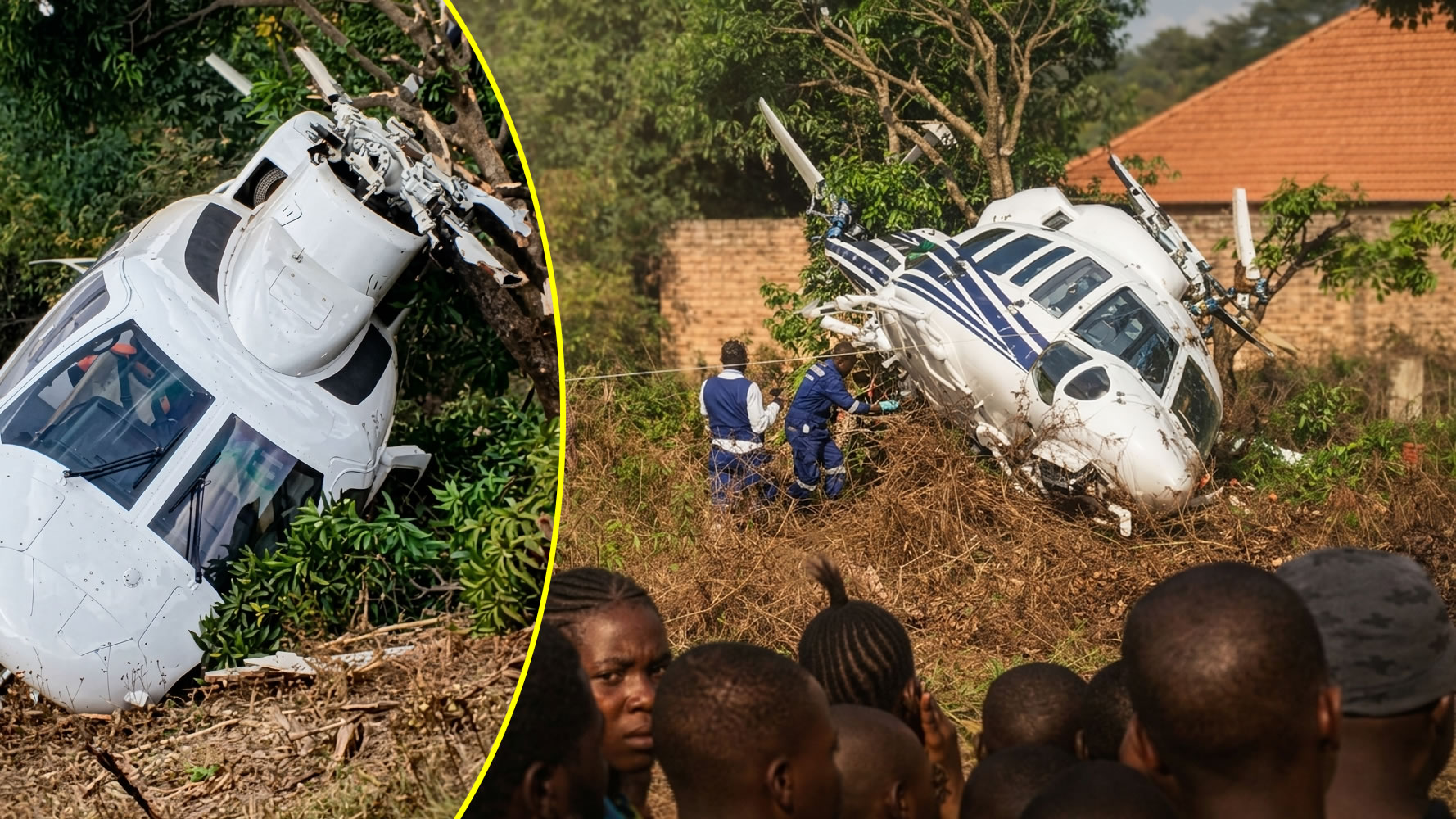
NAKONDE – The dust had barely settled on the makeshift helipad in the border town of Nakonde when the silence of the Muchinga Province was shattered by the grinding of metal and the splintering of timber. In what can only be described as a miraculous escape, Zambia’s Vice President, Mutale Nalumango, walked away from the wreckage of a military helicopter that plunged to the ground mere moments after ascending into the afternoon sky.
The incident, which occurred on Thursday, has left the nation gripped by a mixture of relief and deep-seated suspicion. As the country prepares for the high-stakes general elections scheduled for August, the sight of a crumpled Zambia Air Force (ZAF) AgustaBell 212 lying on its side amidst the scrubland has raised uncomfortable questions about the safety of state travel and the possibility of more sinister forces at play.
A Minute of Terror in Nakonde
Vice President Nalumango, aged 71, was in the northeastern region on an official visit, engaging with local communities and bolstering support for President Hakainde Hichilema's administration. The itinerary was routine, the weather seemingly clear, and the mood optimistic. However, the transition from a successful campaign rally to a life-threatening emergency took less than sixty seconds.
Eyewitnesses described the white ZAF helicopter lifting off with its usual roar. But as it reached a precarious height, the engine note changed—a stuttering, mechanical protest that preceded a sudden, sickening descent. The aircraft tilted, its rotors clipping the canopy of nearby trees before it slammed into the earth.
"After we lifted off, I don’t know whether it was a minute or two… and then we came down," Mrs Nalumango later recounted to Diamond TV, her voice remarkably steady despite the ordeal. "We were eight and all of us are fine."
While the Vice President and the seven other passengers and crew members emerged without visible injuries, the helicopter itself told a different story. Images from the scene showed the tail boom severed and the main fuselage resting awkwardly against a tree, a stark testament to the force of the impact. Government officials confirmed that Mrs Nalumango underwent a routine medical check-up following the crash and was discharged in good health, even vowing to continue her work in the region.
The Spectre of Foul Play
In the corridors of power in Lusaka, the official narrative is one of technical failure. Yet, in the heated atmosphere of an election season, the "foul play" theory has gained significant traction. Investigative sources within the aviation sector suggest that the AgustaBell 212 is a robust workhorse, and a catastrophic failure during a routine take-off — especially one involving the second-highest-ranking official in the land — is statistically rare.
"You have to look at the timing," whispered a source within the security services, speaking on condition of anonymity. "We are weeks away from a pivotal election. The Vice President is a key figure in the President's re-election strategy. When a military-grade machine falls out of the sky under these circumstances, you don't just look at the spark plugs; you look at the environment."
The Zambian government has been quick to downplay such talk, urging the public to wait for the results of a formal investigation by the Air Force. However, the lack of immediate clarity has allowed a cloud of uncertainty to hang over the incident.
A History Written in Wreckage
The Nakonde accident is not an isolated event but a chilling addition to a long and tragic list of African leaders who have met their end, or narrowly avoided it, in the skies. The history of the continent is littered with the charred remains of aeroplanes and helicopters that carried the hopes of nations.
Perhaps the most enduring mystery remains the death of Mozambican President Samora Machel in 1986. His Tupolev Tu-134 crashed into the Lebombo Mountains in South Africa under circumstances that many still believe involved a decoy beacon set by the then-apartheid regime. Machel’s death altered the course of Southern African history, leaving a void that took decades to fill.
In 1994, the world watched in horror as the plane carrying Rwandan President Juvénal Habyarimana and Burundian President Cyprien Ntaryamira was shot down over Kigali. That single act of aerial assassination served as the catalyst for the Rwandan Genocide, proving that a crash in the sky can lead to a bloodbath on the ground.
More recently, the continent was plunged into mourning in June 2024 when Malawi’s Vice President, Saulos Chilima, perished alongside nine others. Their Dornier 228-202K aircraft disappeared in the Chikangawa Forest amid poor weather conditions. The tragedy highlighted the persistent dangers faced by officials who must rely on ageing fleets and unpredictable conditions to reach the remote corners of their countries.
Even the "big men" of West Africa have not been spared. In August 2025, Ghana was rocked by a military helicopter crash that claimed the lives of eight people, including the Defence Minister, Edward Omane Boamah, and the Environment Minister, Ibrahim Murtala Mohammed. The loss of two high-profile cabinet members in a single incident sent the Ghanaian administration into a tailspin, forcing a radical rethink of ministerial transport protocols.
The Mnangagwa Incident: A Narrow Escape in Masvingo
Across the border in Zimbabwe, President Emmerson Mnangagwa has earned a reputation for being a survivor, a trait that was put to the ultimate test in September 2024.
Then, in an incident that bears a striking resemblance to the Zambian accident, an Air Force of Zimbabwe (AFZ) helicopter crashed shortly after take-off at Masvingo Airport in September 2024. The helicopter had been positioned to fly the President back to Harare following his birthday celebrations at the Great Zimbabwe Monuments in the Bikita district. In a twist of fate that likely saved his life, Mnangagwa was not on board when the aircraft experienced a technical failure during its initial ascent. The chopper slammed back onto the runway, leaving one crew member injured and the machine a total loss.
This was not Mnangagwa’s first brush with aerial disaster. In August 2021, his presidential helicopter was forced into an emergency landing approximately 60 kilometres southwest of Harare. The official explanation cited technical faults, but the frequency of these incidents has led to intense speculation about the state of the presidential fleet and the rigour of its maintenance programmes.
The Cost of Leadership
The recurring nature of these accidents raises a fundamental question: Why is the African leadership so vulnerable in the air? The answers are often a complex blend of underfunded maintenance, the use of refurbished military hardware for civilian transport, and the immense pressure placed on pilots to fly in suboptimal conditions to meet the demanding schedules of politicians.
In the case of Zambia, the ZAF fleet has long been praised for its professionalism, yet the Nakonde crash suggests that even the most disciplined units are not immune to disaster. Whether the cause was a genuine mechanical flaw, human error, or something more calculated, the implications are profound.
For Mutale Nalumango, the walk away from the Nakonde wreckage was a moment of grace. But for the Zambian electorate, it is a sobering reminder of the fragility of the state. As the investigation continues, the wreckage in Nakonde remains a silent witness to a day when the course of Zambian history nearly took a tragic turn.
In the coming weeks, the investigators will pore over the flight data recorders and the twisted metal of the AgustaBell. They will look for signs of fatigue, evidence of tampering, and clues to the engine's final moments. But regardless of their findings, the memory of that minute in Nakonde will linger—a stark illustration that for those who lead, the greatest danger often lies in the very machines meant to carry them to their people.
Timeline of Recent African Leadership Air Incidents:
|
Date
|
Leader Involved
|
Country
|
Outcome
|
|
Oct 1986
|
President Samora Machel
|
Mozambique
|
Deceased
|
|
Apr 1994
|
Presidents Habyarimana & Ntaryamira
|
Rwanda/Burundi
|
Deceased
|
|
Aug 2021
|
President Emmerson Mnangagwa
|
Zimbabwe
|
Survived (Emergency Landing)
|
|
Jun 2024
|
Vice President Saulos Chilima
|
Malawi
|
Deceased
|
|
Sep 2024
|
President Emmerson Mnangagwa
|
Zimbabwe
|
Survived (Not on board during crash)
|
|
Aug 2025
|
Ministers Boamah & Mohammed
|
Ghana
|
Deceased
|
|
Jul 2026
|
Vice President Mutale Nalumango
|
Zambia
|
Survived
|
As Zambia moves towards its electoral showdown, the government must now balance the need for transparency with the demands of national security. The people of Zambia deserve to know whether their leaders are safe in the skies, or if the "foul play" headline is more than just a sensational question. For now, the nation breathes a collective sigh of relief, thankful that this time, the story ended with a survivor’s vow rather than a state funeral.