

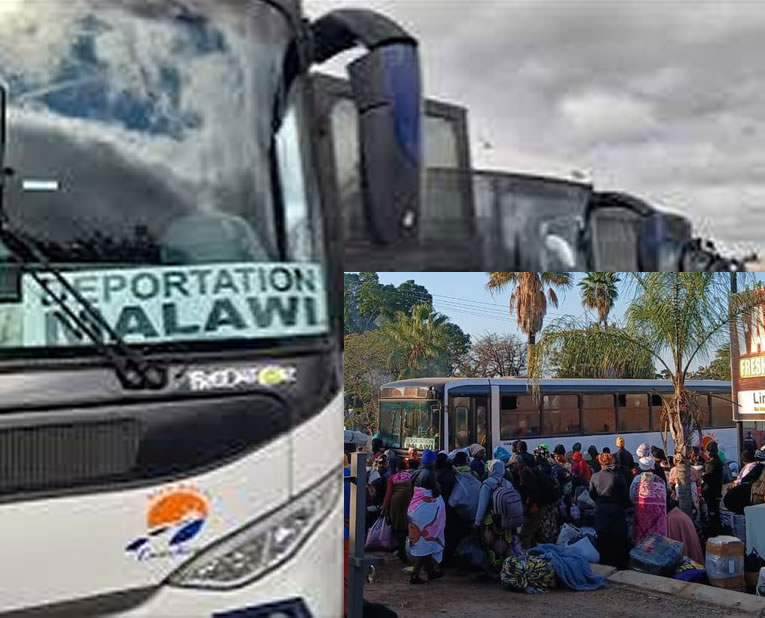
South Africa – An unsettling and mysterious phenomenon is gripping social media across South Africa, as a bus driver’s eerie accounts of Malawian migrants seemingly vanishing from repatriation buses during their journey home go viral. These chilling tales, shared widely online, paint a picture of unexplained disappearances, sparking intense debate and a mix of fear, speculation, and concern over the ongoing mass deportations.
The context for these strange occurrences lies in South Africa’s accelerated efforts to repatriate undocumented foreign nationals. Malawian citizens form a significant portion of those being returned to their home country, often transported in large groups by bus. It is during these long, arduous journeys that the unsettling reports have begun to surface.
A South African bus driver, whose identity remains protected, has become the central figure in these viral accounts. He described a profound sense of unease among his colleagues, detailing instances where buses, which began their trips with a full manifest of passengers, arrived at checkpoints or final destinations with fewer individuals than recorded. What makes these accounts particularly haunting is the claim that no one was seen disembarking, nor were there any official records of passengers leaving the bus at any point during the journey.
“Despite the buses being locked and monitored, some passengers simply were not there when we reached certain checkpoints or the final destination,” the driver reportedly shared in one widely circulated account. He spoke of a specific incident where a bus departed with a full complement of passengers but arrived with several empty seats, leaving both the drivers and accompanying officials baffled. “There was no record of anyone getting off,” he added, highlighting the perplexing nature of the disappearances.
These narratives have ignited a firestorm of discussion on social media platforms. Many South Africans are grappling with the unsettling implications, with theories ranging from the rational to the supernatural. Some online commentators suggest that the “vanishing” acts are a clever ruse, a desperate attempt by migrants to escape the buses mid-journey and re-enter South Africa illegally. This theory posits that individuals might be finding clandestine ways to slip off the vehicles, perhaps with the help of accomplices or by exploiting moments of distraction.
However, another significant portion of the online community is leaning into the more “eerie” and “supernatural” explanations. They share their own stories of unexplained phenomena during long-distance travel, or invoke traditional beliefs about “muti” (traditional medicine or charms) being used to facilitate such disappearances. These discussions reflect a deeper cultural context where the unexplained can often be attributed to forces beyond conventional understanding, adding a layer of mystique and fear to the already tense situation.
The Department of Home Affairs has confirmed the recent deportation of over 520 Malawian nationals, underscoring the scale of these repatriation operations. However, official statements regarding the alleged disappearances have been scarce, leaving a vacuum that social media is quickly filling with speculation and concern. The lack of clear explanations from authorities only serves to fuel the public’s imagination and anxiety.
Adding to the grim atmosphere surrounding these operations are reports of chaotic conditions at repatriation centres, such as those in Epping and Musina. Concerns have also been raised about the roadworthiness of some of the buses used for these long journeys, further highlighting the challenges and potential dangers faced by those being repatriated. Tragically, a Malawian woman recently died on one of these buses after falling ill, a stark reminder of the human cost involved in these mass movements.
The viral nature of the bus driver’s story has brought to the forefront the complex and often fraught realities of migration and repatriation in South Africa. It forces a conversation not only about border control and legal processes but also about the humanitarian aspects and the dignity of individuals caught in the system. The chilling accounts serve as a powerful, albeit mysterious, narrative that resonates deeply with a public already grappling with social and economic anxieties.
As the online debate continues to rage, the true nature of the “vanishing” migrants remains shrouded in mystery. Whether these are calculated escapes, tragic accidents, or something more inexplicable, the stories have firmly captured the attention of the nation, demanding answers and highlighting the urgent need for transparency and accountability in the repatriation process. The Mzansi public watches, waits, and wonders what truly happens on the ghost buses carrying migrants home.