

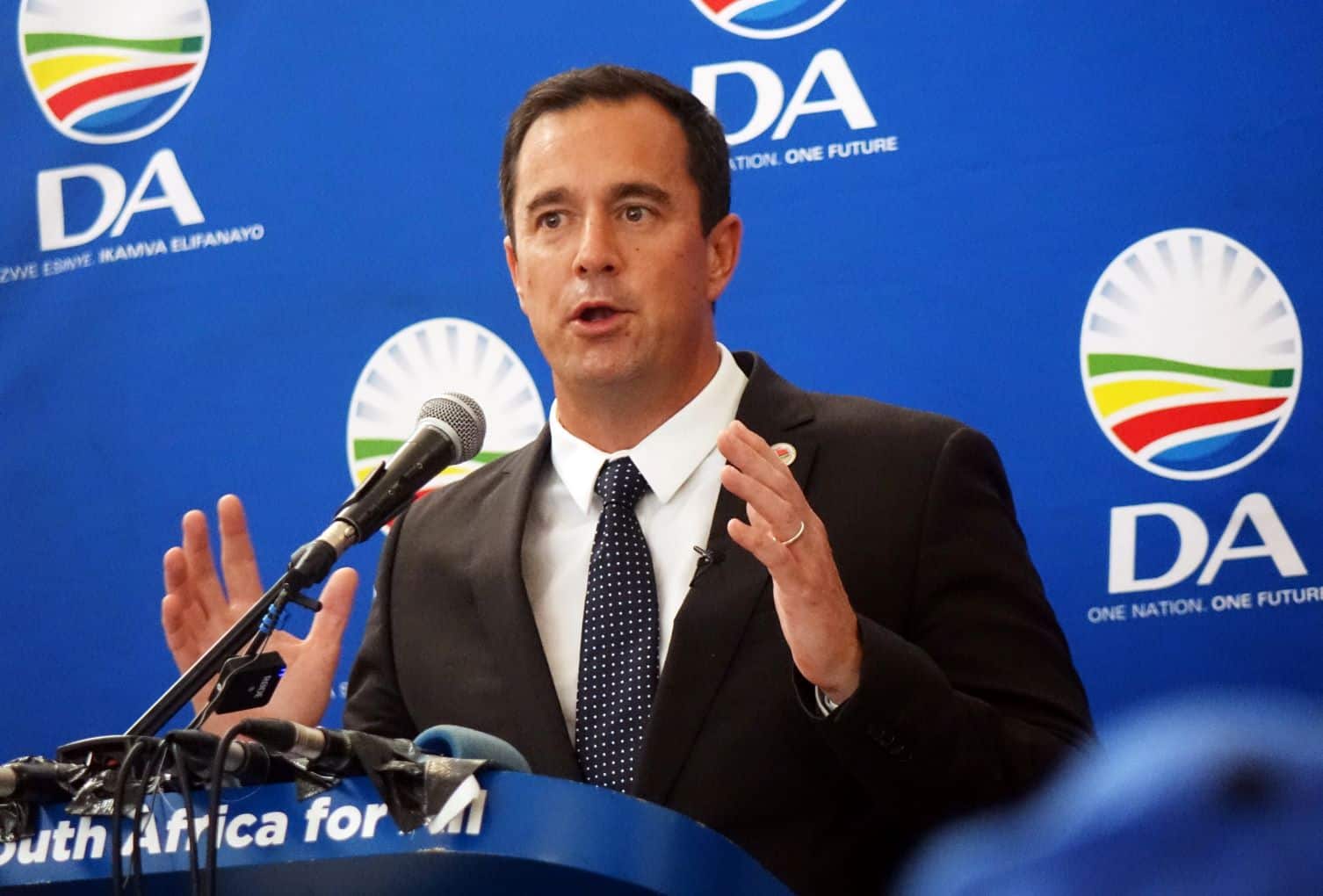
The Democratic Alliance is facing growing internal pressure to discipline former party leader John Steenhuisen after his recent public attacks on the party’s leadership, with some members arguing that his comments have damaged the DA’s image at a sensitive time — just months before local government elections.
The discontent has been building since Steenhuisen’s explosive interview with News24, in which he criticised senior figures, accused some of betrayal and warned of deepening divisions inside the party. While the DA leadership has so far resisted calls to suspend or discipline him, the anger within parts of the party has become increasingly vocal, with some members questioning why Steenhuisen is not being “called to order” for airing internal disputes in public.
The criticism of Steenhuisen comes after his demotion from Minister of Agriculture last month. In the aftermath of a Cabinet reshuffle, he accused newly elected DA leader Geordin Hill-Lewis of betraying him. The dispute has become more than a personal fallout: it is now threatening to spill into formal party processes and could further test the DA’s unity ahead of elections later this year.
Among those demanding action is Shehana Kajee, a long-standing member of the DA’s Federal Legal Commission. She argues that Steenhuisen’s comments amount to bringing the organisation into disrepute — and she says the party’s response has been inconsistent.
“I was previously asked by John Steenhuisen to remove my negative posts about the DA, yet he gets away with bringing the party into disrepute. He needs to face disciplinary action for airing the party's problems in public, especially just months before the local government elections.”
Kajee’s call is significant because it comes from within the party’s own legal structures — a space typically associated with disciplinary and governance processes. Her frustration is rooted in what she describes as a double standard: that ordinary members are cautioned against public criticism, while a former leader is seemingly allowed to make damaging claims without consequence.
Kajee is not the only figure pushing this line. Several senior DA insiders, speaking anonymously, say Steenhuisen’s conduct has harmed the party’s reputation and undermined unity ahead of the upcoming vote. Their statements suggest a wider belief among some party figures that Steenhuisen’s behaviour has been tolerated for too long — and that it has now become a political liability.
One insider offered a sweeping, deeply critical assessment of Steenhuisen’s time in leadership and his role in government, claiming he was shielded by loyalists and had alienated important constituencies within the party.
"John embarrassed the party for far too long, and each time he got away with it. He made sure he placed his cheerleaders and friends in positions where he could count on their loyalty. He became the ANC's puppet in the Government of National Unity. He removed one of the best people we had in the party, Deon George, from his position. The final straw was alienating our key farming constituency through his disastrous handling of the foot-and-mouth disease outbreak. Geordin did the right thing by removing him," the insider said.
Such comments reveal a blunt internal split: where Steenhuisen positions himself as a wronged figure who was pushed out despite a prior understanding, at least some in the DA appear to see his removal as overdue and justified. The insider’s reference to “the final straw” and the claim of alienating the farming constituency speaks directly to one of the key controversies associated with Steenhuisen’s tenure in the agriculture portfolio: the handling of the foot-and-mouth disease outbreak, which has already been a politically charged issue in farming circles.
The DA’s leadership has been working to contain the fallout between Steenhuisen and Hill-Lewis, with a clear focus on limiting damage to the party’s public standing ahead of the local government elections. The elections are expected to be highly competitive in metros and swing municipalities, and the DA’s internal disputes risk distracting from campaigning, governance messaging and coalition strategy.
The controversy has also drawn attention beyond the DA. Steenhuisen’s allegations — particularly his claim that former DA leader Tony Leon used party connections to advance private business interests — have moved from internal party argument to broader political contestation. The ANC and ActionSA have called for investigations into those claims, escalating the stakes for the DA, which now faces pressure not only from its own members but also from political opponents seeking to exploit the division.
Despite this, the DA has rejected calls to suspend or discipline Steenhuisen. National spokesperson Karabo Khakhau said no formal charges have been laid against him, although the Federal Executive is considering allegations he made against Leon and Leon’s communications company.
Khakhau’s position points to a procedural obstacle for those calling for discipline: without formal charges being filed under the party’s disciplinary framework, leadership may argue there is no basis to initiate a case. But the pressure from within suggests some members want the party to go further — either by laying charges internally or by taking a stronger public stance against what they view as misconduct.
The broader question, then, is whether the DA can keep the dispute from deepening into a formal internal conflict that plays out in public. For a party that has long argued it offers stable governance, clean administration and internal accountability, a high-profile feud involving former and current leaders poses reputational risk — especially if it feeds a narrative of factionalism.
For Steenhuisen’s critics inside the DA, the issue is about precedent: if a former leader can publicly criticise the party’s leadership without disciplinary consequences, they argue, it weakens internal rules and encourages further public infighting.
For DA leadership, the calculation may be more political: whether disciplining Steenhuisen would worsen the internal rupture, energise his supporters, or create a larger public spectacle at precisely the wrong moment.
With local government elections approaching, and external parties calling for investigations into some of Steenhuisen’s allegations, the DA’s handling of this internal pressure could prove a key test of its unity — and of whether it can enforce party discipline without further splitting its own ranks.