

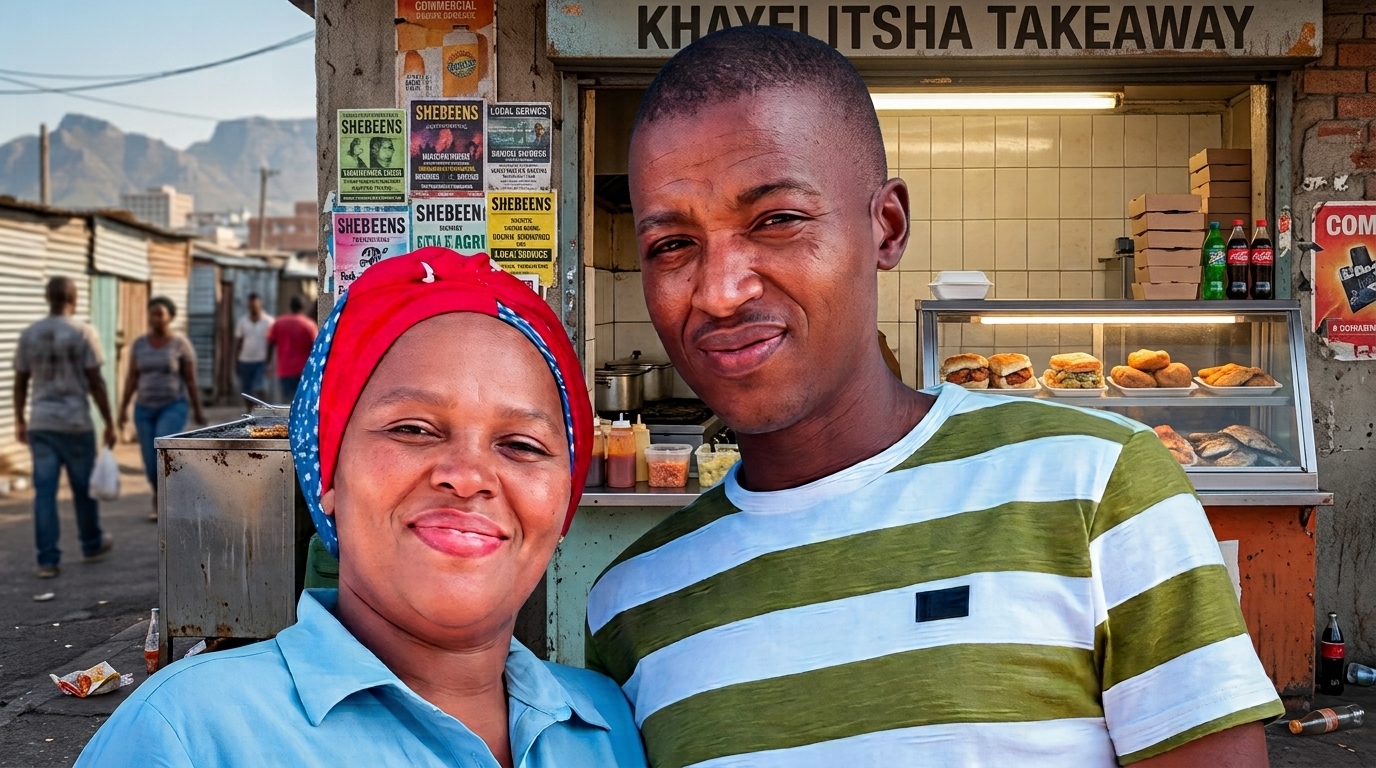
Couple killed as Cape Town protection-fee racket reaches into the poorest businesses
Phumlani Vokovi spent his life trying to build something in Khayelitsha. An actor, artist manager and small-business owner, he was known to friends as someone who wanted to promote the arts and create opportunities in the Cape Town township.
He also ran a modest hawker stall, selling tripe for R20 a plate. Last week, as he was closing for the day, he was shot dead. His wife, Nichume Vokovi, was later killed at their home.
Friends believe the couple were targeted after a dispute over a monthly "protection fee" demanded from Vokovi's stall. Police are investigating two counts of murder and no arrests have been made.
The killings have left relatives and friends frightened to speak openly. One friend, who did not want to be named because of fears about extortion gangs, said: "People are talking, but there is no-one who wants to come out in the open. The people behind protection fees are brutal."
The friend added: "People are hustling to chase the wolf away from their doors and not to get rich, and yet you have these people who come and demand the little that they make."
A week after the murders, those fears remained. Another friend said Vokovi had apparently refused to pay the required fee.
"Apparently he refused to pay the required protection fee," the friend said. "I mean, how much can you get from someone selling tripe for just R20? He did not even have a funeral policy. Some of his friends in the entertainment industry are now trying to raise funds for his funeral."
The Vokovi family has declined to confirm or deny that extortion was behind the killings. A family member said they wanted to wait for the police investigation before discussing the deaths.
"It's too soon to speak about their deaths. People are talking, but for the sake of our safety we will wait for the police report," the family member said.
The case has exposed the way protection-fee demands can reach people operating at the smallest end of the economy. For many informal traders, the money taken by extortionists is not a business expense that can be absorbed. It comes directly from earnings used to buy food, pay rent and support families.
About 40km from Khayelitsha, a 34-year-old woman in Steenberg said protection fees had become so routine that residents in her yard had developed a system to make collection easier.
The yard contains about four shacks. She said residents were woken at 3am one night when men kicked open their doors and demanded money.
"We stay in a yard with about four shacks," she said. "One night at 3am, we were woken by a noise. They were kicking open our doors, demanding a protection fee. They did not harm anyone or steal our belongings. All they wanted was the money. We then decided that the money, which is about R1,500, should be given to one person at month-end for easy collection."
In Dunoon, a salon owner said businesses were expected to pay about R300 a month. The demands are also reported in shops, rental yards, transport businesses and other places where people earn money outside the formal economy.
Western Cape police recorded 109 extortion cases between April and June this year. Protection rackets made up 52 of those cases. They included demands for protection fees, taxi-related extortion and attacks linked to the so-called construction mafia, where operations are disrupted and workers intimidated while contracts, jobs or money are demanded.
Spaza and tuck shops were the most common targets, accounting for 13 cases. Residential rental properties accounted for 10, while supermarkets accounted for six. Salons and barber shops, street vendors, transport and delivery businesses, individuals and religious institutions were also targeted.
The figures record only cases reported to police. In townships and informal settlements, fear often determines whether a victim reports anything at all. The people collecting the money may know where victims live, where their children go to school and how much they earn. Friends of the Vokovis have described that fear directly, refusing to attach their names to accounts of the killings.
The threat also extends far beyond street stalls and small shops. Over the past five financial years, 42 construction or infrastructure projects in Cape Town, worth almost R1.5bn altogether, have been affected by extortion, intimidation or construction-mafia activity.
Those cases have affected projects that are meant to create jobs and improve public infrastructure. In a parliamentary response, Acting Police Minister Firoz Cachalia said 12 projects had been affected by extortion, 16 by intimidation and 14 by construction-mafia activity. The response recorded no arrests or convictions in Cape Town in connection with those projects.
The construction sector has become one of the most visible fronts in the extortion economy. Criminal groups can demand access to sites, insist on a share of contracts or threaten workers and contractors who refuse to comply. The result is delayed work, increased costs and fewer opportunities for legitimate businesses.
Western Cape police oversight and community safety MEC Anroux Marais said: "when gangs and syndicates impose 'protection fees' on residents, business owners and contractors, they are not just stealing money; they are stealing opportunities, which hampers our collective job-creation efforts".
A recent police operation showed how organised the networks can be. Four suspects were arrested in August after an investigation into alleged extortion affecting more than 50 Somali and Ethiopian-owned businesses in Khayamandi and Stellenbosch. The suspects were a father and two sons from Nyanga, one of them a serving police constable, and a Somali businessman.
Police said the businessman allegedly collected specified amounts from the shop owners on agreed dates each month. Investigators seized R120,000 in cash and several mobile phones during the operation. The suspects face charges linked to the alleged extortion network and the handling of criminal proceeds.
The investigation involved serious violent crime detectives, crime intelligence, the drone unit, the National Prosecuting Authority, City of Cape Town security officials and the Financial Intelligence Centre. Police said further arrests could follow.
The presence of a serving police officer among those arrested has added to concerns about the ability of extortion networks to obtain information, protection or influence from within institutions meant to stop them. It has also underlined why victims often believe that reporting a demand could expose them to greater danger.
The government has established a National Priority Committee on Extortion under the National Joint Operational and Intelligence Structure. It brings together the South African Police Service and other agencies, including the National Prosecuting Authority, Business Against Crime South Africa, the Private Security Industry Regulatory Authority, the Department of Public Works and Infrastructure and the State Security Agency.
A national extortion hotline has been established, alongside provincial hotlines in the Western Cape and Eastern Cape. The Western Cape government has urged victims to report demands anonymously to the SAPS extortion hotline on 0800 31 44 44.
For the Vokovi family, however, the official response has come after two lives were lost. Phumlani's friends are now raising money for his funeral, while Nichume's family mourns her death at the couple's home.
The police investigation remains open. Capt FC van Wyk, the Western Cape police spokesperson, said officers were investigating two counts of murder. No arrests have yet been made.
In Khayelitsha, the stall where Vokovi sold a plate of tripe for R20 has become a reminder of the pressure facing people who are trying to survive through small trade. The demands made on them may be described as "protection" fees, but for families living on narrow margins, they can take away the little protection they have: food on the table, money for a funeral and the chance to build a business without fear.