

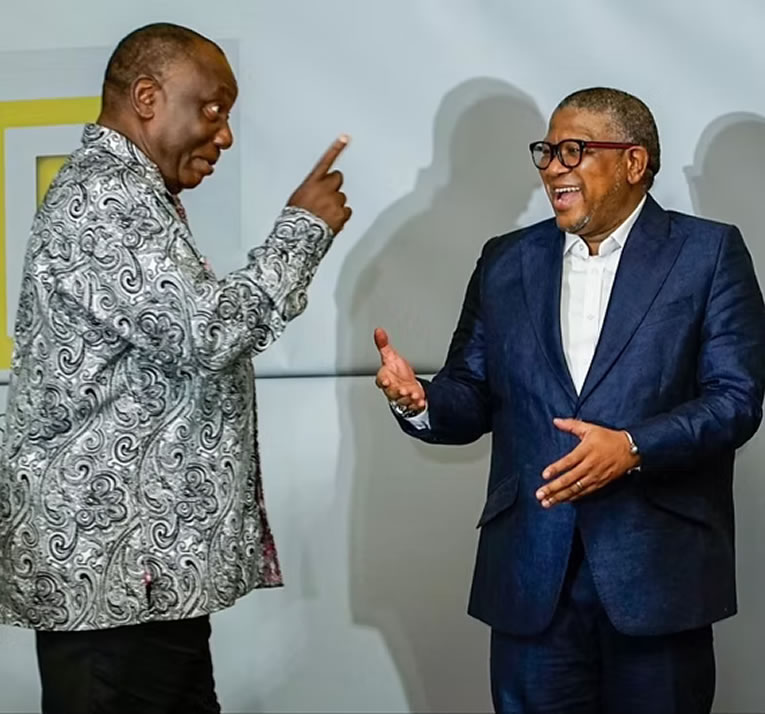
ANC president Cyril Ramaphosa has issued a stern warning to party leaders who are using the councillor candidate-list crisis to turn the political spotlight on secretary-general Fikile Mbalula or demand his removal.
During a tense National Working Committee meeting on Monday, Ramaphosa made it clear that attacks on Mbalula would not be tolerated. The meeting lasted from 2pm until midnight, as senior leaders wrestled with the fallout from the African National Congress’s failure to submit complete candidate lists in several important municipal areas.
The warning comes as an anti-Mbalula bloc inside the party appears to be gathering strength. However, Ramaphosa is said to have intervened forcefully, telling members of the committee to stop attacking the secretary-general or face disciplinary action.
The ANC faces the possibility of being absent from the ballot in municipal strongholds in the Eastern Cape, KwaZulu-Natal and the Free State after failing to complete and submit its full candidate lists before the Electoral Commission of South Africa’s deadline on 28 August.
In Port St Johns and Ngquza Hill, where about three out of every four voters supported the ANC in the 2021 local government elections, the party has no ward or proportional-representation candidates. In Mangaung, uMshwathi, Walter Sisulu and Sundays River Valley, it lost its proportional-representation lists. In total, 181 candidates are affected.
The ANC blamed system glitches for the failure. The Electoral Commission, however, has maintained that the crisis was caused by the party’s own actions. The ANC lost a court application asking the commission to reopen the submission process and has since approached the Constitutional Court in an attempt to challenge that judgment.
Mbalula has taken much of the blame, with several members of the party’s National Executive Committee calling for him to be held accountable. The push against him at Monday’s meeting was reportedly led by deputy minister Mondli Gungubele, who has criticised the candidate-list process. He is believed to have support from Zizi Kodwa, Khusela Sangoni, Stella Ndabeni and chief whip Mdumiseni Ntuli.
The ANC’s decision to pursue a Constitutional Court appeal was also used as ammunition against Mbalula. Those demanding accountability reportedly argued that there was no need to take the matter to the country’s highest court. The party nevertheless went ahead with the appeal.
Ramaphosa is said to have stunned the meeting when he warned that any future attack on Mbalula, whether made openly or through insinuation, would be dealt with through the party’s disciplinary process.
The ANC’s top seven leaders held the line in defence of the secretary-general, with the support of leaders from the Youth League and Women’s League. Other members of the National Working Committee who defended Mbalula included Fébé Potgieter-Gqubule, Justice Minister Mmamoloko Kubayi, national spokesperson Hlengiwe Bhengu, Mdu Manana, David Mahlobo and ANC head of presidency Sibongile Besani.
A third group, including Barbara Creecy and Thembi Simelane, reportedly called for calm as the dispute intensified.
Ramaphosa also told ANC leaders to stop spreading rumours in corridors and private conversations. He invoked a principle made famous by the party’s longest-serving president, Oliver Reginald Tambo: “Say it in front of the comrade or do not say it at all.”
“The president’s message to the leadership was blunt. He was unequivocal in his assessment that the ANC has slid back into a gossip season, with comrades plotting against one another in corridors, on phones and in private meetings rather than in the structures built for exactly that purpose,” an insider said.
Ramaphosa reportedly told the meeting that he knew about the attacks on Mbalula and called for a ceasefire. He warned that leaders who ignored the instruction would face disciplinary action.
“A president seldom ring-fences an individual office-bearer this plainly as the president did for Mbalula in front of the collective,” said an NWC member who is part of the anti-mbalula grouping.
“It took us all by surprise because the message travels in two directions: to the caucus — he was telling us that Mbalula is not isolated — and to the wider NEC. He was clear that the next person caught running a whispering campaign has been warned in advance.
“But talk is cheap. We want to see if he was just making empty threats or he meant it. The test now is enforcement — the first disciplinary step will show whether the directive has teeth.”
People close to Ramaphosa said his strong defence of Mbalula was driven by the belief that the campaign against the secretary-general was ultimately aimed at the president himself.
Ramaphosa is said to understand that Mbalula is viewed inside the ANC as standing between the president and a parliamentary impeachment process linked to the theft of foreign currency at Ramaphosa’s Phala Phala farm. The process relates to allegations surrounding money stolen from the farm, which Ramaphosa has denied wrongdoing in.
“The chief has come to learn that the two issues driving everything that is happening are Parliament’s impeachment process against him and the 2027 National Elective Conference,” the source said.
“The president is aware that the group meets before each NWC meeting at one of the members’ home to agree on talking points and strategy on how to deal with Mbalula and to allegedly plot Ramaphosa’s downfall as head of state before December 2027 conference.
“The objective is stated without embarrassment: drive Mbalula out of Luthuli House by all means necessary to ultimately weaken Ramaphosa and have him recalled from Union Buildings.
“The IEC administrative failures are regarded as the most opportune moment to pounce on Mbalula because this is when they judge him to be at his weakest.
“But what has become clearer is that there are two fights happening simultaneously with one set of combatants.”
On the candidate-list crisis, the National Working Committee resolved that the ANC should commission a forensic audit of the entire candidate-nomination system. The audit will not focus only on the Eastern Cape. The committee also agreed that members should stop blaming one another while the party pursues its Constitutional Court appeal.
Mbalula declined to comment, saying he did not discuss ANC meetings with the media.
Bhengu said details of closed ANC meetings were not meant for public consumption.
“I cannot confirm nor deny that because the NWC is a closed session, particularly on sensitive organizational matters of that nature,” she said.
For now, Ramaphosa’s warning has placed the next move firmly in the hands of the ANC’s disciplinary structures. Whether the president’s threat was a show of authority or the start of a real crackdown will be tested the moment another attack on Mbalula emerges.