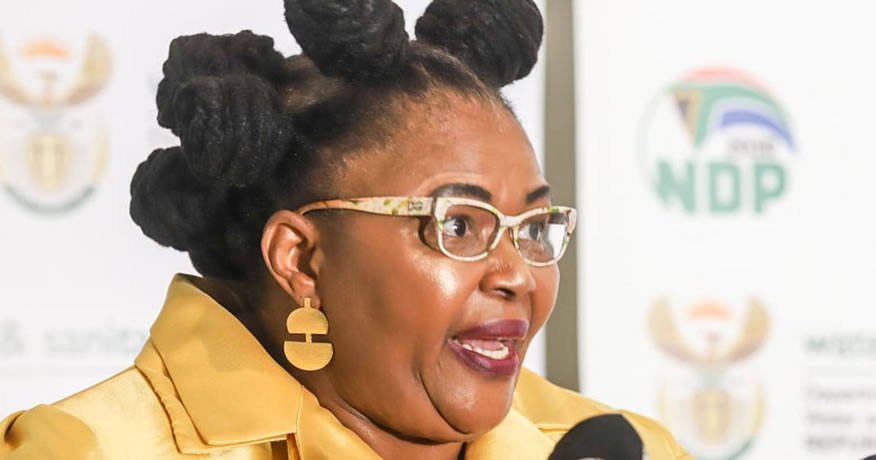
Disabled People South Africa (DPSA) says Water and Sanitation Minister Pemmy Majodina is not off the hook despite her apology after she allegedly swore at a disabled man during a community hall encounter in the Eastern Cape.
The matter has sparked anger among disability advocates after a video circulated on social media showed Majodina swearing at the man while ordering him to leave a community hall at Kouga municipality.
In the clip, Majodina is heard allegedly shouting: “Jou ma se p*es.”
Majodina responded to the controversy after it emerged online, saying her reaction came in response to being sworn at during the removal process of a resident from the venue.
Allegations and Majodina’s response
Majodina said yesterday she responded after a resident swore at her while he was being removed from the venue. She was also accused of trying to hijack an official government gathering to campaign for the ANC, which, according to people present, upset some of those in attendance.
“In the heat of the moment, I reacted after being subjected to profane language,” she said.
Majodina said that outbursts are part of the human experience and expressed regret for her behaviour.
“I sincerely apologise to the people of Kouga and to all South Africans,” she said.
“I also appeal to members of the public that, even when engagements become difficult, or emotions run high, we must
strive to maintain reciprocal respect and ensure that our interactions remain constructive.”
However, DPSA says her explanation does not go far enough.
DPSA: “We actually want her to be fired”
DPSA national chair Patrick Mahlakoane said the organisation was not satisfied by Majodina’s statement and that they would push for disciplinary action.
“We will write to South African Human Rights Commission. We need to protect persons with disabilities from any form of abuse. We actually want her to be fired for what she did even if she did claim to apologise,” he said.
Mahlakoane said they were disturbed by the incident, arguing that disability rights are guaranteed in South African law.
“The rights of persons with disabilities are protected by the constitution of South Africa and by the country’s commitment to equality, human dignity and non-discrimination,” he said.
“Public office bearers have a particular responsibility to uphold these principles.”
DPSA, Mahlakoane added, has also been critical of how political parties approach disability inclusion as the election season draws closer.
He recently accused political parties of excluding people with disabilities as the upcoming elections approach.
He said the organisation was outraged and concerned about the continued marginalisation of people with disabilities.
“South Africa’s democracy cannot be sustained while people with disabilities are excluded from meaningful participation and are not at the centre of the national and local developmental agenda,” he said.
Comparison with another swearing incident by Johannesburg mayor
DPSA’s anger comes only weeks after another senior official faced backlash over swearing at a resident during a community engagement.
The Majodina incident came just weeks after Joburg mayor Dada Morero faced criticism for swearing at a Tshepisong township resident during a community engagement.
The argument reportedly began when an elderly resident repeatedly accused Morero of corruption. The mayor became angry and told the man that, despite his age, he was talking rubbish.
In both cases, disability advocates and reputation experts say the behaviour raises questions about how public representatives handle confrontation—particularly when residents are upset or when tensions rise during gatherings.
Reputation expert calls for training and emotional maturity
Reputation expert Tshepo Matseba said there was a need to train public representatives to handle confrontational situations.
Matseba said the ANC’s condemnation of both the Morero and Majodina incidents was important because it showed that the conduct was inconsistent with the standard expected of public representatives.
“But from a reputation and trust perspective, condemnation after the fact is not enough. These incidents point to a broader leadership risk: public representatives operate in highly frustrated communities where confrontation, criticism and even provocation are inevitable,” Matseba said.
He said the greater responsibility, therefore, rested with leaders to demonstrate emotional maturity, restraint and empathy under pressure.
Citizens, Matseba said, would judge parties not only by what they said, but by how their leaders behaved when confronted by the very people they had been elected to serve.
Majodina takes some accountability for her reaction
While DPSA wants her fired, Majodina has said she accepted responsibility for her conduct and regrets responding with the same words directed at her.
Majodina did take some accountability for her reaction.
“I take responsibility for my conduct and regret responding by using the same words directed at me.”
For DPSA, the apology and expression of regret do not outweigh the allegation and the impact that language directed at a disabled person can have—especially coming from a senior government minister.
As DPSA prepares to write to the South African Human Rights Commission, the incident is expected to remain a political pressure point, with advocates insisting that respect for disabled people must be upheld by officials at all times.