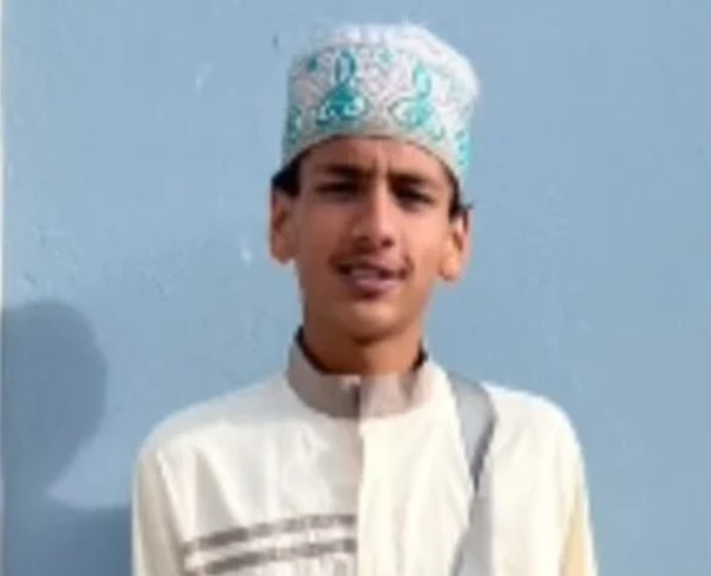
A 17-year-old boy who travelled from the Cape Flats to Gauteng with hopes of building a better future was allegedly stabbed to death in his hostel room at a mosque in Springs.
When Abdul Mutalib left home in July, his grandmother gave him a blanket for the journey. Three weeks ago, that same blanket was used to wrap his body when he was returned to his family in Pelikan Park.
Abdul had travelled to Gauteng to continue his Islamic studies after the premises where he had originally enrolled in Uitenhage, in the Eastern Cape, were vandalised. His family now wants answers about what happened inside the residential section of the Jameah Mahmoodiyah Masjid in Persida, Springs, on 20 August.
The teenager was allegedly attacked by a group of Filipino students and stabbed multiple times with a knife. Police have confirmed that Abdul suffered stab wounds and was declared dead at the scene. No arrests have been made.
His family and those supporting them say the investigation has left them with more questions than answers. They claim that only two witness statements have been taken, despite there allegedly being several people who saw or knew something about the incident.
Advocate Shameemah Salie, who is helping the family seek justice, said some witnesses had still not been contacted by investigating officers. She also said the alleged attackers were apparently still at the mosque when police arrived, but were not questioned at the scene.
It remains unclear whether the men accused of being involved are still in South Africa.
“We are getting no answers. If those students are no longer in the country, they are going to get away with it and do it again. What happened here goes against humanity, regardless of faith.”
Salie said the circumstances surrounding the attack were still not clear. There are allegations that the incident began after a power bank was allegedly stolen. A mosque employee gave a brief account when asked about what had happened.
“They fought over something that was stolen.”
The alleged attack took place in the hostel area, where students were living while studying at the mosque. Abdul was one of nine boys from the Cape who had begun their Islamic studies in Uitenhage. After the vandalism at the Eastern Cape premises, the boys were temporarily moved to Springs in July.
At the Jameah Mahmoodiyah Masjid, they were expected to memorise the Quran, a programme commonly known as Hifz, while also receiving advanced Islamic studies and training in Islamic law. The centre accommodated students from South Africa and other countries. The young Filipino men named in the allegations were also students there.
Abdul’s journey had been a major step for a child who had been raised by his grandparents and extended family. His parents were both deceased, and the family had watched him leave with hope for a life shaped by faith and education.
“He left with hope for a better future, but he never came home,” Salie said.
She described Abdul as a much-loved child whose death has devastated the family. She also recalled a troubling comment he made the last time he was home.
“He was a beautiful boy. It is devastating for the family. The last time he was home, he told his grandmother she could give away his clothes because he would not be wearing them again. It was a strange thing to say,” Salie said.
One of Abdul’s friends was also allegedly assaulted during the incident. The friend survived and later returned to the Cape, but the attack has left Abdul’s family demanding a full account of what took place and why the violence was not stopped.
The condition of the mosque and its hostel has also raised concern. During one visit last week, the gates were locked and the premises were quiet, appearing to be non-operational. When the site was visited again on Friday, students had returned and the centre appeared to be functioning normally.
The mosque said it was cooperating with the authorities and had already handed over all information available to the police. It said it would support the outcome of the investigation “whatever it may be”.
Captain Tintswalo Sibeko, a Gauteng police spokesperson, said the case involved a young man who had sustained stab wounds and died at the scene. She confirmed that nobody had been arrested.
Sibeko said anyone who was unhappy with the handling of the case could report the matter to the station commander in Springs or to the district commissioner.
That response has done little to ease the family’s pain. They want investigators to speak to every possible witness, establish exactly who was present when Abdul was attacked and determine whether those accused are still in the country. They also want the events inside the hostel to be placed on record before memories fade and people move on.
Questions have also been raised about the rules governing Islamic educational centres and residential facilities where young students live away from their families. The Muslim Judicial Council was asked whether centres such as the Jameah Mahmoodiyah Masjid are regulated, and which body is responsible for overseeing them, but no response was received.
For Abdul’s family, the matter is not about an ordinary fight or a missing power bank. It is about a teenager who left home to study, returned in a blanket meant for his journey and never got the chance to complete the future he had travelled so far to pursue.
Until the witnesses are heard, the alleged attackers are accounted for and the police investigation produces clear answers, Abdul’s family will be left facing the same painful question: how did a place meant for learning and spiritual growth become the scene of a young boy’s final moments?