

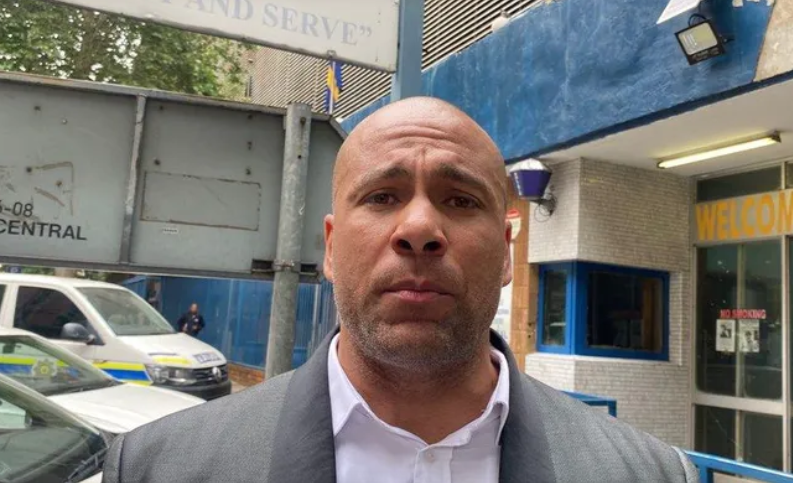
Stuart James Scharnick has been arrested at the Madlanga Commission of Inquiry after a journalist opened an intimidation case against him following an alleged confrontation inside the commission’s auditorium.
The incident reportedly took place at the Bridget Mabandla Justice College in Pretoria, where the commission is sitting.
It allegedly began after Sowetan journalist Herman Moloi filmed Scharnick interacting with suspended National Coloured Congress MP Fadiel Adams during proceedings.
Scharnick allegedly confronted and intimidated Moloi over the recording, leading the journalist to report the matter to police.
Members of the South African Police Service later arrested Scharnick at the commission.
The incident has drawn strong condemnation from Sowetan, which described the alleged conduct against its reporter as unacceptable.
Sowetan editor Sibongakonke Shoba said the publication was appalled by Scharnick’s alleged actions.
“The Sowetan is appalled by the unacceptable conduct of Stuart-James Scharnik, who threatened and intimidated our reporter Herman Moloi, who is covering the Madlanga Commission from the Bridget Mabandla Justice College. We condemn this behaviour in the strongest terms,” Shoba said.
Shoba said the publication had lodged a complaint with the commission and that a criminal case had been opened with police.
“Threats against journalists are a threat against democracy,” he said.
He warned that journalists must be able to cover issues of public interest without fear, threats or harassment.
Shoba said intimidation does not only affect the journalist directly involved, but also undermines the public’s right to access information.
“We call on law enforcement to act swiftly against the perpetrator to protect media freedom,” Shoba said.
The Madlanga Commission also commented on the arrest.
Commission spokesperson Jeremy Michaels said: “We will not tolerate this.”
The arrest happened against the backdrop of the commission’s public proceedings, which are being closely followed because of the senior policing figures and politically connected individuals linked to the inquiry.
Scharnick has also been accused in connection with serious criminal activity, including being described as a “serial hijacker” with an extensive criminal record.
Those allegations are separate from the intimidation case that led to his arrest at the commission.
Scharnick is also an associate of suspended deputy police commissioner Lieutenant-General Shadrack Sibiya.
The circumstances around the alleged confrontation with Moloi are now expected to form part of the criminal case opened with police.
The incident has again raised concerns about the safety of journalists covering public inquiries, court cases and politically sensitive matters.
Journalists attending commissions and court proceedings are often required to record, photograph and document interactions involving public figures and persons of interest, particularly when proceedings are open to the public.
Media organisations have repeatedly warned that intimidation of reporters can have a chilling effect on public-interest journalism.
In this case, Sowetan has made it clear that it views the alleged conduct as an attack on press freedom and the public’s right to know.
The commission’s response also suggests that officials will not allow threats or intimidation to interfere with the work of journalists or the proceedings taking place at the venue.
Police are now expected to process the intimidation complaint and determine the next steps following Scharnick’s arrest.
It remains to be seen whether Scharnick will appear in court and what charges will formally be placed before a magistrate.
The commission is expected to continue with its work despite the incident.
For now, the confirmed facts are that Moloi opened an intimidation case, Scharnick was arrested by SAPS members at the commission, and both Sowetan and the commission have condemned the alleged conduct.
The matter is developing.