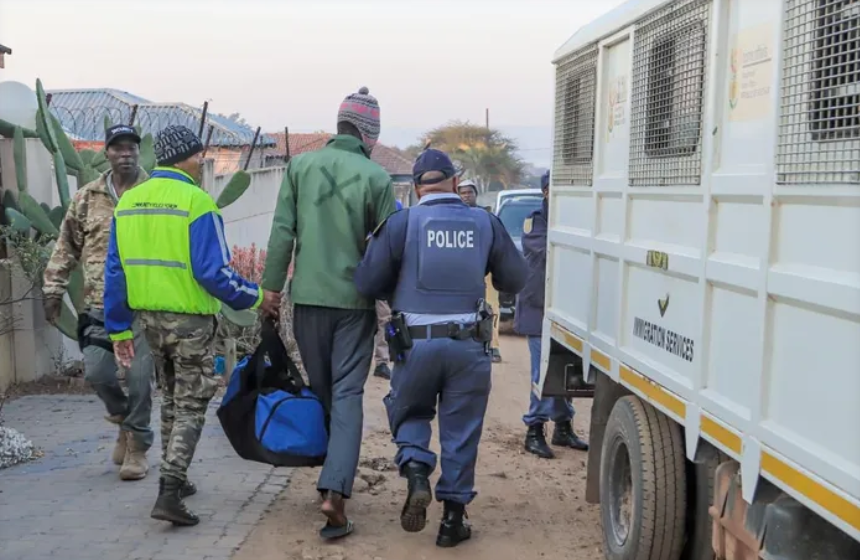
KRANSKOP – A massive police operation has led to the arrest of 65 people following a violent anti-immigrant march in the KwaZulu-Natal town of Kranskop, which left three foreign nationals injured and local businesses looted. The suspects, who were intercepted while allegedly traveling to another town to continue their campaign, appeared in the Kranskop Magistrate’s Court on Thursday, August 6, 2026.
The group faces a litany of serious charges, including public violence, malicious damage to property, and assault with intent to do grievous bodily harm (GBH). The arrests follow a week of high tension in the region as self-styled "anti-illegal immigration" groups have intensified their efforts to shut down foreign-owned businesses.
The Kranskop Chaos
The violence erupted on Wednesday when a march, purportedly aimed at identifying undocumented migrants, descended into chaos. According to witnesses, the peaceful protest quickly turned into a spree of looting and physical attacks.
Three foreign nationals were caught in the crossfire, sustaining significant injuries. KwaZulu-Natal police spokesperson Colonel Robert Netshiunda confirmed that two of the victims were so severely beaten that they had to be rushed to a nearby hospital for emergency treatment.
"The march reportedly resulted in shops being looted and three foreign nationals being injured," Netshiunda told News24. "Preliminary investigations indicate that the injured foreign nationals were in the country legally, although their immigration status will still be verified by the Department of Home Affairs."
The Greytown Interception
The breakthrough in the case came when police received intelligence that the group had boarded a bus and was heading towards Greytown, allegedly to launch a similar wave of attacks.
Acting on this information, SAPS units set up a roadblock on the R74 road. The bus was stopped, and all passengers were taken to a local police station for questioning. While approximately 80 people were initially detained, 65 were eventually linked to the criminal activities in Kranskop and formally charged.
"They were held up at a police station because we had information that they were part of a march in Kranskop which turned violent," Netshiunda explained. "We don’t want to arrest people for no reason, but we also don’t want to lose people who have committed a crime."
A Stern Warning to Vigilantes
The Kranskop incident has prompted a sharp warning from the provincial police leadership. Netshiunda emphasized that while South Africans have a constitutional right to protest, they do not have the right to take the law into their own hands.
"As much as they’ve got a right to march, they must do so within the ambit of the law. Nobody has got the right to assault anybody. Nobody has got the right to search any other individual. It’s the job of law enforcement," he said.
He added that the police would continue to support lawful protests but would act "without fear or favour" against anyone involved in criminal activities, including looting or vigilante-style searches of foreign-owned shops.
The Broader Context
The violence in Kranskop is not an isolated event. It comes on the heels of a massive nationwide crackdown on undocumented migrants that saw over 900 people arrested in July alone. The "March and March" movement and other similar groups have been vocal in their demands for the mass deportation of illegal foreigners, often sparking clashes with both the police and migrant communities.
For the residents of Kranskop, the aftermath of the march has left a trail of destruction. Business owners, both local and foreign, have expressed fears over the continued instability. "We are living in fear," said one shop owner whose store was targeted. "We don't know when they will come back."
Court Appearance and Next Steps
The 65 suspects remained in custody overnight before their appearance in the Kranskop Magistrate’s Court on Thursday. The state is expected to monitor the situation closely, with further arrests not ruled out as forensic investigations into the looting continue.
The Department of Home Affairs is also expected to play a role in the ongoing probe, verifying the status of those targeted during the march to determine if any laws were actually being broken by the shop owners.
For now, Kranskop remains under heavy police presence as authorities work to restore order and prevent any retaliatory attacks. The message from the SAPS is clear: the streets belong to the law, not to the mob.