

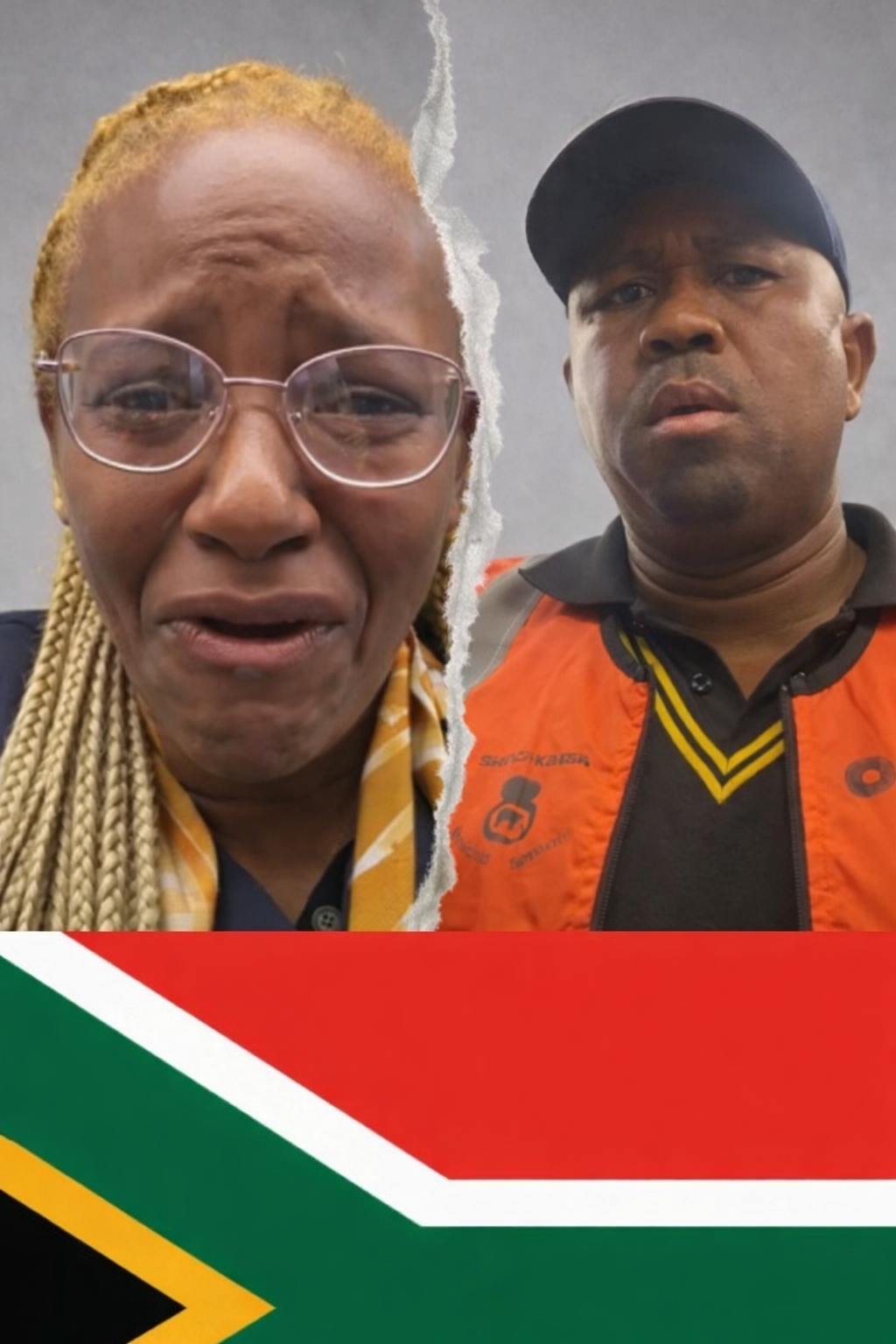
A video posted by a Metrorail commuter in the Western Cape — in which she claims she was harassed and physically manhandled by security guards after failing to return what she describes as an “aan-klop” greeting — has gone viral, triggering political outrage and a formal response from the Passenger Rail Agency of South Africa (Prasa).
The commuter, Lumka Mbele, shared the video with her more than 12 000 social media followers, describing a series of encounters that she says unfolded over several days on her regular train route between Cape Town and Strand. In the footage she recorded, she is surrounded by stern-faced security guards, while one can be heard repeatedly telling her to leave.
Mbele’s account begins with what she describes as a shift in the atmosphere on a train journey she had previously experienced as peaceful. Speaking through tears, she said her “peace” on the route was “uitmekaar geskeur” from Thursday, 9 July — days before she recorded the now widely shared video.
She said what sparked the hostility was a moment she insists should never have escalated: a guard greeted her and she did not respond.
An emotional Mbele explained: “Ever since I’ve been taking the Cape Town to Strand train, I’ve been getting nothing but abuse from security guards on the Prasa train.
“All of this because a security guard greeted me and I didn’t greet back.”
According to Mbele, the situation intensified the next day, Friday, 10 July, and escalated “vinnig”. In her telling, a confrontation then centred around how she was sitting in the carriage — something she says had never been policed before.
She told her followers: “I had my legs on the seat. We used to sit like that when we were sleeping, and nobody ever had a problem with that back then.
“And today, three security guards tried to manhandle me, just because of their friend… just because I didn’t greet their friend back.”
In the video footage, Mbele is surrounded by security guards. Her recording captures the tension at close range. One guard can be heard saying “Hamba! Hamba!” — a word in isiXhosa or isiZulu commonly used to tell someone to go away or to chase them off.
Mbele’s explanation for the alleged mistreatment goes beyond the question of a greeting. She suggested she was targeted because she refused to be flirted with and did not want to engage with the guard in that way.
Mbele added: “They treated me like this because I didn’t want to be flirty with their friend.
“I now have a scar on my forehead as a result of how they treated me.”
View this post on Instagram
Her claim about a scar introduces a potentially serious allegation: that the encounter involved violence resulting in injury. At this stage, the article does not indicate whether she has laid a formal criminal complaint or whether she has provided medical documentation, but the allegation has already become a flashpoint for wider concerns about commuter safety, power abuse and accountability in public transport spaces used largely by working-class residents.
The video has also drawn political reaction. Patriotic Alliance mayoral candidate for Cape Town Cheslyn Steenberg Daniels said he was angered by what he saw and framed the alleged incident as part of a broader pattern of poor people being treated as expendable.
Steenberg Daniels said his blood began to “boil” as he watched the video and saw how Mbele was treated.
Steenberg Daniels wysed: “For the ‘crime’ of resting her feet, this woman was allegedly subjected to violence.
“Not a warning. Not a gentle correction. Violence.
“We’ve suffered enough, beaten down by crime and poverty by a system that often treats poor people as invisible. And we must now accept that a woman can’t even sit on a train without being assaulted?”
His remarks elevate the incident beyond an individual dispute on a train, casting it as symbolic of how commuters — particularly those reliant on public rail — can be vulnerable to abuse by those tasked with ensuring safety.
Prasa, which manages passenger rail services, responded with a statement appealing for respect and reaffirming its obligations to commuters. The agency said it had noted a growing number of commuter experiences being shared on social media, and urged commuters, employees, security personnel and the public to uphold Prasa standards of safety and dignity.
Prasa said it had prioritised its investigation into Mbele’s allegations, indicating the incident would not be ignored. While it did not publicly confirm the identity of the guards involved or specify what disciplinary process may follow, the tone of the statement sought to reassure commuters that discrimination and exclusion would not be tolerated.
The statement reads: “No commuter may be discriminated against or denied passage on the grounds of nationality, race, language, gender or any other personal characteristic.
“This is not simply a matter of policy. It is a constitutional right that Prasa Western Cape is duty-bound to protect.”
The wording is notable because it frames commuter rights as constitutional, not optional — and because it lists several grounds on which commuters may not be discriminated against, including gender. That emphasis may be read as an acknowledgement of the vulnerability women can face in public transport settings, particularly where authority figures are alleged to act abusively.
Mbele’s account, and the reaction it has sparked, lands in a context where rail commuters in the Western Cape have long complained about safety, reliability and inconsistent enforcement of rules. For many who depend on trains to travel to work, school and services, the relationship between commuters and private security or rail protection personnel can be tense, especially when guards are perceived as heavy-handed or unaccountable.
At the heart of Mbele’s claim is a question that has resonated widely online: whether a commuter can be targeted for not responding to a greeting — and whether refusing unwanted attention from a security guard can become the trigger for intimidation and physical handling. If her allegations are substantiated, it would raise concerns about professionalism and abuse of power by those meant to protect passengers.
For now, Prasa says the matter is being investigated, and the video continues to circulate as commuters, activists and political figures debate what happened — and what consequences should follow if Mbele’s claims are confirmed.