

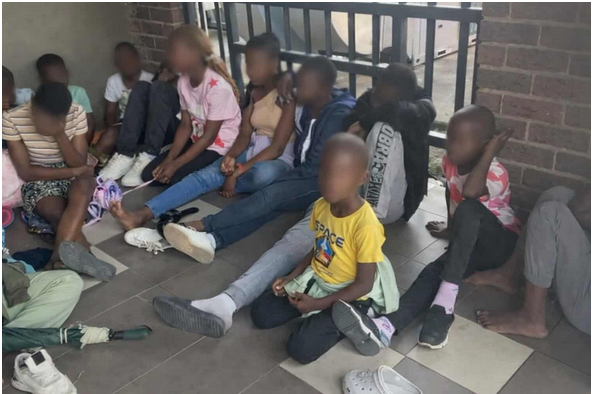
Thousands of Zimbabwean children who have spent their entire schooling lives in South Africa now face being pulled out of classrooms as their families are deported or choose to leave — and education advocates warn that the move could trigger a crisis that will not only disrupt matric exams but potentially set pupils back by years.
The Zimbabwe exemption permit coordinating committee has appealed to both the South African and Zimbabwean governments to intervene urgently, saying a looming education disaster is unfolding for learners who have been educated under South Africa’s curriculum and assessment policy statement (Caps) and may be unable to transition smoothly into Zimbabwe’s schooling system.
At the centre of the committee’s concern is the timing. With the country’s political and enforcement climate pushing some migrant families out — through deportation processes or by fear-driven decisions to leave — children are being uprooted mid-year, some just months before writing South Africa’s high-stakes final examinations.
Edward Muchatuta, the committee’s national coordinator, said the most immediate danger involves Grade 12 pupils who are preparing to write the National Senior Certificate examinations in November. Many, he said, have studied in South Africa from the start of their school careers and have no educational footing elsewhere.
He warned that these matric pupils now face being withdrawn because their parents or guardians are being deported, or are leaving the country.
Those in Grades 10 and 11, Muchatuta said, could also be placed in a near-impossible position: after more than a decade of following Caps, they may be forced to adapt to a different system with different assessments, different language expectations and different subject offerings. The result, he suggested, could be a delay of years in completing school.
“How will they prepare and sit for these critical examinations if they are forced to relocate now. Imagine after 11 years you have been doing Caps and in your final year of school forced to do the Zimbabwean [syllabus],” said Muchatuta.
“Assessment of Zimbabwean secondary schools is different from SA’s Caps. On languages, these children do not understand Ndebele or Shona. Also, in Zimbabwe there is no maths literacy or life orientation.”
The committee’s warning draws attention to the practical, often overlooked reality of migration policy: children do not only cross borders physically; they cross systems — from curricula and timetables to exam rules and subject structures. When that transition happens abruptly and without planning, the damage can be lasting, especially for learners on the cusp of qualification.
Muchatuta said the risk is not confined to high school. Primary school learners may face a similar bottleneck, particularly those approaching key examination points in Zimbabwe’s system.
He said in Zimbabwe, registration for Grade 7 national examinations closed earlier this year, which he believes could leave returning children unable to progress to secondary school next year. For families arriving after that cut-off, the implication is stark: children could be stranded in limbo, unable to sit exams required for the next schooling stage.
The committee also framed the issue as one shaped by inequality. It said most affected families are low-income earners — particularly domestic workers — who are expected to return to Zimbabwe without employment, making the problem of school transition even harder. If parents cannot quickly secure work, afford transport or pay school-related costs, educational disruption can deepen into long-term dropout risk.
In response, the committee has proposed emergency arrangements that would allow affected pupils to continue with the South African Caps curriculum even after returning to Zimbabwe — an idea aimed at preventing learners from losing years of work because of a forced curricular switch.
To make that possible, it has called for education authorities in both countries to establish cross-border mechanisms that treat Caps as an alternative pathway for those returning. It also proposed the creation of joint examination centres at Beitbridge and at the Musina Repatriation Centre, allowing Zimbabwean matric pupils to write South Africa’s final exams even if their families have relocated.
The logic is straightforward: if learners have followed Caps for 11 or 12 years, pulling them out weeks or months before the final exams risks wasting years of schooling — and the committee believes there are practical points along the border where examinations could be administered with the right political agreement and administrative framework.
The committee said qualified teachers among returning Zimbabweans were willing to volunteer to provide academic support if both governments created the necessary framework.
For Muchatuta, the scale of concern is already visible in the responses the committee says it has received from parents. In under a week, he said, there had been “more than 2 000” submissions from parents asking for their children to continue with Caps.
Muchatuta said in less than a week, there had been “more than 2 000” submissions from parents who wanted their children to continued with Caps curriculum.
“Some are not opting for repatriation due to education issues. If there is political will to facilitate Caps as an alternative for those returning, more migrants will send their children back to Zimbabwe,” he said.
His comments suggest that education has become one of the hidden drivers shaping migration decisions: some families may be staying in South Africa, even under pressure, because leaving would derail their children’s schooling at the most critical point.
Meanwhile, Zimbabwe’s government has begun responding publicly to the return of learners. Zimbabwean Information, Publicity and Broadcasting Services Minister Zhemu Soda said President Emmerson Mnangagwa has instructed schools to accommodate pupils returning from South Africa within their catchment areas.
That instruction may address immediate access to classrooms, but it does not resolve the deeper issue raised by the committee: the curriculum mismatch, exam deadlines, language barriers and subject differences that could make “accommodation” in a local school insufficient for learners who have been educated entirely under a different system.
Muchatuta warned the likely outcome if no tailored intervention is made.
“What is going to happen is that our children are not going to be able to continue with their education,” Muchatuta said.
The committee’s appeal also arrives against a rapidly shifting migration context. Since last month, more than 60 000 Zimbabweans have returned home, a movement linked to anti-illegal immigration protests in South Africa. For some families, the decision to leave has been shaped by fear and uncertainty, while others have been pulled into formal deportation processes.
Whatever the legal category, the committee argues the impact on children is the same: schooling that is interrupted not by academic failure, but by policy and enforcement pressure that takes little account of what it means for a child to finish a school year, write an exam, or complete a qualification.
By the time of publication, South Africa’s department of basic education had not responded to questions.
For now, parents, teachers and advocacy groups remain caught between two state systems, trying to stop children from becoming collateral damage in an immigration crackdown. The committee’s proposals — joint exam centres, alternative curriculum arrangements and volunteer teacher support — are, at their core, an attempt to buy time for learners at the edge of crucial milestones, especially those whose November matric exams could determine whether years of schooling culminate in a certificate — or collapse into a forced restart.