

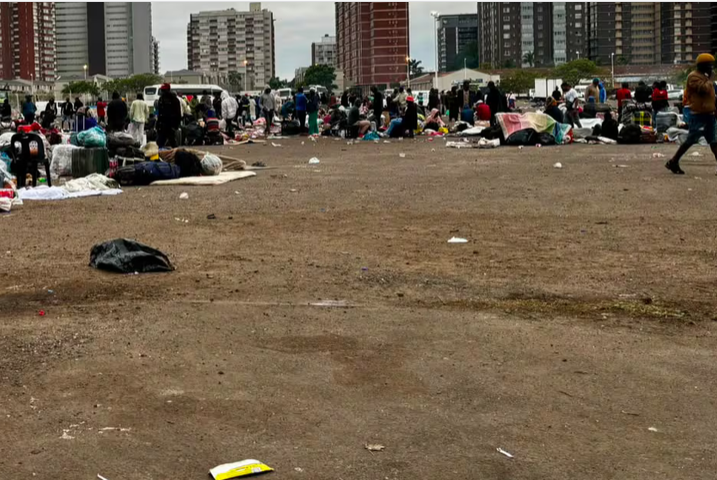
eThekwini municipality has appealed to employers, transport operators and members of the public to stop bringing foreign nationals to the decommissioned repatriation site at the Durban Drive-In, warning that the facility is closed and no services are being provided there.
The call comes after the city said it had already confirmed the site’s closure on Tuesday, yet people continued arriving — some reportedly being “dropped off” by employers in the apparent hope that government would step in and offer assistance. By Friday, the municipality said, about 700 people had gathered alongside the fenced-off site, sitting with bags of clothing and other possessions as uncertainty grew over what would happen next.
The municipality’s latest statement signals both a logistical and humanitarian concern: the site is no longer operational, but people continue to congregate there expecting repatriation services, transport, processing and support that have since been moved elsewhere.
“The public, employers and transport operators are urged to refrain from bringing foreign nationals to the site, as no services are being provided there.
“The temporary repatriation processing centre for undocumented foreign nationals has been centralised in Musina, Limpopo, under the co-ordination of the department of home affairs," the city said on Friday.
The city’s wording was direct and unambiguous. It framed the issue as a matter of public cooperation, saying continued arrivals at the Durban Drive-In were not only unhelpful but could deepen distress for the people left waiting outside a closed facility.
In previous weeks, the Durban Drive-In and Sherwood sites were among the main processing points for repatriation operations, particularly for Malawian nationals. The municipality said more than 20,000 Malawians were processed and repatriated through these sites during the operation — a significant number that reflects both the scale of the exercise and the pressure placed on local logistics, transport and coordination.
“To support the operation, government procured more than 300 buses, of which eThekwini municipality provided 150 on a cost-recovery basis.”
That support, however, now forms part of what appears to be a transitional gap: after the decommissioning of the local processing site, people are still arriving as though the system remains active in Durban. The municipality suggested this was being driven in part by employers who are transporting workers — or former workers — to the fenced-off area in the hope that authorities will resume services there.
The city said the repatriation processing centre for undocumented foreign nationals has now been centralised in Musina, Limpopo, under the coordination of the Department of Home Affairs. By emphasising that point, eThekwini is effectively redirecting the public to national government structures and signalling that there is no municipal authority to continue running or reopening a repatriation site in Durban.
The municipality also stressed that issues relating to undocumented foreigners are not within its primary legal mandate, placing responsibility squarely on Home Affairs.
The municipality said all matters relating to undocumented foreigners fall under the mandate of the department of home affairs.
The timing of the closure is also politically and socially significant. The last group of foreign nationals was transported to Musina on Tuesday — the same day as national protests against illegal migrants and the “deadline” given by organisers for undocumented foreigners to leave the country. In KwaZulu-Natal, and especially in eThekwini, tensions around immigration enforcement and public mobilisation had been closely watched, with authorities deploying security and appealing for calm.
Against that backdrop, the municipality was careful to describe Tuesday’s marches in Durban as peaceful. It said there had been no major incidents of violence, loss of life or significant damage to infrastructure in the city.
The city said the marches held on Tuesday were peaceful and orderly, with no major incidents of violence, loss of life or significant damage to infrastructure reported in the city.
It also credited a range of role players — residents, march organisers and law enforcement agencies — with ensuring that demonstrations proceeded without incident, acknowledging what it described as responsible conduct.
They acknowledged the responsible conduct of residents, march organisers and law enforcement agencies in ensuring that the demonstrations proceeded without incident.
The city’s statement, though largely administrative, reflects the wider reality facing municipalities as national immigration politics and enforcement efforts spill into local spaces. Even where cities are not mandated to handle documentation or deportation decisions, they often find themselves dealing with the real-world consequences: people sleeping outdoors, informal camps forming near processing centres, and humanitarian pressure building when services move or end abruptly.
In this case, the presence of about 700 people by Friday outside a fenced-off, decommissioned site suggests the closure has not been fully absorbed on the ground — either because information is not reaching those affected, or because those arriving are acting out of desperation and uncertainty.
The city has not indicated what support, if any, is available for those already gathered at the Durban Drive-In. But its message makes clear that the site will not provide repatriation processing, transport or shelter, and that the system has shifted north to Musina. For foreign nationals left waiting outside the fence with their belongings, that shift may mean a longer journey, less clarity, and a reliance on networks and resources many may not have.
For employers and transport operators, the municipality’s statement is a warning that dropping people at the site does not constitute a solution and could worsen conditions by increasing the number of stranded individuals with no services available.
At the same time, the city’s emphasis on Tuesday’s peaceful marches appears designed to dampen any narrative that Durban is sliding into instability. By highlighting that there was no major violence or infrastructure damage, eThekwini is presenting the city as orderly — but now confronted with a different kind of challenge: managing the aftermath of a repatriation operation and preventing a closed site from becoming an informal, unmanaged gathering point.
As the situation develops, the key question is what happens to the people currently at the Durban Drive-In — and how quickly Home Affairs, provincial authorities and humanitarian organisations respond to prevent further hardship as more individuals arrive at a place where, the municipality insists, “no services are being provided”.