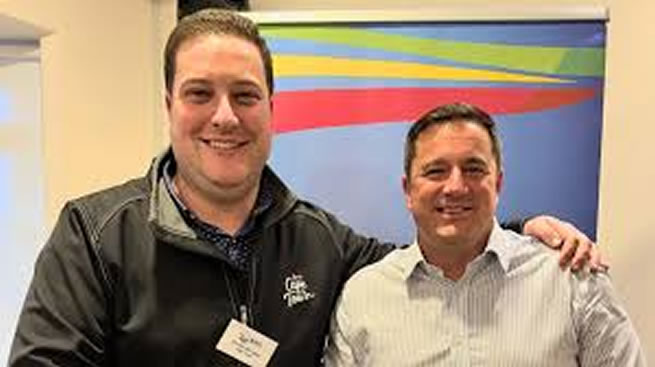
Cape Town, South Africa – A political storm is brewing within the Democratic Alliance (DA) as newly elected leader Geordin Hill-Lewis stands accused of a calculated betrayal, having unceremoniously fired John Steenhuisen from his ministerial post just two months after allegedly promising him job security. The dramatic axing of the former DA leader from his Cabinet role as Agriculture Minister has ignited widespread outrage and division within the party, exposing deep fissures and strategic manoeuvres aimed at winning back disgruntled voters.
The saga began with a promise. According to senior DA politicians and officials with direct knowledge of the events, Hill-Lewis assured Steenhuisen he would retain his ministerial position. This assurance, sources claim, was pivotal in Steenhuisen’s decision not to challenge Hill-Lewis at the party’s elective conference in Midrand in April. “Geordin’s promise to John directly led to him stepping aside from the leadership race,” a senior DA politician revealed, adding a potent claim: “John would have beaten Geordin in Midrand if he ran.” This suggests a calculated political gambit by Hill-Lewis, which has now backfired spectacularly in the eyes of many.
News24 spoke to seven senior party members and officials who painted a vivid picture of the two tumultuous months leading up to Steenhuisen’s dramatic removal. “John feels betrayed. Geordin gave him his word that he would remain minister of agriculture. He expected Geordin to back him through the foot-and-mouth disease (FMD) crisis like the party backed Helen [Zille] after her colonialism tweets,” a staunch Steenhuisen supporter confided to News24. The sentiment of betrayal resonated deeply, with DA MP Emma Powell expressing her dismay on a caucus WhatsApp group: “The expediency and sheer scale of betrayal here is head-spinning… He stepped down on terms agreed to and has now been betrayed in the very worst way possible.”
Steenhuisen, visibly shaken by the turn of events, declined to comment directly on the matter, stating only that he was “still considering his political future.” Hill-Lewis, when pressed on the specific questions regarding his alleged promise, offered a more philosophical defence: “For so long our country’s leaders have turned their face away from making decisions because it is hard. Of course, it is much easier to walk past a problem or pretend it doesn’t exist. But I decline to do so. Because that’s not what will get South Africa working.” His response, while statesmanlike, did little to quell the internal dissent.
The dramatic climax of this political drama unfolded at the airport. Sources close to the situation relayed the tense hours leading up to Hill-Lewis’s executive reshuffle. “John was on his way back from India on Sunday when he got a message from Geordin saying he must come see him on Monday. He went straight from the airport to his office, and Geordin took out a script to read to John,” a source revealed. The confrontation was reportedly terse, with Steenhuisen warning Hill-Lewis that his actions would not solve his “right-wing problem” and that they would simply move on to the next target. Hill-Lewis’s only reply was that he had “made up his mind.”
Steenhuisen had announced in February that he would not run for federal leader, stating his sole focus would be on combating foot-and-mouth disease (FMD). However, Hill-Lewis informed President Cyril Ramaphosa on Wednesday that he would recall Steenhuisen as minister, demoting him to Deputy Minister of Trade and Industry. In his place, Hill-Lewis requested Willie Aucamp, the Minister of Forestry, Fisheries and the Environment, to take over the agriculture portfolio, and proposed David Maynier, Western Cape Education MEC, for Aucamp’s former role. President Ramaphosa is yet to officially announce the Cabinet reshuffle, leaving the political landscape in a state of anxious anticipation.
The move is widely interpreted within the party as a calculated attempt by Hill-Lewis to appease and win back Afrikaner voters, who were deeply aggrieved by Steenhuisen’s handling of the FMD crisis. The Gauteng High Court in Pretoria had recently ruled against Steenhuisen’s department, allowing farmers to independently procure and administer FMD vaccines. Steenhuisen had dismissed the ruling as “puzzling,” arguing it was moot given the department’s new scheme allowing voluntary vaccination. However, the case, brought by the Southern African Agricultural Initiative (SAAI) and Sakeliga, both aligned with the Afrikaner lobby group AfriForum, had clearly resonated with a significant voting bloc.
According to News24’s sources, Steenhuisen believes he was the target of a concerted campaign by what he terms “AfriMAGA,” and that Hill-Lewis capitulated due to fears of losing white voters to the FF Plus, particularly in Tshwane. One source bluntly stated: “If the DA thinks they are going to win votes by getting rid of Steenhuisen, they are wrong. These right-wingers have never voted for the DA.” Another added, “This is showing the right-wingers we are willing to dance to their tune.” A different source questioned the DA’s priorities, suggesting an obsession with “keeping AfriForum happy instead of actually going out and trying to win back the coloured vote we are losing to the Patriotic Alliance.”
Conversely, some senior DA members defended Hill-Lewis’s decision as a “necessary reset.” A senior Member of Parliament argued that the DA was on a “hiding to nothing” if Steenhuisen remained, claiming that the “vast majority of Afrikaners would not have voted for us.” Another senior DA source, sympathetic to Hill-Lewis, described his position as “difficult,” stating he “had to take action against a friend; he had to put the party first.” This source revealed Hill-Lewis was “devastated” by the decision, highlighting the personal toll of the political manoeuvre. The “last straw,” according to this source, was an article in Rapport detailing an alleged confrontation involving Steenhuisen’s chief of staff, Jana le Roux, at an agriculture exhibition, where she reportedly used profanities.
Le Roux, who was recommended to Steenhuisen by Hill-Lewis himself, strongly denied using profanities, describing her discussion as “pleasant.” However, the incident, coupled with the court defeat and an email from an FMD group she allegedly called “amusement,” created an untenable situation. DA MP Emma Powell, in her WhatsApp message, suggested Le Roux was “thrown under the bus as a convenient proxy,” condemning the “absolute lies peddled by the media” and the “leaks that sought to destroy people’s lives.”
Amidst the internal turmoil, questions are being raised about consistency. One source questioned the difference between Steenhuisen’s court defeat and Hill-Lewis’s recent loss in the Western Cape High Court in a case about fixed rates, brought against him by AfriForum and the South African Property Owners Association (Sapoa). A source sympathetic to Hill-Lewis maintained that a “reset” was needed in the agriculture sector, acknowledging that “John was antagonistic toward some of these people; they were antagonistic toward him. It was a really tough space to be in.” The core issue, it seems, was ensuring the sector felt it had access to its minister.
Ultimately, Hill-Lewis framed his decision as a commitment to building a party capable of winning a national election and earning the trust of millions of South Africans. “We are still some way away from that, but it starts with the public knowing that we will do what is right, not what is easy,” he concluded. However, the immediate fallout suggests that for many within the DA, the path chosen by Hill-Lewis has been anything but easy, leaving a trail of broken promises and simmering resentment that could define his leadership for years to come.