

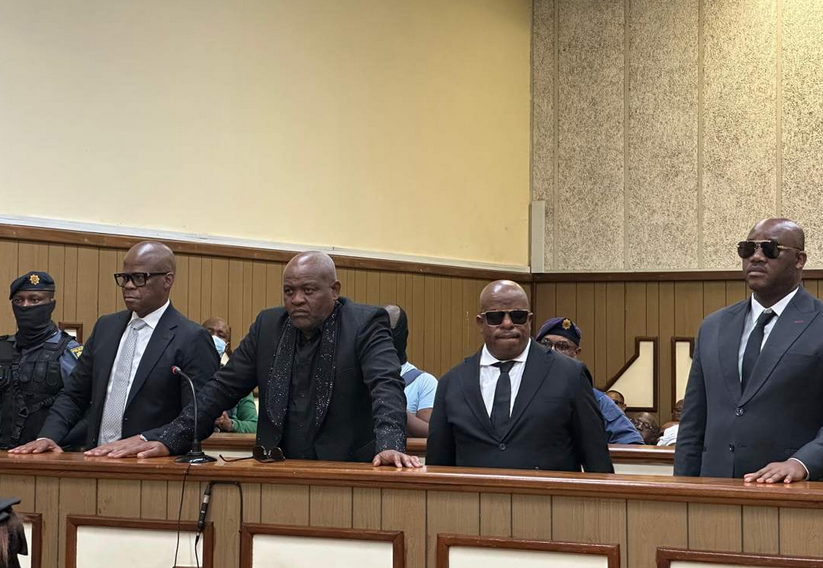
Middelburg, South Africa – The veil has been dramatically lifted on the alleged sinister inner workings of a multimillion-rand extortion racket, purportedly orchestrated by one of South Africa’s most powerful and feared taxi moguls, Madoda Joe “Ferrari” Sibanyoni. This week, the National Prosecuting Authority (NPA) laid bare a chilling narrative of intimidation and illicit payments, threatening to expose the shadowy syndicate known as the National Cartel Structure and its alleged grip on lucrative infrastructure projects.
At the heart of this explosive case is a staggering R2.2 million “protection fee” allegedly squeezed from prominent mining executive Thomas Ntuli. Ntuli, whose company was deeply involved in the massive R573 Moloto Road construction project, found himself ensnared in a web of alleged coercion that began in July 2021. The Sunday Times has revealed intricate details of this alleged plot, outlining how Ntuli was purportedly forced into making monthly payments ranging from R50,000 to R300,000. These payments allegedly commenced after Sibanyoni’s syndicate became aware of Ntuli’s contract to supply aggregate stones for Sanral’s colossal R3.7 billion Moloto Road construction.
Sibanyoni, a figure of considerable influence and the executive president of the South African Local and Long Distance Taxi and Bus Organisation, stands accused alongside Bafana Kabini Sindane, Mvimbi Masilela, and Makhaya Msiza. The NPA’s case is bolstered by compelling evidence, including bank payment records dating back to December 9, 2022. These records reportedly show payments funnelled into Absa and FNB accounts belonging to Sibanyoni’s company, MJS & Sons. The final alleged payment of R50,000 was made into an FNB account on November 8 last year, a mere five days before Ntuli bravely opened a case of extortion with Middelburg police.
Ntuli’s decision to come forward was driven by a profound fear for his life and the safety of his family. “The three suspects who are extorting money from me are working together, and I now fear for my life and my family,” he reportedly told authorities. The mining executive provided a detailed breakdown of the alleged payments, including R2.1 million transferred via bank accounts and an additional R150,000 allegedly paid in cash during July 2021 and December 2022. This testimony stands in stark contrast to Sibanyoni’s defence, where he claimed Ntuli had borrowed R900,000 from him and that their interactions were purely business-related. “Ntuli, who is a business associate, has visited my residence on numerous occasions and had even borrowed R900,000 from me during the period 2022 to 2025, which he has since repaid. I last saw him at a funeral over two weeks ago,” Sibanyoni stated in his bail application, dismissing the charges as defamatory.
However, Ntuli’s account paints a very different picture. He informed police that in 2021, he was advised that to involve the community in his project, he needed to meet with the KwaMhlanga business forum, allegedly led by the four accused. According to Ntuli, he first met Msiza, who introduced himself as the forum’s community liaison officer. Msiza then allegedly introduced him to Masilela, the forum’s chairperson. Their initial meeting was reportedly scheduled for June 2021 at a drinking spot called Etshanini in KwaMhlanga. It was there, Ntuli claims, that he was told they needed to travel to Pretoria to be introduced to their “boss,” Sibanyoni.
“I respectfully submit that the whole process from the CLO Msiza through to Sibanyoni was a cartel process of extortion through the name of the business forum for their own personal benefit,” Ntuli asserted to the authorities. The director of Tangane Mining described how his company’s contract to supply aggregate stones for the road project became the catalyst for his alleged entanglement in this “cartel process.” Meetings were not confined to informal settings; they also took place at more exclusive venues, including the elite Centurion Golf Estate, further highlighting the alleged sophistication of the operation.
The pressure on Ntuli was relentless. On March 30, 2023, he reportedly received a WhatsApp message from Sindane, a co-accused, reminding him to pay the protection fee. Ntuli responded by explaining that the project was still in its nascent stages and had not yet generated any income. This explanation, however, did not deter his alleged tormentors. He was subsequently summoned to Sibanyoni’s golf estate, where he claims he was further threatened. Law enforcement has reportedly been provided with additional WhatsApp messages, showing that between February and August 2024, Sindane repeatedly pressured Ntuli for the protection fee. A particularly “strong WhatsApp message” on July 2, 2024, demanded a response within 48 hours regarding a R100,000 payment.
The alleged demands escalated when the scope of work on the Moloto Road project was extended. Ntuli told law enforcement that the business forum then demanded increased protection fees. “The same procedure applied. The first group, consisting of Sibanyoni and Kabini, demanded R120,000 every month. The second group, led by Masilela, the chairperson, demanded R15 per ton of material delivered.” These details paint a grim picture of a systematic and organised criminal enterprise, leveraging community forums as a front for illicit activities.
Sibanyoni, who has been linked to the notorious “Big Five” cartel, and his co-accused are currently out on R70,000 bail each. The matter has been re-enrolled by the NPA in the Delmas magistrate’s court, where the legal battle is set to unfold. In an attempt to counter Ntuli’s claims, Sibanyoni’s legal team presented WhatsApp messages between him and Ntuli, dating back to 2024, in his bail application. These messages reportedly show the two using nicknames like “Landlord” and “Growthpoint,” and even clan names, which Sibanyoni’s defence argues demonstrates a close business relationship, not an extortionate one. However, Ntuli has publicly denied borrowing money from Sibanyoni, further deepening the mystery surrounding their interactions.
The case has cast a harsh spotlight on the pervasive issue of extortion within South Africa’s taxi industry, an industry frequently associated with violence, drug dealing, money laundering, and criminal cartels. The alleged involvement of a figure as prominent as Sibanyoni in such a scheme underscores the urgent need for decisive action to dismantle these criminal networks. The outcome of this trial will undoubtedly have significant implications, not only for the individuals involved but also for the broader fight against organised crime and corruption in South Africa’s vital infrastructure sectors.