

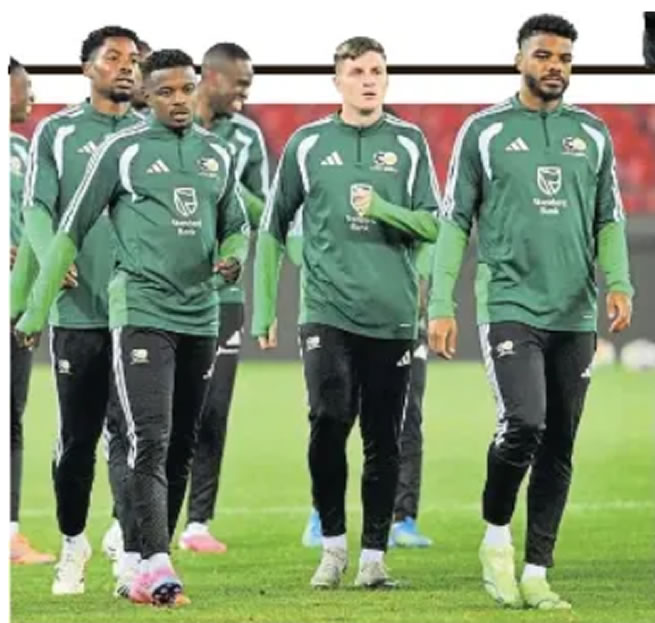
Bafana Bafana are set to cash in at the 2026 Fifa World Cup, with each of the 26 players said to have been promised R2‑million in bonus money for the three group stage matches — and far more if they progress. The arrangement follows swift talks between the South African Football Association (Safa) and the players’ committee, led by captain Ronwen Williams, on arrival in Mexico this week.
Sunday World has it on good authority that Safa held a meeting with the players’ leadership to lock down a bonuses framework before the opener against Mexico on Thursday. The agreement lands against a lucrative backdrop: Safa is guaranteed a minimum of about $9‑million (roughly R150‑million) in prize money for Bafana’s participation in the group phase against Mexico, South Korea and Czechia, plus an additional $1.5‑million (about R25‑million) in upfront preparation fees from Fifa. Should Bafana qualify for the next round of the competition, the amount will leapfrog from $9‑million to $11‑million (R180‑million).
It’s understood that Safa has given assurances to the players and technical team, led by coach Hugo Broos, that they will share 30% of this amount. A high ranking official who attended the meeting said, “Both parties agreed in unison; it was not as heated as in previous negotiations ahead of tournaments. The matter was quickly resolved, and it was agreed that the players would get 30% of whatever they would be able to achieve at the tournament,” said the high-ranking Safa official.
“It was agreed upon that the bonus fee would cascade to a higher amount should they advance to the next round [last 32]. Even if they do not win any game, there’s that prize money.”
The structure places a guaranteed R2‑million on the table per player for the three group fixtures, while tying bigger cheques to performance if Bafana reach the last 32. The promise of a clean 30% share — applying to players and the technical team — marks a notable shift in tone from previous bonus rows that have dogged national team build‑ups.
Bafana Bafana have clashed with Safa over bonuses multiple times, most recently after the 2025 CHAN tournament when players complained of unpaid R100000 bonuses. Earlier disputes also surfaced around Afcon and World Cup campaigns, with Safa often accused of delaying or reneging on agreed payments. That track record has made clarity and speed essential in Mexico, where the squad is balancing high‑altitude acclimatisation with tournament planning.
On the labour side, the South African Football Players Union (Safpu) says the principle is straightforward: those who deliver on the field should share materially in the rewards. South African Football Players Union (Safpu) president and former Bafana Bafana captain, Thulani Hlatshwayo, confirmed to this publication that the players and the mother body held a successful meeting in Mexico regarding bonuses.
“As a matter of principle, Safpu maintains that players should receive no less than 30% of any prize money earned through their performances. Those who generate the success and secure rewards should receive a fair share of the benefits.”
Another insider said they believed Bafana players and the technical team could demand as much as a R6‑million payout per individual had they been sterner in the negotiations. The players are also said to be receiving a $100 (R1 656.80) daily allowance for the duration of their stay and travel with the national team.
Safpu also took the opportunity to wish coach Broos and his charges all the best at the biggest stage of football. “The players have worked hard to earn their place on this stage, and they carry the hopes and pride of millions of South Africans.
Safa had still not responded to questions at the time of going to print.
The money picture extends beyond the national team. Fifa has confirmed that its Club Benefits Programme has jumped by 70% from the 2022 World Cup in Qatar and is now worth $355‑million (approximately R5.8‑billion). Significantly, the scheme covers clubs whose players featured in the 2026 World Cup qualifiers, not only the finals, widening the pool of beneficiaries.
That uplift means South African clubs stand to gain alongside Bafana. Local clubs in the Premier Soccer League that are set to cash in for having more players on national team duty at the World Cup are recently crowned CAF Champions League winners Mamelodi Sundowns and the new PSL champions Orlando Pirates. Both teams will be guaranteed $145000 (approximately R2.4‑million), per player, as they both have eight players representing them, which amounts to around R19.2‑million in total. Kaizer Chiefs will only receive R2.4‑million as it only has one player, defender Bradley Cross, in the Bafana setup.
For Safa, the calculus is clear: Fifa’s guaranteed pots ensure baseline revenue even if results go against Bafana, while performance escalators create room for a larger pie should the team advance. It’s a framework designed to align incentives and reduce friction, after multiple cycles in which pay disputes overshadowed preparations.
For the players, certainty matters as much as the sums. The R2‑million per player group‑stage bonus, the 30% share promise on total prize money, and the daily allowance combine to send a message of stability at a moment when focus must be on Mexico, South Korea and Czechia — and the demanding conditions that come with playing at altitude. With Hugo Broos’ staff included in the 30% share, the arrangement recognises the technical team’s role in any success.
Still, the shadow of past disputes lingers. The CHAN 2025 saga over unpaid R100000 bonuses is the freshest example of how quickly trust can fray when agreements aren’t honoured. The explicit 30% commitment set out in Mexico may go some way to rebuilding that trust, particularly if payments are made on time and in full, regardless of whether Bafana exit at the group stage or push into the knockouts.
The broader football economy will also watch how the Club Benefits Programme filters into PSL balance sheets. For Sundowns and Pirates, eight Bafana representatives apiece translate into meaningful cheques that can underwrite high‑performance departments, youth development, or contract renewals. Chiefs, with a single call‑up in Bradley Cross, will bank a smaller but still notable amount. Across the league, the qualifiers clause could offer further uplift where clubs contributed to the road to 2026.
With the opener against Mexico looming, the money story is settled enough to move backstage. The stakes on the pitch are as high as the numbers: a strong group performance locks in the guaranteed R2‑million per player and keeps the 30% escalator alive into the last 32. Off it, the union’s “no less than 30%” principle has been met, at least for now. If Bafana translate clarity into results, everyone’s share grows — and, for once, the headlines may be about football first and finances second.