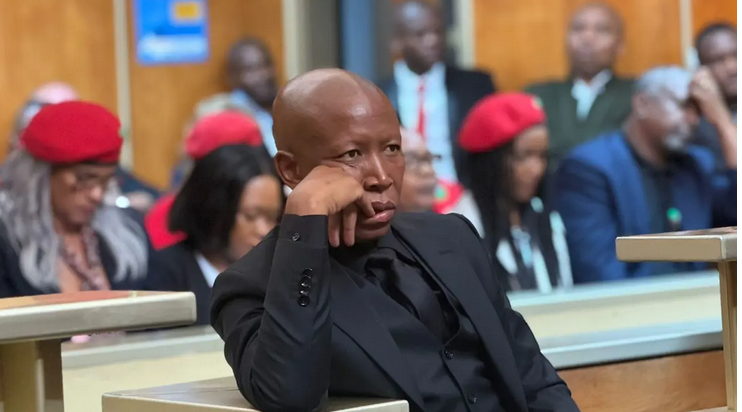
Julius Malema’s five-year prison sentence has done far more than place the EFF leader at risk of serving time behind bars. It has opened a constitutional and political fight that could reshape his future in Parliament, place his role in the Judicial Service Commission under severe pressure, and leave one of South Africa’s most recognisable opposition figures in prolonged legal limbo.
The sentence, handed down by the East London magistrate’s court on Thursday, has triggered intense scrutiny of what comes next for Malema as an MP and as a member of the Judicial Service Commission, the body responsible for interviewing and appointing judges. While the EFF remains defiant, the judgment has created a fresh and serious test for the party’s leader at a time when his political standing and legal vulnerability are colliding head-on.
At the centre of the matter is a constitutional question with enormous consequences. Under section 47(1)(e) of the constitution, a person is disqualified from being a member of Parliament if they are sentenced to more than 12 months in prison without the option of a fine. Malema’s sentence falls squarely into that territory because magistrate Twanet Olivier imposed direct imprisonment rather than a fine for the primary charges. That means the constitutional threshold has been crossed, even if the practical consequences will not take effect immediately.
For now, Malema does not automatically lose his seat. The constitution allows a person in his position to remain in office until the appeal process has been exhausted. That is a critical distinction, and it may prove to be Malema’s biggest short-term lifeline. The appeals process could stretch over years, which means his status in Parliament may remain technically intact while the case winds its way through the courts. In political terms, that creates a strange and unstable situation: a party leader still able to function in public office while fighting to overturn a sentence that directly threatens his long-term place there.
The uncertainty becomes even more complicated when his role in the Judicial Service Commission is considered. Malema currently sits on the JSC, a body whose work goes to the heart of judicial independence and public confidence in the legal system. That has made his position particularly sensitive. A politician with a five-year prison sentence hanging over him, and a criminal conviction forming the backdrop to every public appearance, is now expected to help assess and appoint judges. That tension is at the core of why this story has rapidly become bigger than a single court outcome.
The original report makes clear that this is where the greatest flashpoint may lie. Malema’s continued presence on the JSC is likely to be viewed through the lens of his own conviction every time the commission meets and every time it interviews candidates for the bench. That is a difficult reality for any public institution, especially one that must be seen to act without fear, favour or political contamination. The issue is not simply whether Malema has political support. It is whether a person facing this level of legal jeopardy can continue to participate in decisions that shape the judiciary’s future without further damaging trust in the process.
Olivier’s remarks in court will deepen that pressure. According to the source article, the magistrate explicitly stated that the judiciary “stays in its lane” and will not be intimidated by “politically charged utterances”. Those words matter because they suggest a court determined to project independence in a case loaded with political tension. They also hint at the tone higher courts may adopt if Malema’s legal team presses ahead with appeals while framing the matter in political terms.
The ruling went further. Olivier’s judgment also emphasised a “complete absence of accountability and breach of trust” by Malema as an elected leader. That finding carries weight beyond the courtroom. If higher courts uphold that view, the pressure on Malema’s public roles will intensify sharply. His critics will argue that a politician found wanting in that way cannot credibly continue to help oversee the careers of judges, nor remain untouched in a legislative body that is meant to uphold constitutional standards.
Political opponents are already positioning themselves for that fight. The VF Plus, according to the report, has vowed to push for Malema’s removal from Parliament in order to “protect the integrity of the National Assembly” once the legal process has run its course. That signals that the case will not remain a narrow legal issue. It will become a broader political campaign over legitimacy, accountability and the limits of constitutional tolerance.
Even so, Malema’s formal state positions and his political authority inside the EFF are not the same thing. The report notes that he may lose his official roles but is unlikely to lose control of the party. That distinction is important. Malema’s influence has never relied only on institutional office. It rests heavily on his ability to dominate public attention, shape political narrative and project defiance in the face of pressure. A legal setback may weaken him in formal constitutional structures, but it does not automatically strip him of his status as the EFF’s central figure.
That is one reason the party’s response is likely to be so combative. The EFF has already branded the prosecution a “witch hunt”. If Malema is eventually forced out of Parliament or removed from the JSC, the party is expected to present that outcome as proof of a “political conspiracy”. That strategy may energise supporters, but it could also deepen political polarisation at a time when public confidence in institutions is already under strain.
Another important feature of the case is the possibility that even a suspended sentence on appeal may not fully save Malema from constitutional danger. The report notes that legal experts believe the disqualification issue could still arise depending on the final structure of the sentence. In other words, a successful appeal that changes the sentence but does not eliminate the constitutional problem may still leave his political future hanging in the balance. That makes the legal path ahead far more complicated than a simple win-or-lose court battle.
Malema himself has made clear how far he is prepared to take the matter. According to the report, he has indicated that he will only accept a “guilty” verdict from the Constitutional Court. That points to a drawn-out legal war that could keep his parliamentary future unresolved until the country’s highest court has spoken. It also means that this case is unlikely to disappear from the headlines any time soon.
Outside court, the political mood has already been visible. EFF supporters marched towards the East London magistrate’s court where Malema appeared this week, underlining that the case is not being experienced as a dry legal dispute by his base. For supporters, it is part of a larger battle over power and political targeting. For opponents, it is a long-overdue test of whether senior politicians are truly answerable to the law.
That is what makes this moment so significant. Malema’s sentence is not just about punishment. It has become a constitutional countdown, a test of the independence of the judiciary, and a measure of how far South Africa’s legal order is prepared to go when one of the country’s most powerful political figures is in the dock. The appeals process may delay the final reckoning, but it cannot remove the reality that his future in Parliament is now uncertain in a way it has never been before.
Whether he ultimately remains in the National Assembly, loses his place there, or fights all the way to the Constitutional Court, one fact is already clear: this case has shifted the ground beneath him. What was once a legal threat has now become a full-blown constitutional and political battle over his future at the centre of South African public life.