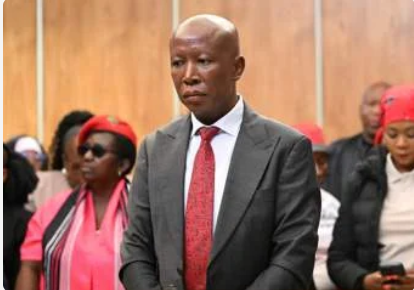
KuGompo, Eastern Cape – In a significant legal reprieve that keeps his immediate political future alive, Economic Freedom Fighters (EFF) leader Julius Malema has been granted leave to appeal his five-year direct imprisonment sentence. The ruling, delivered by Magistrate Twanet Olivier in the KuGompo City Magistrate’s Court on Thursday afternoon, follows a day of high drama and widespread civil unrest in major South African urban centres.
While the court’s decision to allow an appeal against the sentence offers Malema a temporary lifeline, it was not a total victory for the embattled leader. Magistrate Olivier explicitly denied his bid to appeal against the underlying conviction itself. This means that while the severity of the five-year jail term will be scrutinised by a higher court, the legal finding that Malema is guilty of contravening the country’s firearm laws remains firmly in place for now.
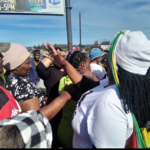
Following the ruling, Malema was released on bail, allowing him to walk out of the court and rejoin his supporters who had gathered in their thousands outside the precinct. The atmosphere in KuGompo was electric, with the red-clad faithful erupting in song and dance as news of his release filtered through the heavy police cordons.
The case, which has captivated the nation, stems from an incident in July 2018 during the EFF’s fifth-anniversary celebrations at the Sisa Dukashe Stadium in Mdantsane. Malema was captured on video discharging a semi-automatic rifle into the air in front of a massive crowd. After years of legal wrangling, he was found guilty in January on five counts, including the unlawful possession of a firearm and ammunition, discharging a firearm in a built-up area, and reckless endangerment.
Earlier on Thursday morning, the court had sent shockwaves through the political establishment by sentencing Malema to an effective five years of direct imprisonment. The magistrate had ruled that the various counts would run concurrently, with the five-year term for unlawful firearm possession being the primary sentence. She also declared Malema unfit to possess a firearm, a move that carries significant symbolic and practical weight for a public figure.
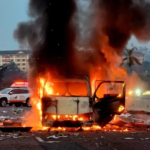
The immediate aftermath of the sentencing saw a rapid escalation of tensions. In the Johannesburg CBD, EFF supporters rioted, forcing businesses to shutter and the High Court to lock its gates. The chaos in the streets reflected the deep-seated passions surrounding the case and the potential for Malema’s legal fate to trigger broader social instability.
The granting of leave to appeal the sentence is a critical procedural step. Under South African law, the lodging of an appeal typically suspends the execution of a sentence, meaning Malema will not have to begin serving his jail time while the matter is being considered by a higher court. This also has profound implications for his status as a Member of Parliament. According to the Constitution, a member only loses their seat if they are sentenced to more than 12 months without the option of a fine, but this disqualification is stayed pending the outcome of an appeal.
Malema’s legal team is expected to argue that the five-year sentence is shockingly inappropriate and that the magistrate failed to give sufficient weight to mitigating factors, such as his personal circumstances and the lack of actual injury or damage resulting from the 2018 incident. The State, however, is likely to maintain its stance that a firm message must be sent regarding the reckless use of firearms, particularly by influential public figures in crowded public spaces.
As Malema prepares for the next phase of his legal battle, the nation remains on edge. The split decision by the magistrate—granting leave to appeal the sentence but not the conviction—sets the stage for a complex and high-stakes legal showdown in the months to come. For the EFF, the ruling provides a much-needed breathing space, allowing their leader to remain at the helm as they navigate a turbulent political landscape. For the broader South African public, the case continues to serve as a litmus test for the principle of equality before the law and the resilience of the country’s judicial institutions.