Serious questions are being asked about possible police collusion with criminal networks after a suspended Pretoria detective, Sergeant Fannie Nkosi, was arrested when a raid on his home uncovered closed cash‑in‑transit (CIT) and hijacking dockets, firearms and cash hidden under a mattress.
The discovery has shaken confidence in internal controls at several police stations and cast a fresh shadow over testimony already heard at the Madlanga commission, where Nkosi has been implicated as a go‑between for senior SAPS management and alleged criminal cartels.
National police spokesperson Brigadier Athlenda Mathe confirmed that investigators recovered multiple original dockets at Nkosi’s Pretoria property which should have been locked away in official police storage.
According to national police spokesperson Brig Athlenda Mathe, the dockets were illegally in Nkosi’s possession and not at the police storage facility.
Mathe said Nkosi, who is on suspension, is not permitted to have any dockets or a service pistol in his possession.
However, after police raided his home after a tip‑off, they found dockets in a backroom on his property.
“At the back of his house, they (police) found six dockets, five of them original dockets and one copy,” Mathe said.
“The six dockets [are of] CIT robberies; one that happened in Roodepoort and one in Musina, Limpopo. “Others are car hijacking cases and all of them trace to serious and violent crimes.
“Further investigation [continued and] we found that all these six dockets … were closed as undetected.”
Sowetan has established that one of the dockets found at his home dates back to September 2022 CIT robbery in Musina.
Mathe explained that all six cases had officially been finalised as “undetected”, a designation used when investigators have exhausted all available leads.
According to Mathe, when a docket is closed and labelled undetected, it means police cannot find any leads to an arrest.
“[It means] there is no new information and the case is then archived.
“When the docket is archived, it is not allowed to be in the possession of an investigating officer,” she said.
Under SAPS procedures, such files must be booked into a secure storage facility at the originating police station.
Mathe said the dockets should have been stored in a storage facility at the police station where they were registered.
“So our team now has been deployed to various police stations where these dockets were registered to ascertain how he got hold of these dockets and what are they doing in his possession and what role he played,” she added.
The investigation now stretches across multiple stations, including those that initially handled the Roodepoort and Musina CIT robberies and the linked hijacking cases. Detectives are probing not only how Nkosi acquired the archived files, but whether their removal was part of a broader effort to interfere with or exploit serious and violent crime investigations.
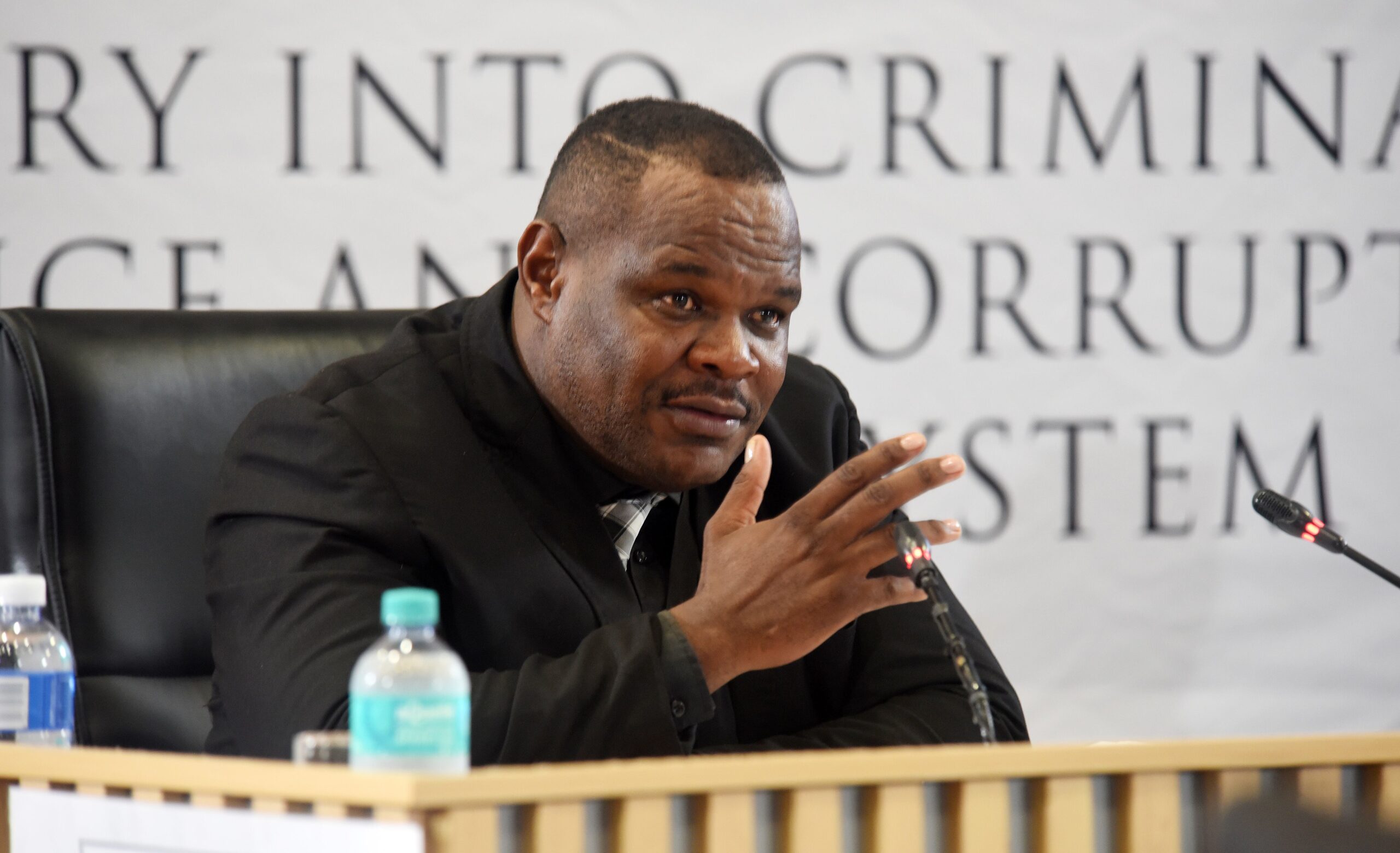
The Musina case has particular resonance: last month, Nkosi appeared before the Madlanga commission, where he testified that he had been deployed to Limpopo to work on a 2022 CIT matter.
Last month, Nkosi told the Madlanga commission that suspended deputy police commissioner Lt‑Gen Shadrack Sibiya had deployed him to Musina to a CIT case in 2022. He told the commission that because of his hard work in the case, he became closer to Sibiya.
The commission is probing allegations of deep‑seated corruption and the capture of policing and security structures by criminal syndicates.
During testimony at the Madlanga commission, it was alleged that Nkosi was the middleman between Sibiya and criminal cartels.
Information before the commission suggest that the cartels are involved in CIT and cross‑border hijackings as well as contact murders, among several other things.
As part of evidence led at the inquiry, investigators traced WhatsApp messages allegedly sent between Nkosi and figures linked to organised crime.
Nkosi’s WhatsApp messages, which were flagged at the commission, show that late taxi boss Jotham “Mswazi” Msibi used to tell Nkosi the case numbers of matters he wanted the details of.
Msibi is reported to have been the leader of the Big Five criminal cartel.
The commission also heard of another instance in which a taxi boss allegedly reached out to Nkosi for sensitive information on a high‑profile murder case.
Last month, the commission also flagged a WhatsApp text in which a taxi boss, Irvin Mthakathi, gave Nkosi the ID details of a suspect and asked Nkosi to verify if the owner of the ID was indeed arrested for the murder of Vereeniging engineer Armand Swart.
Nkosi’s arrest followed swiftly after the raid on his home, in which investigators also seized firearms and a substantial sum of cash.
Nkosi was arrested following the discovery of the dockets as well as more than R50,000 in cash concealed under the mattress, a revolver and an R5 firearm.
He appeared at the Pretoria North magistrate’s court yesterday on charges that include failure to safeguard firearms, defeating the ends of justice, failure to secure ammunition, possession of SAPS goods suspected to be stolen and unlawful possession of a stun grenade.
In court, prosecutors signalled that they would oppose his release.
In court, lawyers for the state asked for the matter to be postponed to Monday so that they can have time to gather information for bail, which they intend to oppose.
Magistrate Rene Venter granted the postponement.
During his brief appearance, Nkosi raised concerns about his personal safety should he be sent to a correctional centre instead of a police holding facility.
In court, Nkosi raised his fears of being detained at the Kgosi Mampuru correctional facility in Pretoria, stating that he feared he might be killed there.
He asked that he be detained at Villeria police station instead.
However, Venter ruled against him and ordered that he be kept at Kgosi Mampuru but in a specific section.
The matter was postponed to April 13 for bail application.
The fallout from Nkosi’s alleged conduct is not limited to violent crime investigations. The Madlanga commission has also heard evidence suggesting he leveraged his position and contacts within the Tshwane municipality.
When the commission resumed yesterday, Tshwane Metro Police Department chief Yolande Faro testified that Nkosi had communicated with high‑ranking municipality officials about a multi‑million rand security tender that his brother’s company was bidding for.
Faro described Nkosi’s chats with metro officials, including CFO Gareth Minisi, about the municipality’s security, as irregular.
“He had no authority.”
As police management now tries to trace the trail of the missing dockets and the full extent of any potential sabotage or manipulation of CIT and hijacking cases, the Nkosi matter is likely to remain central to both the criminal courts and the Madlanga commission in the coming months.