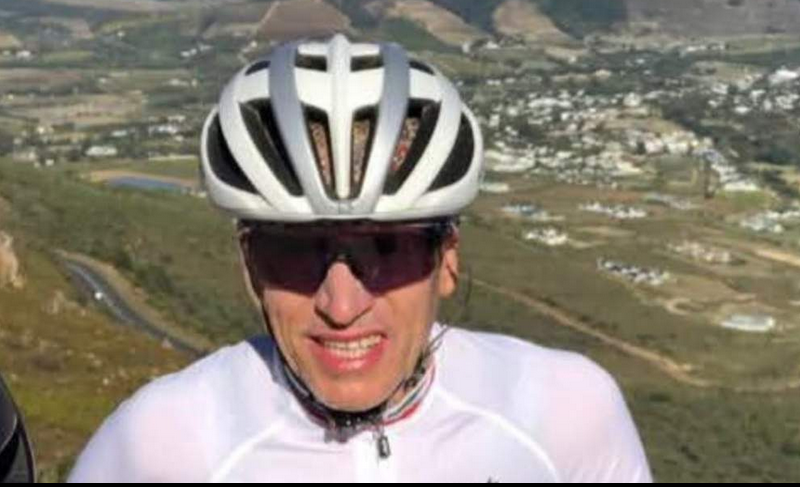
Durbanville cyclist Landon la Grange, who had his left leg amputated after being struck by a minibus taxi in Camps Bay on Monday, has died in hospital, deepening concern over cyclist safety on Western Cape roads.
La Grange, 61, a renowned and highly experienced rider with more than three decades in the saddle, was on a routine coffee ride with fellow cyclists when the crash occurred on Victoria Road shortly before 08:00. The popular coastal strip, flanked by Camps Bay’s beaches and mountains, is a favoured route for both motorists and cyclists.
Western Cape police spokesperson Sergeant Wesley Twigg confirmed that La Grange died on Tuesday and that the criminal case had been escalated.
Twigg said the charge had since been changed from reckless and negligent driving to culpable homicide.
Following claims that the taxi driver fled the scene, Twigg denied this, saying that the 38-year-old had remained in contact with the authorities.
“The driver has provided his licence and personal details,” Twigg said.
La Grange’s death has sent ripples through Cape Town’s tight-knit cycling community, where he was widely admired not only for his racing pedigree but also for his mentorship and presence in the sport.
He had competed in multiple Cape Epics, the Old Mutual Wealth Double Century, and other long-distance cycling events, building a reputation as a tough and disciplined athlete with a deep love for the sport.
“He is a highly respected athlete within the cycling community,” said Neil Robinson, CEO of the Pedal Power Association (PPA) and a close friend of La Grange.
Robinson, who has been outspoken about the risks faced by cyclists on South African roads, said initial accounts of the incident indicated reckless driving by the taxi.
According to Robinson, the minibus taxi had overtaken several vehicles before ploughing into La Grange.
“Landon was the only one hit, while the others managed to evade the vehicle,” said Robinson.
La Grange had been riding in a group of more than a dozen cyclists at the time. While his companions managed to avoid impact, he was struck and left critically injured on the tarmac.
A medical doctor, who had also been cycling, was on the scene and began treating La Grange before emergency services arrived.
“His left leg was severely injured and had to be amputated above the knee. He also sustained two broken arms, liver injuries, and multiple lacerations and bruises. He was intubated overnight,” Robinson said, before La Grange succumbed.
In the hours before his death, his wife, Anna-Marie, spoke of the shock and disbelief gripping their family.
Anna-Marie was at home when calls began pouring in on Monday morning, alerting her that the “love of [her] life” had been struck by a “speeding” taxi on Victoria Road.
A day after losing his leg, she told News24 she was not sure her husband fully understood the extent of his injuries.
Hours before he succumbed to his injuries, La Grange’s wife, Anna-Marie, told News24 she didn’t think her husband grasped that the crash had resulted in him losing his limb.
La Grange had been intubated from the time he arrived at hospital and remained in a critical condition. He was due to undergo multiple further procedures on Tuesday.
La Grange had been intubated since arriving at the hospital. He had been scheduled for multiple surgeries, including on his liver, and further scans on his brain, back, and pelvic area.
Despite the severity of his injuries, Anna-Marie had clung to hope, emphasising his resilience and determination.
Anna-Marie, who had not left her husband’s side, had been hopeful that her husband would recover, telling News24 he was a “very strong man with incredible willpower”.
The scene of the crash left a lasting impression on those who arrived in the aftermath.
Wayne Rodrigs, a cyclist who got to Victoria Road shortly after the collision, described the chaos and distress playing out as emergency workers battled to stabilise La Grange.
Wayne Rodrigs, a cyclist who arrived at the scene shortly after the accident, described it as “horrific”.
“There was glass all over the road and Landon was lying in excruciating pain. Medics, firefighters, and police all rallied around him while traffic officers monitored the scene,” Rodrigs said.
For cycling advocates, the incident has reignited longstanding frustrations about inadequate enforcement of traffic laws and the perceived lack of accountability for motorists who endanger vulnerable road users.
Robinson said La Grange’s death was a stark reminder of how exposed cyclists remain, even when riding in groups and on popular, well-known routes.
He lamented that cyclists remained “extremely vulnerable on the roads”.
He highlighted the dangers cyclists face, citing reckless driving and insufficient protection. Robinson also called for stronger road safety measures, visible policing, and proper prosecution of offenders.
“Far too often, cases are mishandled or result in derisory sentences,” he said.
The PPA and other advocacy bodies have long argued that visible law enforcement, meaningful consequences for reckless driving, and a cultural shift in how cyclists are regarded on the roads are essential to reducing fatalities.
La Grange’s death now becomes part of a growing list of serious incidents involving cyclists across the Western Cape, with Victoria Road and other scenic routes often flagged as high-risk because of speeding, congestion and limited space for non-motorised transport.
Colleagues and friends describe La Grange as a rider who understood those risks but continued to ride out of passion and commitment to the sport he loved. As news of his death spread, tributes poured in from riders across Cape Town and beyond, many recalling his experience, quiet strength and willingness to support others in the peloton.
While the criminal case progresses, cycling organisations are expected to renew pressure on authorities to prioritise the safety of cyclists and other vulnerable road users. For La Grange’s family, his riding partners and the wider community, the focus now shifts to mourning a man whose life on the bike touched many.