

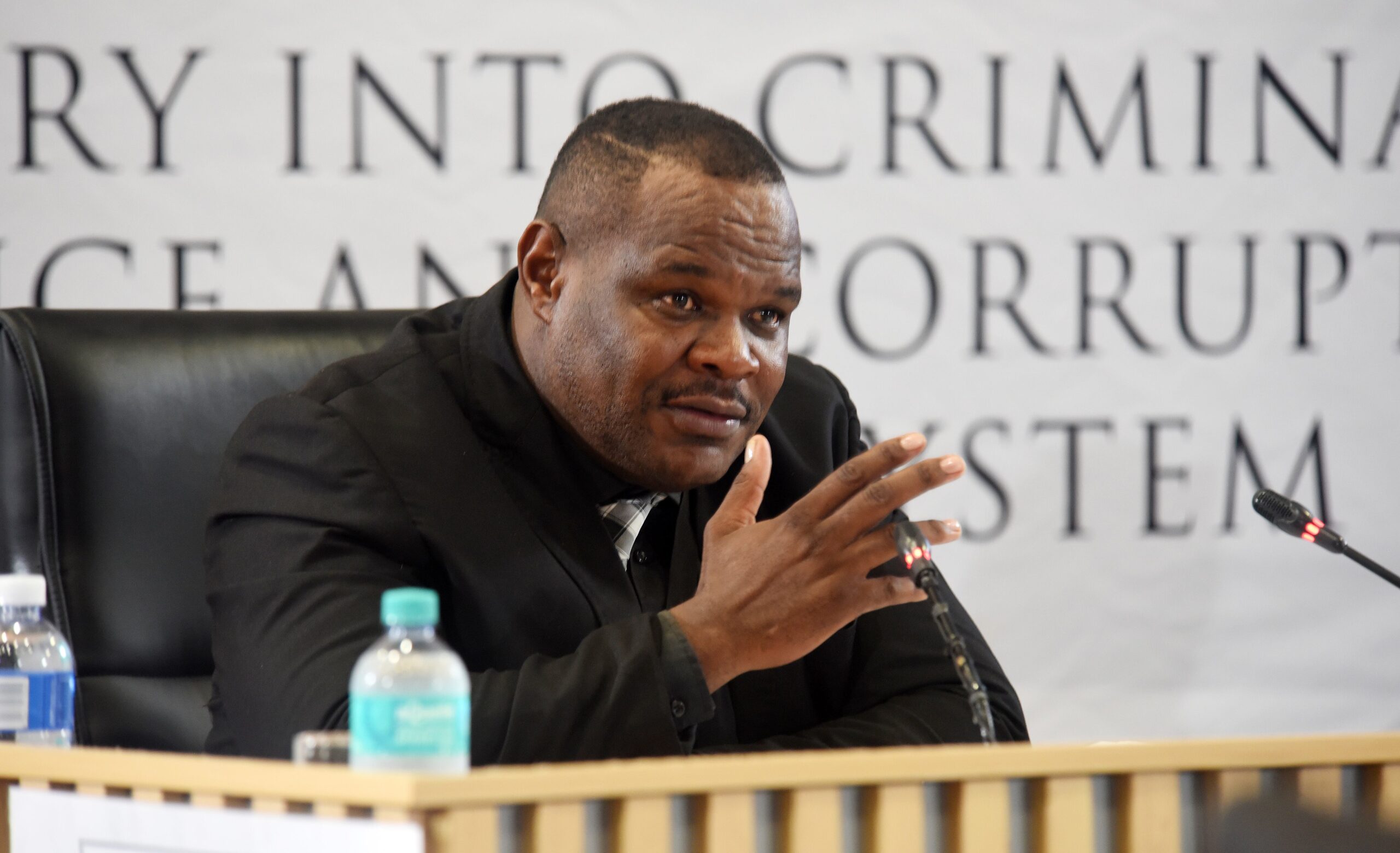
A dawn raid at a Tshwane property has led to the arrest of Sergeant Fannie Hezekiel Nkosi, a Gauteng Organised Crime Unit officer and central figure in the Madlanga commission of inquiry, after investigators uncovered a cache that included 490 rounds of unlicensed ammunition, a state‑issued hand grenade, multiple police case dockets and eight licensed firearms stored in breach of the Firearms Control Act. The discovery marks a dramatic escalation in the commission’s investigation into alleged police corruption and suspected links between SAPS insiders and organised crime cartels.
An internal SA Police Service (SAPS) communication, seen by City Press, records that the commission’s investigative team executed a J50 warrant at approximately 7.30am on Thursday. The raid culminated in Nkosi’s arrest on 2 April as part of the broader probe into corruption allegations within the SAPS. Officials also noted the presence of improperly stored state firearms at his residence.
According to the internal documents, the eight firearms — four pistols, three rifles and one shotgun — were licensed to Nkosi but were not secured in the prescribed safe as required under the Firearms Control Act. Alongside the state‑owned hand grenade and the large quantity of unlicensed ammunition, investigators seized multiple police case dockets, raising immediate questions about how official records and state ordnance came to be kept at a private home.
The findings have triggered a raft of criminal counts. Nkosi now faces multiple charges, including possession of unlicensed ammunition, theft, defeating the ends of justice, and failing to keep firearms and ammunition in a prescribed secure safe. The case has been registered at Pretoria North SAPS, and Nkosi was scheduled to appear in court on Tuesday, 7 April. Sources close to the operation indicated that, for security reasons, the Madlanga commission team planned to move the suspect from Pretoria North SAPS to an undisclosed “safe neutral place”.
Thursday’s operation reflects the heightened stakes confronting the Madlanga commission, which was established to investigate links between suspected crime cartel bosses and law enforcement agencies. Nkosi’s name has surfaced repeatedly in the inquiry, where he testified as Witness F and was positioned as a pivotal figure in understanding the alleged infiltration of police structures by criminal networks.
We previously reported that Nkosi was accused of acting as a middleman between suspected crime bosses and senior law enforcement officials — a claim that, if proven, would expose a deep and damaging breach within SAPS’s own crime‑fighting ranks. His testimony before the commission has been contentious, punctuated by repeated reprimands from the chairperson for refusing to answer questions and for claiming memory lapses. A bid by Nkosi to testify in camera was denied, keeping proceedings open to public scrutiny and heightening interest in the inquiry’s progress.
What investigators found in Tshwane adds a new layer to a case that had largely been framed as a corruption probe. The ammunition count alone — 490 rounds without the required licences — underscores the seriousness of the alleged offences. The presence of a state‑issued hand grenade at a private residence, combined with the discovery of multiple police case dockets, pushes the matter well beyond mere administrative infractions, pointing to potential breaches that could intersect with the commission’s core mandate on organised crime.
The eight firearms discovered were, on paper, legally licensed to the officer, but their storage did not comply with statutory requirements — a violation that carries criminal consequences under the Firearms Control Act. The fact that these weapons — four pistols, three rifles and a shotgun — were allegedly not kept in a prescribed secure safe will likely feature prominently in the state’s case, alongside the unlicensed ammunition and state ordnance charges.
While the internal SAPS memo provides the operational backbone — the J50 warrant, the 7.30am start, and the sequence that led to the 2 April arrest — the broader implications stretch into the heart of how certain police units are supervised and held accountable. The raid and arrest raise pointed questions about oversight within specialist divisions tasked with combating organised crime, particularly when an officer embedded in such a unit becomes the subject of a high‑stakes corruption and firearms probe.
For the Madlanga commission, Nkosi’s detention is both evidential and symbolic. It signals that the inquiry’s work is moving from testimony and allegations into tangible law‑enforcement action, with the potential to map how alleged criminal networks exploited or co‑opted police processes, resources and personnel. It also tightens the focus on what, if anything, the seized case dockets might reveal about the handling of sensitive investigations and the possible diversion or manipulation of evidence.
As Nkosi’s court appearance proceeds, the legal terrain is set to broaden. The current charge sheet — possession of unlicensed ammunition, theft, defeating the ends of justice, and failures under the Firearms Control Act — may yet be joined by further counts if forensic analysis of the seized items and dockets uncovers additional offences. Meanwhile, the security‑driven plan to relocate him to a “safe neutral place” underscores the volatile environment around the case and the potential risks attached to witnesses and suspects at the centre of the commission’s work.
For now, the arrest draws a sharp line under months of inquiry hearings that have sketched an uneasy picture of alleged cartel–police collusion. By shifting the focus from the witness box to a stash of ammunition, a state grenade and compromised firearm storage at a serving officer’s home, the case against Sergeant Fannie Hezekiel Nkosi has moved decisively into the criminal courts — and deeper into the core questions the Madlanga commission was set up to answer.