

South African Revenue Service (SARS) has launched an urgent legal bid to force the immediate sale of five properties linked to reality TV star Shauwn “MaMkhize” Mkhize, alleging that the assets are deteriorating and that the state is paying security bills to keep watch over them.
The application, heard by the KwaZulu-Natal High Court in Durban on Wednesday, sought to move the matter forward even though the properties were previously placed under a preservation order. During the proceedings, Mkhize sat quietly at the back of the courtroom as lawyers argued over the fate of what she has described and defended as part of her property empire—while the taxman insists the state cannot keep funding ongoing costs while the legal battle drags on.
SARS’s application arrives with a heavy backdrop: Mkhize’s staggering R40 million tax debt hangs over her business interests. In court, the tax authority painted a picture of neglect and rapid decline, while her legal team raised serious questions—both about urgency and about ownership.
Advocate Hein Snyman SC represented SARS and told the court that there were signs of neglect on the properties and that keeping them locked in place would only worsen the damage. “There are signs of neglect on the properties; there will be nothing left of the properties if they are not converted to cash,” Snyman said, adding that taxpayers were ultimately funding round-the-clock security.
He further pointed to costs already incurred, saying, “[SARS] already had a proverbial R88 000 bill yesterday. It is necessary under the circumstances to sell the assets,” Snyman told the court.
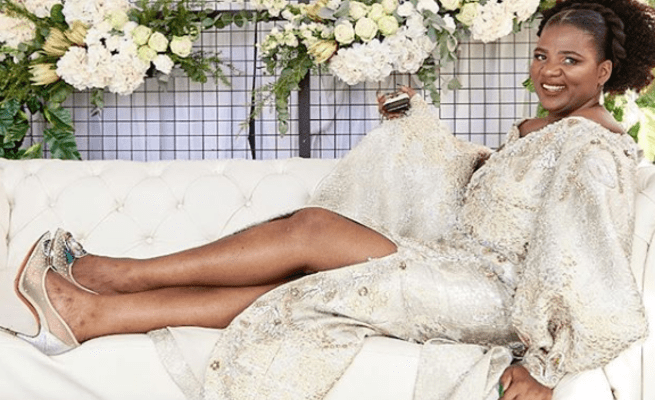
Mkhize herself, known for her love of flashy fashion, did not dress in her usual dramatic style. On Wednesday she wore a white suit, Dolce & Gabbana sneakers and a matching handbag. She watched the legal arguments from behind designer sunglasses while the matter unfolded in Durban.
The preservation order that froze Mkhize’s assets was granted by the same court on 27 November 2024, marking the start of an increasingly bitter legal war between the Durban businesswoman and SARS. Since that order was put in place, the dispute has widened beyond tax debt and into the practical consequences of keeping properties maintained under preservation.
The urgent hearing also shed light on the details of what SARS is asking the court to do next. According to what emerged in court, only two Sandton addresses were mentioned during proceedings, and they are understood to form part of a palatial compound dubbed the “Royal AM Palace”.
The property complex is said to be surrounded by a high wall of white shale. Archaic statues of various characters from Greek mythology peek out from large inlays. An ornate water fountain greets visitors at the gates, while expansive lawns, a large swimming pool and an imposing edifice of more white structures complete the scene described in court.
SARS’s main argument was that the properties are being kept at taxpayer expense and are losing value. Snyman insisted that unless the assets are turned into cash, they could collapse further and become harder to sell later. “SARS is doing it with our tax money, and the property is depreciating, and the only thing that can stop this train is if these properties are turned to cash, then parties can have [the] leisure to argue about ownership,” he said.
Crucially, SARS told the court that selling the properties would not immediately settle Mkhize’s tax debt. Instead, it said the money would be preserved in a way that allows for the outcome of all pending legal proceedings, including disputes over the properties themselves. In other words, SARS’s proposal was framed as a way to prevent further decline while the court process runs its course.
Another name entered the crossfire: Mkhize’s son, Andile Mpisane, was listed as the second respondent in the proceedings and claimed that he used two of the properties as his primary residence. But Judge Jacqueline Henriques effectively pulled apart that claim during the hearing. The judge noted that Mpisane’s affidavits listed only his La Lucia home, which was absent from the current proceedings.
The judge’s observation was that this undermined any suggestion that those preserved properties were essential to his living arrangements. The court recorded: “This works in favour of the applicant (SARS) though because it means that he (Mpisane) has an alternative address in La Lucia if the properties are sold.”
While the judge was weighing the practical arguments around urgency and property decline, Mkhize’s defence team argued that the situation is being stretched and that SARS’s application should not be allowed to rush the matter forward before key ownership issues have been properly tested.
The defence raised concerns about the ownership of some properties and argued that selling them would be premature. They said the sale would be “premature, pending a trial into ownership”. However, the team did not go into detail during the hearing about the specific ownership reasons, leaving the court to weigh the general contention against SARS’s evidence of ongoing costs and damage.
SARS, however, rejected the idea that the properties are being properly maintained. Snyman insisted that the respondents were not keeping them in good condition. He said, “SARS already had a proverbial R88 000 bill yesterday,” and argued that the only realistic solution is to convert the assets into cash immediately.
The court documents revealed a more complex picture than the initial narrative suggested. The joint practice note stated that all five properties are located in Sandown Extension 24. It also said that four of the properties are registered under Yaron Peretz while one is registered under 22 Aston Investment (Pty) Ltd.
But SARS maintained that beneficial ownership lies with either Mkhize or Zikhulise Group (Pty) Ltd. SARS also said it would hold R5.25 million in trust for disputed ownership claims, as part of its plan to protect contested interests while the sale is underway.
The record further included property value information. The joint practice note stated the properties have a combined municipal value of R22.8 million and a market value of R35 million, while their forced-sale value was R24.5 million.
It also laid out significant taxpayer costs tied to preserving the assets. The documents listed monthly security expenses of R188 261.90. They also recorded biannual insurance costs of R97 922.30, and outstanding municipal charges of R1.79 million as of October 2025. The note added that the properties were uninsured when preserved, which meant SARS had to cover costs linked to security and other overheads.
A valuer confirmed “broken windows and damp damage” with “signs of lack of general maintenance”. The documents also stated that four properties lacked approved building plans for improvements, adding another layer to SARS’s argument that the assets are not merely expensive to maintain, but are structurally and administratively vulnerable.
For Mkhize’s defence, the urgency itself came under attack. Her team argued that the application lacked urgency and claimed it was “self-created” by SARS, according to supplementary heads of arguments.
The defence also alleged that SARS provided no invoices, receipts or documentary proof of the claimed costs. They described the allegations as “untested hearsay”. Additionally, they raised jurisdictional objections, arguing that only preservation judges should handle such matters. The defence also argued that SARS had pursued an urgent application when it should have brought a normal opposed application, implying procedural missteps in how the tax authority approached the court.
At the end of the hearing, the court did not immediately deliver a decision. Judgment was reserved.
For now, the courtroom remains the battlefield—while Mkhize watches from behind designer sunglasses and waits to see whether SARS will win the right to turn preserved property into cash, even as ownership disputes and tax debt remain tied up in the wider legal fight.