

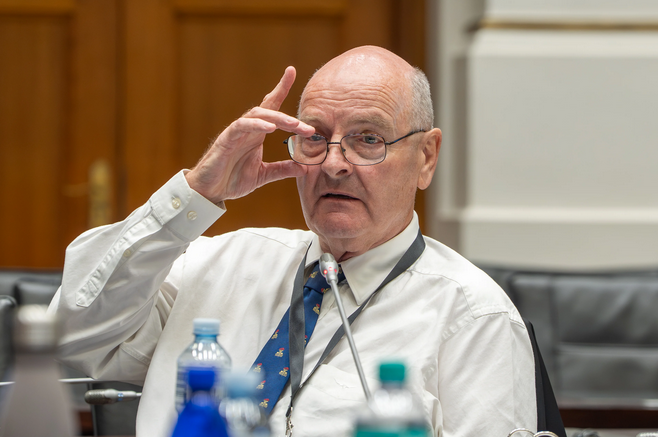
In a dramatic turn of events that has gripped South Africa, Paul O’Sullivan, a figure synonymous with high-stakes investigations and unwavering pursuit of justice, has once again taken centre stage. His recent testimony before a parliamentary ad hoc committee has not only peeled back layers of political intrigue but also reignited public debate about the integrity of the nation’s policing institutions. O’Sullivan, often described as a maverick investigator, delivered an explosive account, detailing how the bitter political rivalry between former presidents Thabo Mbeki and Jacob Zuma catastrophically undermined the South African Police Service (SAPS).
For years, O’Sullivan has been a thorn in the side of corruption, his name frequently appearing alongside some of South Africa’s most significant legal battles. His latest appearance before Parliament was no exception, as he recounted the intricate web of power struggles that ultimately led to the downfall of former National Police Commissioner Jackie Selebi. Selebi, once a respected figure on the international stage, was convicted of corruption in 2010, a verdict that sent shockwaves through the country and exposed deep-seated issues within the SAPS. O’Sullivan’s testimony illuminated the extent to which the Mbeki-Zuma feud, a defining political saga of the late 2000s, created a fertile ground for malfeasance and eroded the very foundations of law enforcement.
During his testimony, O’Sullivan vehemently denied accusations of being a spy, clarifying his past role as a British intelligence operative against the Irish Republican Army (IRA) in the 1970s. This clarification was crucial in addressing long-standing whispers and attempts to discredit his work. He asserted that his motivations have always been rooted in a commitment to justice and accountability, irrespective of political affiliations. His narrative painted a grim picture of a police force caught in the crossfire of political machinations, where loyalty to factions superseded the constitutional mandate to serve and protect all citizens. The consequences, he argued, were far-reaching, contributing to a climate of impunity that allowed corruption to fester.
O’Sullivan’s involvement in the Selebi investigation was pivotal. He meticulously gathered evidence, often at great personal risk, which ultimately contributed to Selebi’s prosecution. His parliamentary testimony served as a stark reminder of the challenges faced by those who dare to expose corruption at the highest levels. He highlighted how the political infighting not only hampered investigations but also led to the victimisation of honest officers and whistleblowers. The Mbeki-Zuma rivalry, which culminated in Zuma’s ascendancy to the presidency, created a deeply fractured political landscape, and O’Sullivan’s insights provided a rare glimpse into how this division permeated critical state institutions.
The impact of the Mbeki-Zuma feud on South Africa’s policing capabilities cannot be overstated. O’Sullivan’s account suggested that the focus shifted from effective crime fighting to internal power struggles, leaving the public vulnerable. This period saw a significant decline in public trust in the SAPS, a sentiment that continues to linger. The investigator’s detailed recollections of the events leading up to Selebi’s conviction underscored the fragility of democratic institutions when subjected to intense political pressure and personal vendettas. His testimony implicitly called for a renewed commitment to depoliticising law enforcement and strengthening oversight mechanisms to prevent similar abuses of power in the future.
Furthermore, O’Sullivan’s appearance before the committee also touched upon broader issues of national security and the role of intelligence services. His past as a British operative, while clarified, inevitably raised questions about the delicate balance between national interests and international cooperation in intelligence matters. He maintained that his work in South Africa has always been in the interest of the country, focusing on combating organised crime and corruption, which he views as existential threats to the nation’s stability and prosperity. The committee’s probing questions reflected a desire to understand the full scope of external influences and internal vulnerabilities that have historically plagued South Africa’s security apparatus.
The revelations from O’Sullivan’s testimony are likely to fuel further discussions on governance, accountability, and the urgent need for institutional reform within South Africa. His unwavering resolve in the face of adversity serves as a powerful testament to the importance of independent oversight and the courage required to challenge entrenched systems of corruption. As the nation grapples with ongoing challenges in its fight against crime and corruption, O’Sullivan’s voice remains a potent reminder of the battles fought and those yet to be won in safeguarding the integrity of South Africa’s democratic institutions. The public, eager for transparency and justice, will undoubtedly follow the unfolding implications of his parliamentary disclosures with keen interest, hoping that these insights will pave the way for a more robust and accountable future for the SAPS.