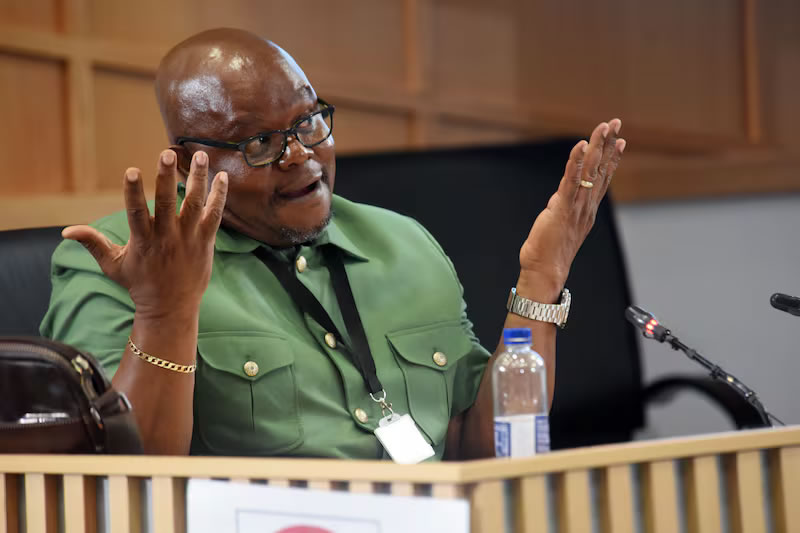
The Madlanga Commission has uncovered troubling WhatsApp conversations suggesting that Maj-Gen Lesetja Senona, head of the KwaZulu-Natal Hawks, maintained a questionable relationship with Vusimuzi “Cat” Matlala, an alleged member of a drug cartel. This revelation comes despite Senona's knowledge of Matlala’s connection to the 2021 murder of whistleblower Babita Deokaran, who exposed grand corruption within the Tembisa Hospital.
During the commission's hearings, it was revealed that Senona had claimed to have begun distancing himself from Matlala on March 5 of the previous year after discovering the drug cartel figure's link to Deokaran's assassination. Deokaran, who served as the acting chief director of financial accounting in the Gauteng Department of Health, was shot outside her home in Winchester Hills after flagging Matlala’s companies for irregular tenders worth millions awarded by Tembisa Hospital.
However, less than a week later, on March 10, Senona sent Matlala a sensitive police affidavit related to alleged kidnapping kingpin Esmael Nangy. This document included personal information such as ID numbers, the names, and contact details of police officers investigating the case. Senona defended his actions by stating he believed the document would serve as a warning to Matlala about a kidnapper also residing in Centurion, where Matlala lived.
“I never thought it contained personal documents. I never read the documents. It caught my eye, and I sent it [to Matlala]. I never realised the magnitude of the document,” Senona stated during the hearings. He added, “Maybe I can say it was an oversight for me not to read the entire document before sending it. I made an error and did not read the whole document. I read the first page only.”
Despite his assertions, the commission challenged Senona, noting that he failed to explain how he obtained the police affidavit and resorted to suggesting it was in the public domain. On the same day he claimed to have cut ties with Matlala, Senona was informed about Matlala changing the directors of his business and the alleged fraud involved in securing a tender from the South African Police Service (SAPS). This revelation prompted him to become “wary” of Matlala, yet evidence of ongoing exchanges between the two contradicts his claims of distancing himself.
The commission presented various WhatsApp chats that depicted continued communication between Senona and Matlala, calling into question the integrity of Senona's earlier assertions. These included details of a meeting he organised between Matlala and Lt-Gen Nhlanhla Mkhwanazi, the KwaZulu-Natal police commissioner, set for April of the previous year at a hotel in Durban. Senona acknowledged that he attended the meeting to offer moral support to Matlala while maintaining that it had been arranged by former police minister Bheki Cele.
Justice Mbuyiseli Madlanga expressed scepticism regarding Senona's claims of a waning relationship, indicating that attending the meeting contradicted his narrative. “If that is the case, then let it be,” Senona replied, appearing to concede to the mounting evidence against him.
Further establishing the nature of their relationship, Matlala sent Senona a “confidential” document titled “Memo Biz Traces” containing three alleged ID numbers connected to President Cyril Ramaphosa. Senona contended that he had not read this document, a claim met with scepticism by the commission.
Additionally, in March, the two were seen meeting at Menlyn Mall, after which Matlala forwarded a document to Senona detailing the suspended police minister Senzo Mchunu's foundation. This exchange has led to accusations that Senona may have shared sensitive police information to maintain the business relationship that his son had with Matlala, thus intertwining personal and professional affiliations.
The commission’s investigation into these ties and the implications surrounding them continues, as South Africa grapples with ongoing issues of corruption and the potential collusion between law enforcement and criminal elements. The complexities of these relationships exemplify the challenges facing the country's crime-fighting agencies, and further revelations are anticipated as the hearings progress.
The case of Babita Deokaran remains a poignant reminder of the dangers faced by whistleblowers in South Africa, highlighting the urgent need for accountability and transparency within the ranks of the police and beyond.