

This video brings together four major South African political stories unfolding as the country approaches a consequential local government election.
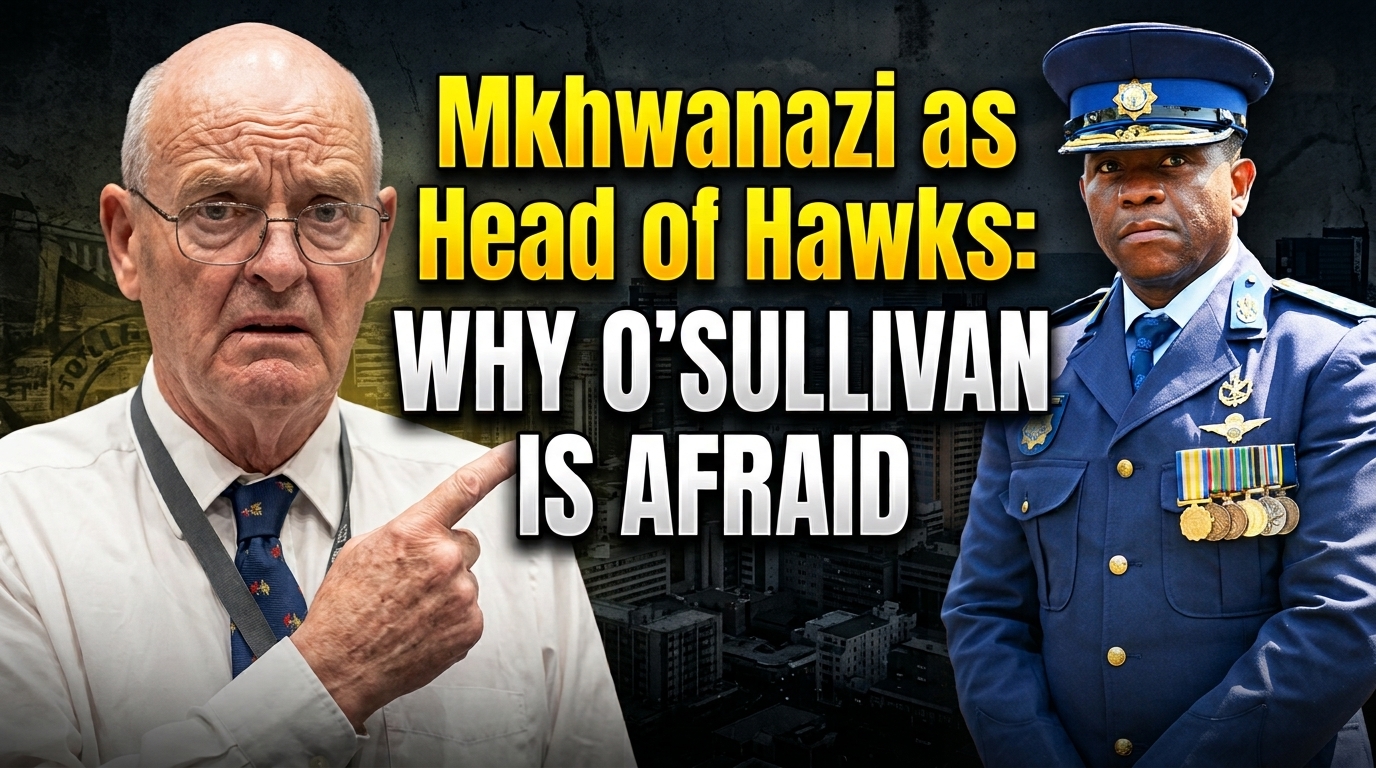
The first is the dispute over Lieutenant-General Nhlanhla Mkhwanazi’s proposed appointment as national head of the Hawks, the unit responsible for investigating serious and organised crime, corruption and other priority offences. Acting Police Minister Firoz Cachalia has begun the appointment process, but private investigator Paul O’Sullivan and his organisation, Forensics for Justice, have threatened legal action. O’Sullivan argues that the process should be suspended or opened to public scrutiny, raising questions about whether Mkhwanazi meets the legal requirement to be a fit and proper person.
His challenge comes amid a long-running feud involving accusations, counter-accusations and competing claims about influence over law-enforcement agencies. Mkhwanazi has accused O’Sullivan of foreign intelligence links, which O’Sullivan denies, while both men have pursued defamation claims. Analysts disagree about O’Sullivan’s motives and Mkhwanazi’s suitability, leaving the appointment at the centre of a wider debate about police leadership, accountability and public trust.
The second story concerns a 38-year-old TikTok creator arrested after posting a video insulting Mkhwanazi and calling for violence. Police say the video may contain elements of crimen injuria and incitement to violence. Investigators located the suspect at an uMkhonto weSizwe Party election rally in KwaMashu. The arrest highlights how online speech about a prominent police official can become a criminal investigation, particularly as Mkhwanazi’s possible move to the Hawks intensifies public scrutiny.
The video then examines what analysts describe as one of the strangest local elections since 1994. Polling points to a possible hung council in Johannesburg, where neither the ANC nor the DA may secure enough support to govern alone. The DA could perform strongly, while the ANC’s share may fall below 30 per cent. Yet the arithmetic could leave the rivals needing one another after campaigning against each other.
Other parties, including the EFF, MK Party and Patriotic Alliance, may influence coalition negotiations. In Cape Town, the DA also faces debate over a proposed N2 barrier intended to address crime. Supporters see it as protection, while critics warn it could divide communities without tackling the roots of violence. The ANC and DA are both presenting municipal plans focused on service delivery, finances, maintenance, integrity and public safety.
Finally, the programme looks at EFF leader Julius Malema’s remarks on farm killings. At a rally, Malema said the party’s controversial chant about killing the boer and the farmer was not meant literally, condemned the murder of farmers and other people, and rejected claims of a white genocide. The chant’s meaning has been contested in South African courts and international political debate. Malema’s comments arrive as parties address voters’ concerns about crime, corruption, jobs and failing services.
Together, these stories ask who will shape South Africa’s future: who leads its crime-fighting institutions, how political speech is handled, which parties govern after the election, and whether leaders can put public needs ahead of personal and party battles.