

South African Afro-soul star Vusi Nova has moved to explain the striking funeral theme in his upcoming music video for ‘When I’m Gone’, saying the concept is a deeply personal meditation on mortality, legacy, and how he hopes to be remembered.
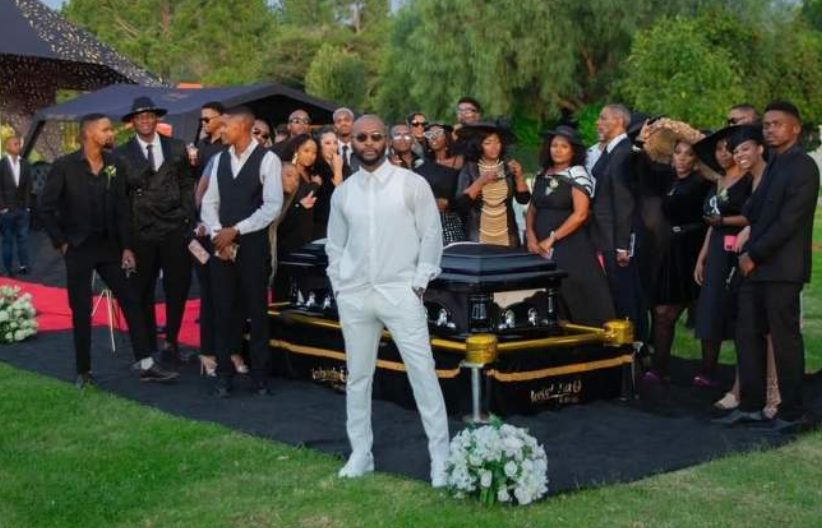
The singer has been at the centre of intense social media debate after behind-the-scenes clips from the shoot went viral, showing what appeared to be a fully staged funeral – with such realistic detail that many fans briefly believed he had actually died.
The unreleased single, taken from his forthcoming EP ‘Here to Stay’, tackles themes of death, remembrance and the imprint an artist leaves behind. While those ideas are woven into the music, it is the visual treatment that has truly lit up timelines.
In the footage shared online, Vusi Nova is seen at the centre of a sombre, meticulously constructed funeral scene. There is an obituary bearing his name, mourners in black, and cameo appearances by close friends and colleagues, including media personality Moshe Ndiki and veteran actor Luthuli Dlamini.
View this post on Instagram
The realism of the set, coupled with the presence of well-known faces, created an unsettling authenticity. For a time, some social media users thought they were watching genuine scenes of mourning rather than a music video in the making. Concerned messages, speculation and even premature tributes began to surface before word spread that this was part of a creative project.
The level of detail left many fans momentarily convinced the scenes were real, sparking concern, speculation, and debate across social media platforms.
Once it became clear that the scenes were conceptual, the debate shifted. Many praised the boldness of using one’s own funeral as an artistic device, while others questioned whether the imagery was too dark, too soon, or tempting fate.
Vusi Nova has responded by firmly situating the video within a long tradition of artists confronting uncomfortable truths through their work. He stresses that the idea did not come from a morbid place, but from a desire to be honest about his fears and intentions.
However, Vusi Nova has since clarified that the concept is rooted not in morbidity, but in meaning.
According to the artist, ‘When I’m Gone’ is a deeply personal reflection on how he wishes to be remembered, both as a musician and as a person.
At the heart of his explanation is an anxiety that many artists share: that their life’s work might fade or be forgotten once they are no longer here to perform it.
He admits to having a long-standing fear of his name “dying with the flesh,” and says the song became a way to confront that reality while solidifying the legacy he hopes to leave behind.
In an interview with Drum, Vusi emphasised that this vulnerability is not new territory for him, even if the visuals feel more provocative than usual.
“I’ve never been one to shy away from being vulnerable,” he told Drum, emphasising that the song is not a premonition, but an artistic expression.
“I’m not saying I’m thinking of dying soon. I’m just being creative. That’s who I am,” the singer added.
From his perspective, staging his own funeral on screen was not a gimmick, but the most honest way to translate the song’s core message into images. To speak about death and legacy without shying away, he felt he had to walk into that space fully – coffin, obituary and all.
Vusi shared that the decision to depict his own funeral was the only way to visually convey the message.
The project also intentionally presses on cultural sensitivities. Vusi is acutely aware that death is a subject many in his audience would prefer not to see dramatised, especially in such a personal manner.
More than just a dramatic concept, the video aims to challenge cultural discomfort around death, particularly within Black communities.
“I understand that we as Black people are so afraid of death, but I embrace both life and death. Mourning and grief are important, but we must not forget to celebrate,” he highlighted.
That tension between grief and celebration is central to both the song and its visuals. The funeral scenes are not designed as a spectacle of despair, but as a symbolic space where people can honour a life, remember the music, and find joy in what was shared.
Grief and celebration sit at the heart of the visual narrative.
Rather than presenting death as purely tragic, Vusi Nova hopes to reframe it as a moment to honour a life lived fully.
Still, the creative risk has not been universally welcomed. Alongside the praise for his courage, critics on social media have argued that staging one’s own funeral “invites” bad luck or negative energy. In a country where superstition and faith often sit side by side, the idea of rehearsing one’s death does not sit comfortably with everyone.
Some critics have accused the singer of inviting bad luck or negative energy by staging his own funeral.
Vusi, however, firmly rejects this notion, standing by his creative freedom and spiritual grounding.
“There is no such thing. God made me this way. I can’t be afraid to put out what I’ve been gifted because of what people might think,” he said.
He frames the project as part of his broader calling as an artist: to say the difficult things, to spark conversation and to trust that his audience can hold more than one emotion at a time.
The scale and authenticity of the production were made possible by a network of collaborators from across the entertainment and funeral services industries. Visual creatives, performers and long-time friends contributed to building a world that feels painfully close to reality.
The production itself was a collaborative effort, featuring a wide network of creatives, friends, and industry figures.
He also gave special recognition to funeral services company Icebolethu Group, whose involvement added an undeniable layer of authenticity to the scenes.
That partnership, in particular, helped replicate the rituals, aesthetics and emotional textures of a real funeral, amplifying the impact of the final product – and, arguably, the intensity of the public reaction.
As the dust settles on the initial social media storm, Vusi is hoping listeners will engage more deeply with what ‘When I’m Gone’ is trying to say about remembrance and the fragile line between life and legacy.
As anticipation builds for both the single and the full EP, Vusi hopes audiences will move beyond the initial shock and engage with the deeper message behind the work.
“At the end of the day, we won’t all think the same, but we need to meet each other somewhere in the middle, and celebrate each other for being bold, for being creative, and for being ourselves,” he said.
‘When I’m Gone’ is set to drop soon, with fans eagerly awaiting a project that promises to be as introspective as it is provocative.
For now, the video remains unseen in full – a talking point fuelled by fragments and speculation. Once it is officially released, it is likely to add fresh layers to a conversation that Vusi Nova seems determined to have: not just about how he might one day be remembered, but about how South Africans confront the realities that await us all.